Top 10 Best Next-Generation Firewall (NGFW) Solutions in 2026
As cyber threats grow more sophisticated and pervasive, the traditional firewall, once a stalwart against digital intrusion, is no longer sufficient. Organizations today face advanced persistent threats, polymorphic malware, and increasingly cunning social engineering attacks that bypass basic packet filtering. This reality demands a proactive, intelligent defense mechanism at the network perimeter: the Next-Generation Firewall (NGFW).
For 2026, selecting the right NGFW is not just about blocking ports; it’s about deep packet inspection, application-level control, integrated threat intelligence, and the ability to adapt to new attack vectors. This comprehensive guide will dissect the leading NGFW solutions, empowering IT professionals and security analysts to make informed decisions for robust network security.
Understanding the Evolution: Why NGFWs are Crucial
The term “Next-Generation Firewall” signifies a significant leap beyond its predecessors. While traditional firewalls primarily enforce access control based on IP addresses and port numbers, NGFWs integrate a much broader array of security functionalities. These advanced capabilities are essential for combating modern cyber threats:
- Inspect traffic at the application layer, not just the port. This allows for granular control over individual applications, even those using standard ports (e.g., distinguishing between sanctioned Box.com access and unauthorized P2P file sharing).
- Perform deep packet inspection (DPI) to analyze the actual content of data packets, identifying malicious payloads or anomalous behavior that port-based filtering would miss.
- Decrypt TLS (SSL/TLS inspection) to reveal hidden threats within encrypted traffic, which cybercriminals increasingly use to mask their activities.
- Integrate intrusion prevention system (IPS) capabilities to block known and zero-day intrusions inline, preventing them from reaching internal systems.
- Enforce identity-based policies, linking users and user groups to specific access rights and security profiles, regardless of their device or location.
- Incorporate threat intelligence feeds and machine learning for proactive threat detection and prevention, constantly updating defenses against emerging threats.
Top 10 Best Next-Generation Firewall (NGFW) Solutions in 2026
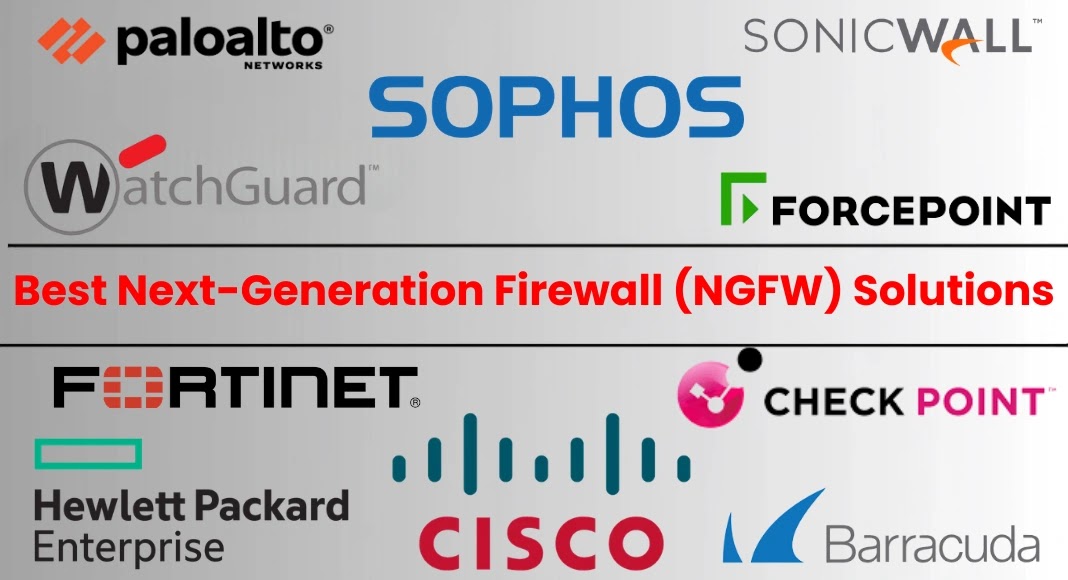
After extensive analysis of market trends, technological advancements, and user adoption, we’ve compiled our definitive list of the top NGFW solutions poised to dominate in 2026. This selection prioritizes comprehensive security, performance, ease of management, and adaptability.
1. Palo Alto Networks PA-Series (Top Overall Pick)
Palo Alto Networks continues to set the benchmark for NGFW technology with its PA-Series. Renowned for its unparalleled security efficacy, the PA-Series integrates cutting-edge features that make it our top overall recommendation for comprehensive enterprise protection.
- Key Strengths: Market-leading App-ID technology for precise application control, advanced machine-learning threat prevention, robust Sandboxing capabilities (WildFire), and extensive cloud-native security integrations. Its security operating platform provides a unified view and simplifies complex policy management.
- Ideal For: Large enterprises, cloud-centric organizations, and environments demanding the highest level of security and granular control.
2. Fortinet FortiGate (Best Price-to-Performance)
Fortinet’s FortiGate series consistently delivers an exceptional balance of powerful security features, high performance, and competitive pricing, making it an outstanding choice for a wide array of organizations, particularly distributed networks and mid-market companies.
- Key Strengths: Strong integration within the Fortinet Security Fabric ecosystem, high throughput, integrated SD-WAN capabilities, and robust threat intelligence from FortiGuard Labs. It offers extensive security services without compromising performance or budget.
- Ideal For: Mid-market businesses, distributed enterprises with numerous branch offices, and organizations seeking strong security features at an accessible price point.
3. Check Point Quantum Security Gateways
Check Point remains a stalwart in the cybersecurity landscape, offering a mature and highly effective NGFW solution with its Quantum Security Gateways. Their emphasis on threat prevention and consolidated security architecture is a significant draw.
- Key Strengths: Industry-leading threat prevention with a focus on Sandboxing (SandBlast), extensive intrusion prevention capabilities, and a comprehensive suite of security blades that can be activated as needed. Their unified management platform streamlines security operations.
- Ideal For: Enterprises prioritizing robust threat prevention, deep visibility, and a consolidated security architecture.
4. Cisco Secure Firewall (formerly Firepower)
Cisco’s Secure Firewall family, including the Firepower series, offers a tightly integrated security solution leveraging Cisco’s extensive network expertise and threat intelligence. It’s particularly attractive for organizations already heavily invested in Cisco’s networking infrastructure.
- Key Strengths: Deep integration with Cisco’s networking ecosystem, advanced threat intelligence from Talos, superior IPS capabilities, and robust URL filtering. Offers both physical and virtual deployments, and can be managed via Cisco Defense Orchestrator.
- Ideal For: Cisco-centric enterprises, data centers, and organizations requiring tightly integrated network and security management.
5. Sophos Firewall (XGS Series)
Sophos has carved a niche with its user-friendly interface and synchronized security approach. The XGS series exemplifies this, offering robust protection combined with ease of management, particularly beneficial for IT teams with limited resources.
- Key Strengths: Synchronized Security for automated threat response between endpoint and firewall, excellent ease of use and management, advanced threat protection, and integrated SD-WAN. Offers robust web and application control.
- Ideal For: Small to medium-sized businesses (SMBs), organizations seeking simplified security management, and those using Sophos endpoint protection.
6. Juniper Networks SRX Series
Juniper’s SRX series excels in high-performance environments and is known for its reliability and scalability. Leveraging Juniper’s strong networking foundation, these NGFWs are a solid choice for service providers and large enterprises.
- Key Strengths: High throughput and low latency, advanced threat prevention via Juniper ATP Cloud, robust routing and switching capabilities, and flexible deployment options. Junos OS provides a consistent operating environment.
- Ideal For: Service providers, data centers, large enterprises with high-traffic demands, and organizations requiring integrated networking and security.
7. SonicWall TZ/NSa Series
SonicWall continues to be a strong contender, particularly for SMBs and distributed enterprises, offering a range of appliances that deliver strong security features and ease of use. Their Capture Advanced Threat Protection (ATP) multicore Sandboxing technology is a highlight.
- Key Strengths: Patented Reassembly-Free Deep Packet Inspection (RFDPI) engine, multi-engine Sandboxing (Capture ATP), integrated wireless control, and user-friendly management. Good scalability for branch offices.
- Ideal For: Small to medium-sized businesses, retail environments, and distributed enterprises looking for comprehensive security that is easy to deploy and manage.
8. WatchGuard Firebox
WatchGuard’s Firebox series provides a compelling blend of security features, performance, and visibility, often at a competitive price point. Their focus on unified threat management (UTM) simplifies security for many organizations.
- Key Strengths: Comprehensive UTM feature set, advanced threat detection with Sandboxing, integrated SD-WAN, and intuitive management tools with robust reporting. Offers strong value.
- Ideal For: Small to medium-sized businesses, distributed organizations, and those seeking an all-in-one security solution with strong visibility.
9. Forcepoint Next Generation Firewall (NGFW)
Forcepoint’s NGFW distinguishes itself with a strong emphasis on consistent policy enforcement across diverse environments and robust enterprise-grade features, including advanced evasion prevention and multi-link network connectivity.
- Key Strengths: Advanced evasion prevention, centralized management for large deployments, high availability, and strong integration with Forcepoint’s broader security portfolio (DLP, Web Security). Exceptional policy enforcement capabilities.
- Ideal For: Large enterprises, government agencies, and organizations with complex networks requiring granular policy enforcement and high uptime.
10. Barracuda CloudGen Firewall
Barracuda CloudGen Firewalls are designed for the modern, cloud-first enterprise, offering robust security, application visibility, and powerful SD-WAN capabilities, particularly beneficial for hybrid and multi-cloud environments.
- Key Strengths: Advanced threat protection, integrated SD-WAN for optimized cloud connectivity, granular application control, and centralized management for distributed networks. Strong focus on cloud integration.
- Ideal For: Cloud-centric organizations, businesses relying heavily on SaaS applications, and those implementing SD-WAN strategies.
Remediation Actions and Best Practices for NGFW Deployment
Deploying and managing an NGFW effectively requires more than just choosing the right vendor. Here are crucial remediation actions and best practices:
- Thorough Planning and Sizing: Accurately assess your network traffic, user count, and future growth to properly size your NGFW appliance. Under-sizing can lead to performance bottlenecks and security gaps.
- Regular Policy Review: Firewall policies can become stale or overly complex. Conduct regular audits to remove unnecessary rules, optimize existing ones, and ensure they align with current business needs and threat landscapes. Old or overly permissive rules are a common vector for exploitation (e.g., related to CVE-2021-34440, where misconfigurations can lead to unauthorized access).
- Enable and Optimize Threat Prevention Features: Don’t just deploy; activate IPS, Antivirus, Sandboxing, URL Filtering, and Application Control. Fine-tune these features to minimize false positives while maximizing detection rates.
- Implement TLS/SSL Inspection (Decryption): Given the prevalence of encrypted traffic used by threat actors, SSL/TLS inspection is non-negotiable. Implement it carefully, considering privacy implications and ensuring proper certificate management.
- Integrate with Threat Intelligence: Ensure your NGFW is constantly updated with the latest threat intelligence feeds to protect against emerging threats, including zero-day exploits (e.g., preventing future attacks similar to CVE-2023-20198).
- Leverage Centralized Management: For distributed environments, a unified management console is vital for consistent policy enforcement, real-time monitoring, and efficient incident response.
- Regular Firmware Updates: Keep your NGFW firmware up-to-date to patch vulnerabilities and acquire new features. Many critical exploits target known vulnerabilities in outdated firmware (e.g., as seen in various FortiOS vulnerabilities such as CVE-2022-42475).
- Monitor Logs and Alerts: Actively monitor NGFW logs and alerts. Integrate them with a SIEM (Security Information and Event Management) system for centralized visibility and correlation of security events.
- User-ID Integration: Integrate the NGFW with your directory services to enforce identity-based policies, providing granular control and better visibility into user activity.
Conclusion
The cybersecurity landscape of 2026 demands a proactive and intelligent defense at the network’s edge. Next-Generation Firewalls are no longer an option but a necessity for organizations striving to protect their digital assets against an ever-evolving threat matrix. While Palo Alto Networks PA-Series stands out as our top overall pick for its advanced threat prevention and application control, Fortinet’s FortiGate series offers an unrivaled price-to-performance ratio for mid-market and distributed networks.
The optimal NGFW choice will ultimately depend on your organization’s specific needs, budget, existing infrastructure, and risk tolerance. A careful evaluation of the leading solutions, combined with diligent implementation of best practices, will ensure your network remains resilient against the cyber challenges of today and tomorrow.