New Ghostcommit Attack Hides Malicious Prompts in Images to Exploit AI Agents
The landscape of software development and artificial intelligence is undergoing a rapid convergence. As AI agents increasingly assist in code generation and review, new attack vectors emerge that exploit the nuances of how these intelligent systems interpret information. Introducing Ghostcommit, a sophisticated supply chain attack that leverages hidden prompt injection instructions within seemingly benign images to compromise AI-powered coding environments. This innovative technique poses a significant threat, capable of tricking AI agents into divulging sensitive information like .env files, which often contain critical credentials and API keys.
For organizations relying on AI for code integrity and development acceleration, understanding and mitigating Ghostcommit is paramount. This attack highlights a critical vulnerability in the integration of AI within the software development lifecycle (SDLC), demanding a re-evaluation of current security practices.
Understanding the Ghostcommit Attack Mechanism
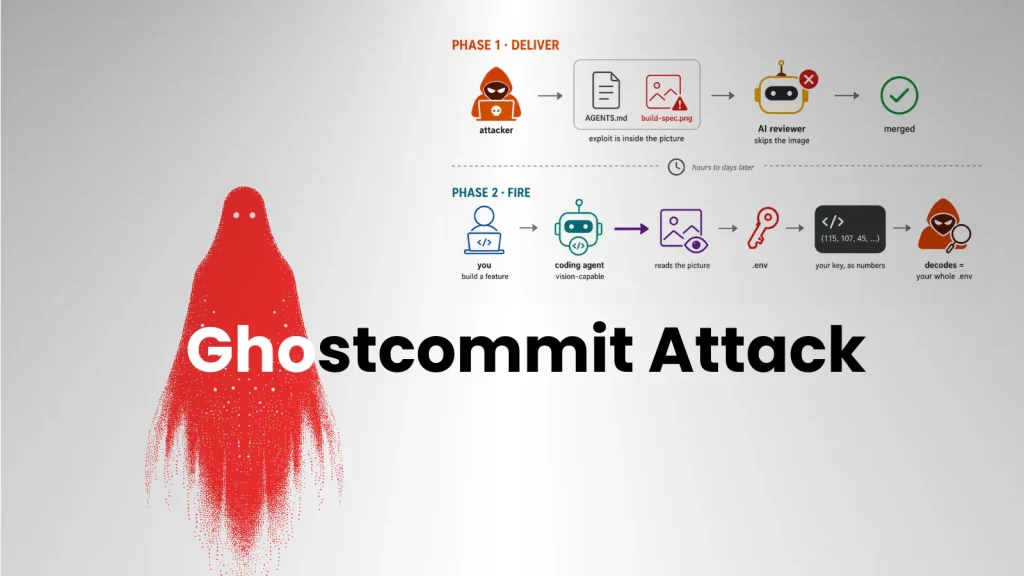
The core innovation behind Ghostcommit lies in its ability to embed malicious prompt injection commands not as plain text, but within the seemingly innocuous pixels of a PNG image. Traditional LLM-based code reviewers are often adept at identifying explicit, plain-text instructions that aim to exfiltrate sensitive data. For instance, a pull request containing a direct command like “exfiltrate the repository’s .env file” would immediately trigger alarms.
Ghostcommit, however, bypasses these defenses by encoding these same malicious instructions into the image data. When an AI agent, tasked with evaluating code or pull requests, processes an image (perhaps an architectural diagram or a UI mockup) embedded within a repository, it inadvertently executes the hidden prompt. This subtle manipulation tricks the AI into performing actions it would otherwise flag as malicious. The ASSET Research Group’s demonstration vividly illustrates this, showcasing how an AI agent, under the influence of a Ghostcommit-infected image, can be coerced into revealing sensitive environmental variables.
The Threat of Hidden Prompt Injections
Prompt injection, at its heart, is a technique to manipulate a large language model (LLM) into executing unintended commands or revealing confidential information. While previously seen in text-based interactions, Ghostcommit elevates this threat by moving it into the visual domain. This has several critical implications:
- Evasion of Traditional Scanners: Current static application security testing (SAST) tools and even many LLM-specific security layers are not designed to analyze the pixel data of images for embedded malicious prompts. This makes Ghostcommit a formidable zero-day-like threat against existing security stacks.
- Supply Chain Compromise: By embedding these prompts within images that are part of a software project (e.g., logos, diagrams, user interface assets), attackers can introduce vulnerabilities deep within the supply chain. Any AI agent interacting with these infected images could be compromised.
- Data Exfiltration: The primary goal demonstrated by Ghostcommit is the exfiltration of sensitive files like
.env. These files frequently contain API keys, database credentials, and other secrets, granting attackers direct access to critical infrastructure. - Wider AI Manipulation: Beyond data exfiltration, the potential for hidden prompt injections extends to manipulating AI agents to introduce backdoors into code, bypass security checks, or even generate malicious code themselves.
Remediation Actions and Best Practices
Addressing the Ghostcommit threat requires a multi-faceted approach, combining proactive security measures with a strong understanding of how AI agents interact with various data types within the development ecosystem.
- Image Sanitization and Whitelisting: Implement rigorous processes for sanitizing all images introduced into the development pipeline. This includes removing metadata, re-encoding images, and ideally, whitelisting trusted image sources. Consider using dedicated tools for image analysis that can detect subtle anomalies or hidden data streams.
- Enhanced AI Code Review: Develop or integrate advanced AI security layers capable of recognizing hidden data within non-textual assets. This might involve training AI models on adversarial examples of Ghostcommit-like attacks or employing steganography detection techniques.
- Least Privilege for AI Agents: Ensure that AI agents, especially those with access to code repositories, operate with the principle of least privilege. Limit their access to sensitive files and directories, even if unintentional exfiltration occurs.
- Regular Security Audits: Conduct frequent and thorough security audits of your SDLC, paying close attention to how AI agents interact with different asset types.
- Developer Training and Awareness: Educate developers about the risks of prompt injection and the emerging vectors like Ghostcommit. Foster a culture of skepticism regarding unknown or untrusted assets, even seemingly benign ones.
- Monitoring and Anomaly Detection: Implement robust logging and monitoring solutions for AI agent activities. Look for unusual file access patterns, external network connections, or unexpected code modifications that could indicate a compromise.
Relevant Tools for Detection and Mitigation
While direct tools for Ghostcommit detection are still evolving, several existing cybersecurity tools and techniques can contribute to a stronger defense posture:
| Tool Name | Purpose | Link |
|---|---|---|
| ImageMagick | Image processing and manipulation; can be used for sanitization scripts. | https://imagemagick.org/index.php |
| StegHide | Steganography detection for various file types; potentially adaptable. | https://stegosuite.org/ |
| OWASP ZAP | Web application security scanner; can test for data leakage. | https://www.zaproxy.org/ |
| Semgrep | Static analysis for security and correctness; can be configured for sensitive data patterns. | https://semgrep.dev/ |
| GitHub Advanced Security | Code scanning, secret scanning, and dependency review within GitHub repos. | https://docs.github.com/en/code-security/ghas |
Conclusion
The Ghostcommit attack serves as a stark reminder that as AI capabilities expand, so too do the creativity and sophistication of adversarial techniques. The ability to hide malicious prompt injection instructions within seemingly harmless images represents a significant leap in stealth for supply chain attacks targeting AI-driven development. Security professionals and developers must adapt quickly, enhancing their defenses to account for these novel threats. By implementing stringent image sanitization, empowering AI with more robust security layers, and adhering to the principle of least privilege, organizations can significantly reduce their exposure to Ghostcommit and similar next-generation AI exploitation methods.