Hackers Expanding Destiny Stealer Across the US and Europe. Is Your Organization Ready to Defend?
Destiny Stealer: A Growing Threat to US and European Organizations
Organizations across the United States and Europe are facing an escalating threat from the Destiny Stealer malware. This sophisticated information-stealing agent is actively targeting corporate accounts, user credentials, and sensitive business data, posing a significant risk to data integrity and operational security. Recent reports indicate a surge in its activity, demanding immediate attention from security leaders and IT professionals. The ease with which Destiny Stealer compromises a single endpoint and then cascades access to critical systems makes it a particularly insidious threat.
The Escalating Reach of Destiny Stealer
The core concern with Destiny Stealer is its expansive target list once it infiltrates a system. A successful compromise, often initiated through a seemingly innocuous infection, can have far-reaching consequences. Data at risk includes:
- Corporate Passwords and Credentials: Directly exposing access to various internal and external services.
- Session Cookies: Allowing attackers to bypass login prompts and access accounts as legitimate users.
- VPN Details: Providing a direct pathway into an organization’s internal network.
- Outlook Data: Granting access to sensitive communications, contacts, and attached files.
- Cryptocurrency Wallets: Directly compromising financial assets.
- Wi-Fi Profiles: Revealing network configurations and potentially providing access to other connected devices.
- Desktop Screenshots: Offering a visual record of user activity and sensitive information displayed on the screen.
This breadth of data exfiltration capabilities means that even a minor lapse in security can quickly lead to a major breach affecting multiple facets of an organization’s digital footprint. The critical issue for security leadership is the often-delayed visibility; some samples of Destiny Stealer have exhibited stealthy behavior, prolonging the detection window and increasing the potential for damage.
Understanding the Attack Chain and Impact
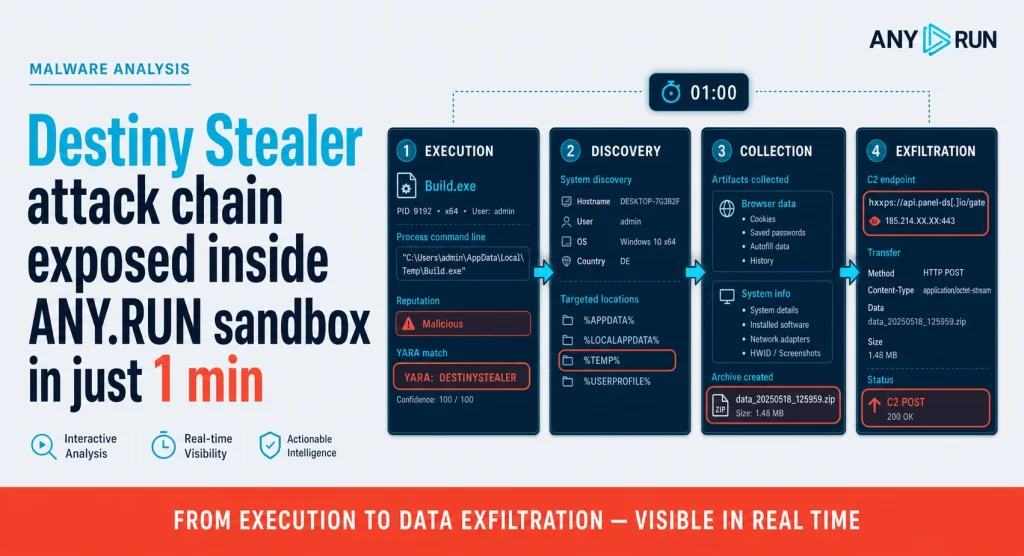
Destiny Stealer typically operates by leveraging various initial access vectors, though the exact methods can vary. Once executed on an endpoint, it begins its data harvesting process. The malware is designed to systematically comb through user profiles and system configurations to identify and extract the aforementioned sensitive data. The stolen information is then exfiltrated to attacker-controlled command-and-control (C2) servers. This exfiltrated data can be used for a variety of malicious purposes, including:
- Further network penetration and lateral movement.
- Financial fraud and direct theft.
- Espionage and intellectual property theft.
- Identity theft and credential stuffing attacks on other platforms.
The impact of a Destiny Stealer compromise extends beyond immediate data loss. It can severely damage an organization’s reputation, lead to regulatory fines, and incur significant costs associated with incident response, forensic analysis, and system recovery. The potential for disruption to business operations is substantial.
Remediation Actions and Proactive Defense
Addressing the threat of Destiny Stealer requires a multi-layered and proactive cybersecurity strategy. Organizations must not only focus on detection and response but also on preventing initial infections and limiting the malware’s capabilities if an endpoint is compromised.
- Robust Endpoint Detection and Response (EDR): Implement and continuously monitor EDR solutions capable of detecting suspicious processes, file modifications, and network connections indicative of stealer malware activity.
- Multi-Factor Authentication (MFA): Enforce MFA for all corporate accounts, especially for remote access, email, and cloud services. While stealer malware can steal session cookies, MFA significantly reduces the risk of credential compromise.
- Regular Security Awareness Training: Educate employees on phishing tactics, safe browsing habits, and the dangers of opening unsolicited attachments or clicking on suspicious links, which are common initial infection vectors.
- Patch Management: Ensure operating systems, applications, and web browsers are kept up-to-date with the latest security patches to mitigate known vulnerabilities.
- Principle of Least Privilege: Limit user permissions to only what is necessary for their job functions. This restricts the potential damage an attacker can inflict even if a user account is compromised.
- Network Segmentation: Segment corporate networks to contain potential breaches and prevent lateral movement of malware if an endpoint is compromised.
- Data Encryption: Encrypt sensitive data at rest and in transit to minimize its exposure even if exfiltrated.
- Threat Intelligence Integration: Subscribe to and integrate threat intelligence feeds that provide information on emerging malware like Destiny Stealer, including indicators of compromise (IoCs).
- Regular Backups: Implement a robust backup and recovery strategy to ensure business continuity in the event of a data breach or system compromise. Test these backups regularly.
- Web Content Filtering: Utilize web filtering solutions to block access to known malicious domains and websites associated with malware distribution.
Tools for Detection and Mitigation
| Tool Name | Purpose | Link |
|---|---|---|
| Endpoint Detection and Response (EDR) Solutions | Real-time threat detection, incident response, and forensic capabilities on endpoints. | (Varies by vendor, e.g., CrowdStrike Falcon, SentinelOne Singularity) |
| Next-Generation Antivirus (NGAV) | Behavioral analysis, machine learning, and signature-based detection to prevent malware execution. | (Varies by vendor, e.g., Microsoft Defender for Endpoint, Sophos Intercept X) |
| Security Information and Event Management (SIEM) | Centralized logging and analysis of security events to detect anomalies and potential threats. | (Varies by vendor, e.g., Splunk, IBM QRadar) |
| Threat Intelligence Platforms (TIPs) | Aggregates and analyzes threat data to provide actionable intelligence for proactive defense. | (Varies by vendor, e.g., Anomali ThreatStream, Recorded Future) |
| Network Intrusion Detection/Prevention Systems (NIDS/NIPS) | Monitors network traffic for malicious activity and can block suspicious connections. | (Varies by vendor, e.g., Snort, Suricata) |
Protecting Your Organization from Information Stealers
The expansion of Destiny Stealer’s activity across the US and Europe serves as a stark reminder of the persistent and evolving threat posed by information stealer malware. Organizations cannot afford to be complacent. A proactive, defense-in-depth approach is essential, combining advanced security technologies with robust employee training and stringent security policies. By prioritizing strong authentication, continuous monitoring, and rapid incident response, businesses can significantly reduce their attack surface and defend against sophisticated threats like Destiny Stealer, safeguarding critical assets and maintaining trust.