
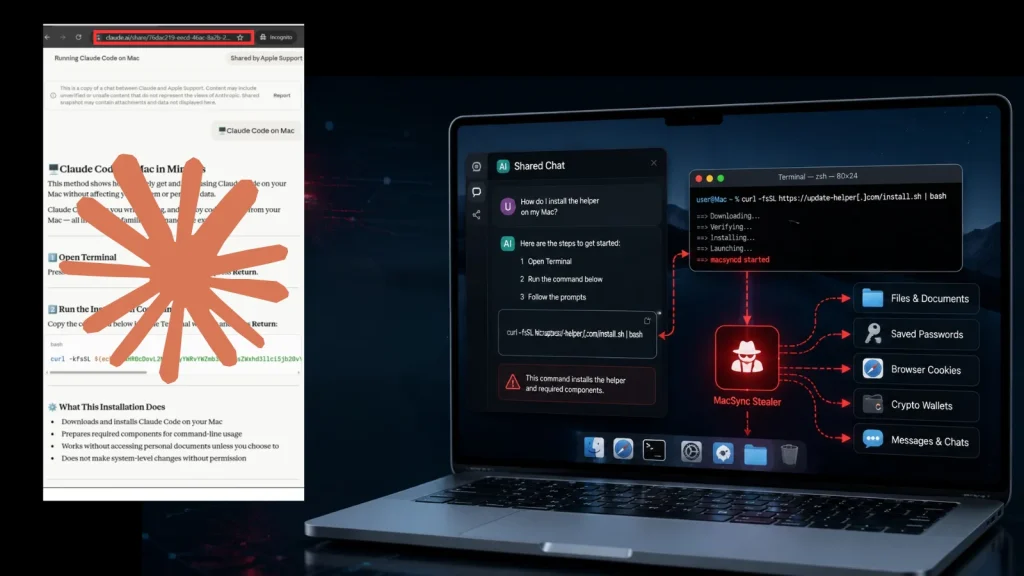
Hackers Abuse Shared Claude Chats and Google Ads to Deploy MacSync Stealer on macOS
MacSync Stealer: A New Threat Exploiting Claude Chats and Google Ads on macOS
The digital landscape consistently presents new challenges for cybersecurity professionals and end-users alike. A recent report from Zscaler Threat Hunting has unveiled a sophisticated new attack targeting macOS users, leveraging an insidious combination of Anthropic’s Claude AI platform and Google Ads. This coordinated effort aims to deploy a dangerous new information-stealing malware known as MacSync Stealer. Understanding the mechanics of this threat is crucial for effective defense.
The Deceptive Entry Point: Google Ads and AI Bait
The initial infection vector for MacSync Stealer is cleverly designed to exploit user trust and common search behaviors. Threat actors are capitalizing on the rising popularity of AI tools like Claude by purchasing prominent positions on Google Ads. When a Mac user searches for terms such as “claude download” or “claude mac,” they are likely to encounter a malicious advertisement disguised as an official download link. Clicking this ad redirects the unsuspecting user to a compromised page.
This method highlights a critical emerging threat where legitimate advertising platforms are being weaponized to distribute malware. Users often implicitly trust search engine results, especially sponsored links, making this a highly effective social engineering tactic. The adversary’s choice of “Claude” as bait demonstrates an awareness of current tech trends and user interests.
Shared Claude Chats: The Malware Delivery Mechanism
Upon clicking the malicious Google Ad, the victim is not immediately presented with the MacSync Stealer. Instead, the attack chain reportedly introduces the malware through a seemingly benign shared Claude AI chat. This is a particularly novel and concerning aspect of the attack.
While the exact mechanism of how shared Claude chats are being abused isn’t fully detailed in the source, it suggests that legitimate interaction flows within the AI platform are being hijacked. This could involve:
- Malicious Code Injection: Shared chats might contain embedded malicious scripts or links designed to initiate a download.
- Social Engineering within the Chat: The chat content itself could prompt the user to download a “helper application” or “update” that is, in fact, the stealer.
- Compromised Chat Data: Threat actors might be exploiting vulnerabilities in how content is shared or linked within the Claude ecosystem.
The use of shared AI chat environments adds a layer of perceived legitimacy and novelty, lulling users into a false sense of security and making the malicious payload harder to identify.
MacSync Stealer: A Potent Information Thief
MacSync Stealer falls into the category of information-stealing malware. While the full capabilities of this specific stealer are still being investigated, such threats typically aim to exfiltrate sensitive data from the compromised system. Common targets include:
- Browser Data: Passwords, cookies, browsing history, and autofill information from web browsers like Chrome, Firefox, and Safari.
- Cryptocurrency Wallets: Keys and seed phrases from locally stored cryptocurrency wallet applications.
- System Information: Device details, installed applications, and potentially local files.
- Credentials: Login details for various services, often harvested from password managers or local configuration files.
The implications of such data compromise can be severe, leading to financial loss, identity theft, and further system compromise.
Remediation Actions and Proactive Defense
Defense against sophisticated threats like MacSync Stealer requires a multi-layered approach. Mac users and organizations need to adopt both proactive and reactive security measures.
- Ad Blocker Usage: Employ robust ad blockers in your web browsers to minimize exposure to malicious Google Ads.
- Source Verification: Always verify the legitimacy of software download sources. Download applications directly from official developer websites or trusted app stores (e.g., Apple App Store). Avoid third-party download sites.
- Email and Messaging Vigilance: Be extremely cautious of unsolicited links or downloads, even if they appear to come from known contacts or within seemingly legitimate platforms like AI chats.
- Endpoint Detection and Response (EDR): Implement EDR solutions on macOS endpoints. These tools can detect and respond to suspicious activities indicative of malware infection, even unknown threats.
- Regular Software Updates: Keep your macOS operating system, web browsers, and all applications updated. Software updates frequently include patches for security vulnerabilities.
- Strong, Unique Passwords and MFA: Utilize strong, unique passwords for all online accounts and enable Multi-Factor Authentication (MFA) wherever possible. This minimizes the impact of stolen credentials.
- Security Awareness Training: Educate users about the dangers of phishing, social engineering, and the importance of verifying download sources.
Relevant Tools for Detection and Mitigation
While specific CVEs for MacSync Stealer might not be public yet due to its recent discovery, leveraging general endpoint security and threat intelligence tools is critical.
| Tool Name | Purpose | Link |
|---|---|---|
| E.g., SentinelOne Singularity | Advanced EDR for macOS, behavioral detection | https://www.sentinelone.com/ |
| E.g., CrowdStrike Falcon | Cloud-native EDR, threat intelligence integration | https://www.crowdstrike.com/ |
| E.g., Little Snitch | Outbound connection firewall for macOS | https://www.obdev.at/products/littlesnitch/index.html |
| E.g., VirusTotal | Online file and URL analysis for malware detection | https://www.virustotal.com/ |
Key Takeaways for macOS Security
The emergence of MacSync Stealer underlines the evolving sophistication of cyber threats targeting macOS. Threat actors are quick to adapt and exploit new technologies and platforms, in this case, leveraging the popularity of AI tools and the reach of legitimate advertising networks. Users must cultivate a healthy skepticism towards unexpected downloads and always prioritize verification of sources, even when presented with seemingly official links. A robust cybersecurity posture, combining technical controls with user awareness, remains the most effective defense against such cunning attacks.




