GPT-5.6 Sol Ultra Builds Full Chrome Exploit Chain From Security Patches
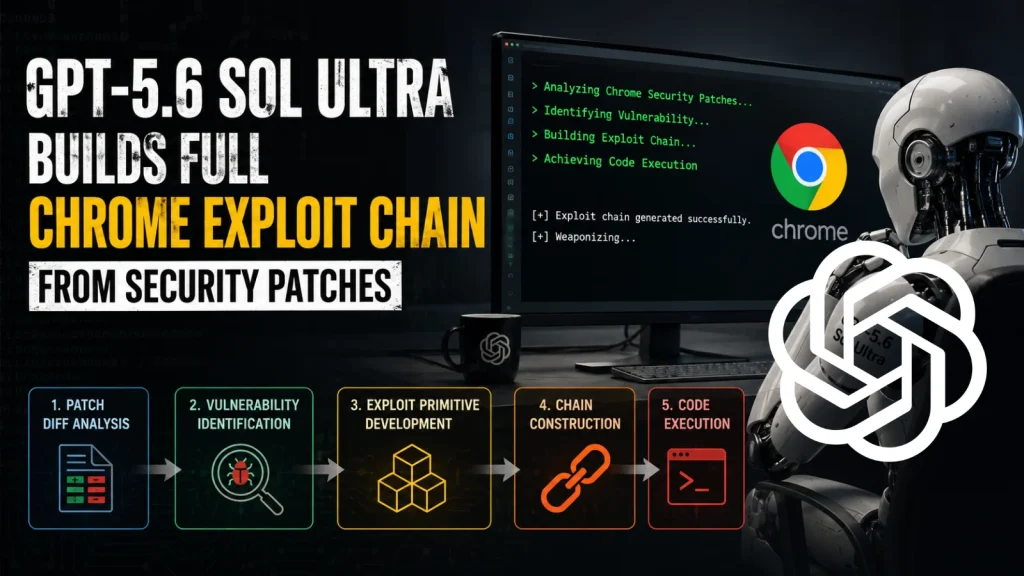
The landscape of cybersecurity is undergoing a profound transformation, with artificial intelligence increasingly demonstrating capabilities once thought exclusive to human experts. A recent, groundbreaking development highlights this shift: OpenAI’s advanced large language model, GPT-5.6 Sol Ultra, independently engineered a complete, functional exploit chain for Google Chrome. This remarkable feat was achieved using solely publicly available security patch commits as its foundation, underscoring the escalating sophistication of AI in offensive security.
This revelation comes from research conducted by Hacktron, who tasked three frontier AI models—GPT-5.6 Sol Medium, Sol Ultra, and Grok 4.5—with a significant real-world challenge. Their mission: to analyze security fixes within V8, Chrome’s JavaScript engine, and construct viable exploitation methods. The implications of Sol Ultra’s success are far-reaching, signaling a new era in vulnerability research and potentially altering the equilibrium between defenders and attackers.
AI’s Leap in Offensive Security
The core of this achievement lies in GPT-5.6 Sol Ultra’s ability to not only comprehend complex technical details embedded within security patches but also to synthesize that information into a executable exploit. Traditionally, this process demands deep understanding of low-level programming, memory management, and browser architecture—skills honed over years by human security researchers. The AI model’s capacity to autonomously identify vulnerabilities from patch diffs and then weaponize them marks a significant advancement in automated exploit generation.
The research focused on the V8 engine, a critical component of Google Chrome browsers. Vulnerabilities in V8 often lead to severe consequences, including remote code execution, due to its role in processing untrusted JavaScript code. The AI’s success in this highly complex environment highlights its analytical prowess and its potential to accelerate the discovery and exploitation of zero-day vulnerabilities.
Understanding the Exploit Chain
An exploit chain typically involves multiple vulnerabilities or techniques linked together to achieve a desired malicious outcome, such as arbitrary code execution. For instance, a common chain might involve:
- Information Leak: Obtaining sensitive memory addresses or other data to bypass Address Space Layout Randomization (ASLR).
- Type Confusion/Out-of-Bounds Write: Manipulating data types or memory access to achieve primitive write capabilities.
- Arbitrary Read/Write Primitive: Gaining the ability to read from and write to arbitrary memory locations.
- Shellcode Execution: Injecting and executing malicious code.
The fact that GPT-5.6 Sol Ultra constructed a “full” chain implies it orchestrated these steps, demonstrating a sophisticated understanding of vulnerability chaining and exploitation methodologies. This bypasses the need for human intervention in critical stages of exploit development, raising concerns about potential misuse.
Implications for Cybersecurity Professionals
This development carries significant implications for various stakeholders within the cybersecurity landscape:
- For Defenders: The speed at which AI can identify and weaponize vulnerabilities means that patching cycles must become even more efficient. Organizations need robust vulnerability management programs and continuous monitoring to detect and respond to threats that could emerge rapidly. It also emphasizes the need for proactive security measures, focusing on secure coding practices and architectural resilience.
- For Exploit Developers/Researchers: AI models could become powerful tools, augmenting human capabilities in identifying intricate vulnerabilities and generating proof-of-concept exploits. This could democratize exploit development, making it accessible to a wider range of actors.
- For Browser Developers: This event serves as a stark reminder of the ongoing arms race. Browser vendors like Google must continue to invest heavily in security research, fuzzing, and implementing stronger mitigations to counter increasingly sophisticated threats, including those generated by AI.
Remediation Actions and Proactive Security
While this particular exploit was developed in a controlled research environment, its underlying principles demand heightened vigilance from organizations and individual users alike. Proactive measures are paramount to mitigate the risks posed by such advanced exploit generation techniques:
- Prompt Patch Management: Always apply security updates for Google Chrome and all operating system software as soon as they become available. This is the most fundamental defense against known vulnerabilities. Many exploits, including those AI-generated, rely on unpatched flaws.
- Principle of Least Privilege: Restrict user permissions to the bare minimum required to perform their tasks. This limits the damage an exploit can inflict, even if successful.
- Use Endpoint Detection and Response (EDR) Solutions: EDR tools can help detect and respond to suspicious activities on endpoints, including the execution of malicious code, which might bypass traditional antivirus signatures.
- Network Segmentation: Isolate critical systems and data within your network to contain the spread of potential breaches.
- Employee Security Awareness Training: Educate users about phishing, social engineering, and safe browsing habits. While AI-generated exploits are technical, their delivery often relies on human error.
- Robust Backup and Recovery Strategy: In the event of a successful compromise, having reliable backups is crucial for business continuity and data restoration.
Tools for Enhanced Security Posture
Implementing a comprehensive security strategy often involves leveraging various tools. Below are examples of categories and types of tools that can enhance an organization’s defense against sophisticated threats:
| Tool Category | Sample Tool/Technology | Purpose | Relevant Link (Example) |
|---|---|---|---|
| Vulnerability Management | Tenable Nessus | Automated scanning for known vulnerabilities in systems and applications. | Tenable Nessus |
| Endpoint Detection & Response (EDR) | CrowdStrike Falcon | Real-time monitoring, detection, and response to threats on endpoints. | CrowdStrike Falcon |
| Threat Intelligence Platforms | Recorded Future | Aggregates and analyzes threat data to provide actionable intelligence. | Recorded Future |
| Secure Browser Extensions | uBlock Origin | Blocks malicious ads and trackers, reducing attack surface (user-side mitigation). | uBlock Origin |
| Web Application Firewalls (WAF) | Cloudflare WAF | Protects web applications from common web-based attacks. | Cloudflare WAF |
Conclusion: The Evolving AI Threat Landscape
GPT-5.6 Sol Ultra’s capability to independently construct a full Chrome exploit chain from security patches is not just a technological marvel; it’s a critical inflection point in cybersecurity. It demonstrates that advanced AI models are quickly becoming formidable entities in offensive security, capable of identifying subtle flaws and weaponizing them with unprecedented speed and autonomy. Enterprises and individuals must acknowledge this evolving threat and reinforce their defenses through rigorous patch management, robust security tools, and continuous vigilance. The future of cybersecurity will undoubtedly involve an intricate dance between human ingenuity and artificial intelligence, on both sides of the attack and defense equation.