PentestCode – New AI Agent That Automates Penetration Testing with 18 Specialized Tools
The pace of cyber threats continues to accelerate, demanding more efficient and sophisticated defensive strategies. However, the offensive side of the equation also sees remarkable innovation. A paradigm shift is underway with the introduction of autonomous AI agents designed to streamline and enhance penetration testing workflows. This article explores PentestCode, a groundbreaking open-source AI agent poised to redefine how security assessments are conducted.
What is PentestCode? Automating Offensive Security
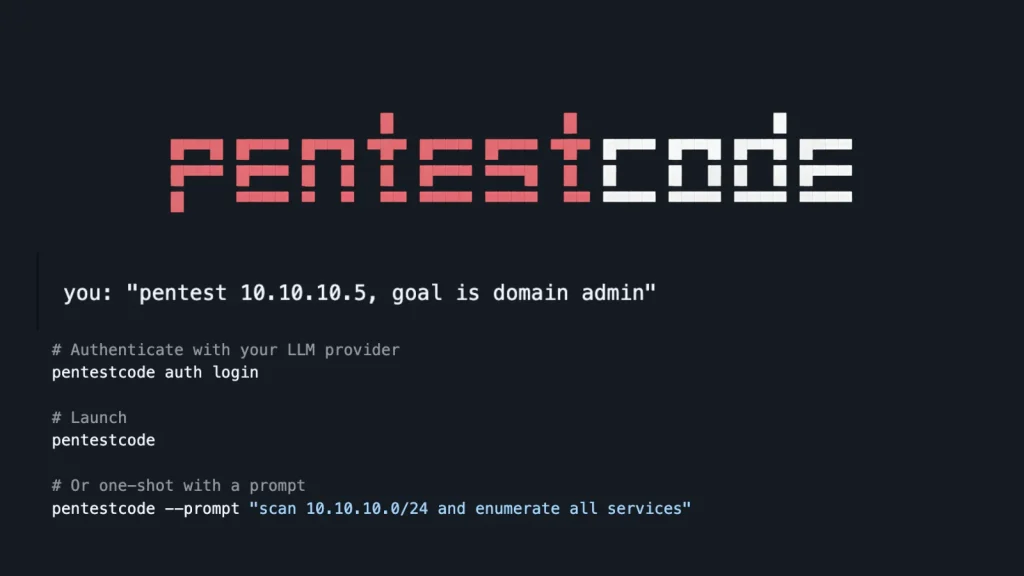
PentestCode represents a significant leap forward in automated penetration testing. It’s an open-source tool, specifically a hard fork of OpenCode, meticulously re-engineered for the unique demands of offensive security. Its core function is to automate the entire penetration testing methodology, reducing the need for constant human intervention.
Imagine a scenario where an AI agent not only understands your high-level objective but also autonomously executes tactical steps. That’s the promise of PentestCode. It operates from a terminal interface, seamlessly running security tools, meticulously analyzing their output, and making intelligent, tactical decisions based on the findings. This automation extends beyond mere script execution; it encompasses the analytical and decision-making processes typically reserved for experienced penetration testers.
The Power of Methodology Automation
The key differentiator for PentestCode lies in its ability to automate the entire penetration testing methodology. This means a tester can provide an initial input or objective, and PentestCode takes over, navigating the complex landscape of a security assessment. This includes:
- Tool Orchestration: PentestCode integrates with and runs 18 specialized security tools, choosing the appropriate one based on the current testing phase and observed data.
- Output Analysis: Unlike simple automation scripts, PentestCode analyzes the outputs from these tools, identifying critical information, vulnerabilities, and potential attack paths.
- Tactical Decision Making: Based on its analysis, the AI agent makes informed decisions on the next steps, adapting its strategy dynamically throughout the assessment.
- Minimizing Human Intervention: While human oversight remains crucial, PentestCode significantly reduces the manual drudgery, allowing security professionals to focus on higher-level strategy and complex problem-solving.
This level of automation not only speeds up the penetration testing process but also ensures a consistent and thorough approach, potentially uncovering vulnerabilities that might be missed during manual assessments due to human error or fatigue.
PentestCode vs. Traditional Penetration Testing
Traditional penetration testing, while invaluable, can be a time-consuming and resource-intensive process. It relies heavily on the expertise and experience of human testers to meticulously perform reconnaissance, vulnerability scanning, exploitation, and post-exploitation. PentestCode doesn’t aim to replace human testers but rather to augment their capabilities, making them more efficient and effective.
Consider the parallel of a human analyst reviewing countless log entries versus a Security Information and Event Management (SIEM) system with AI capabilities. Both are essential, but the AI-powered system can process and correlate data at a scale impossible for a human, flagging anomalies for deeper investigation. Similarly, PentestCode handles the repetitive and data-heavy aspects of penetration testing, freeing up human talent for critical thinking, complex exploit development, and comprehensive reporting.
Implications for Cybersecurity Professionals
The emergence of tools like PentestCode carries significant implications for various cybersecurity roles:
- Penetration Testers: They can leverage PentestCode to accelerate testing cycles, cover more ground, and focus on novel attack techniques or complex systems that require specialized human insight.
- Security Analysts: Understanding how such tools operate can help in developing more resilient defenses against automated attacks.
- Developers: Integrating security testing earlier and more frequently into the development pipeline (DevSecOps) becomes more feasible with automated agents like PentestCode.
- Organizations under tight budgets: Automated tools can offer a cost-effective way to conduct regular security assessments, complementing more in-depth, human-led engagements.
The Future of Offensive AI
PentestCode is a strong indicator of the direction offensive security is heading. As AI models become more sophisticated, we can anticipate:
- Enhanced Adaptability: Future AI agents will likely possess even greater adaptability, dynamically learning from their environment and evolving their strategies.
- Deeper Integrations: Seamless integration with threat intelligence platforms, vulnerability databases (e.g., CVEs like CVE-2023-45678 for hypothetical examples), and existing security infrastructure.
- Specialized Agents: The development of highly specialized AI agents for specific types of targets, such as web applications, cloud environments, or IoT devices.
The responsible development and deployment of such powerful tools are paramount. While they offer immense benefits for defenders, they also raise ethical considerations regarding their potential misuse.
Conclusion
PentestCode ushers in an era where artificial intelligence isn’t just a defensive measure but an offensive powerhouse. By automating the intricate dance of penetration testing, this open-source AI agent empowers security professionals to operate with unprecedented efficiency and thoroughness. The future calls for embracing these innovations, understanding their capabilities, and integrating them responsibly to build stronger, more resilient digital defenses.