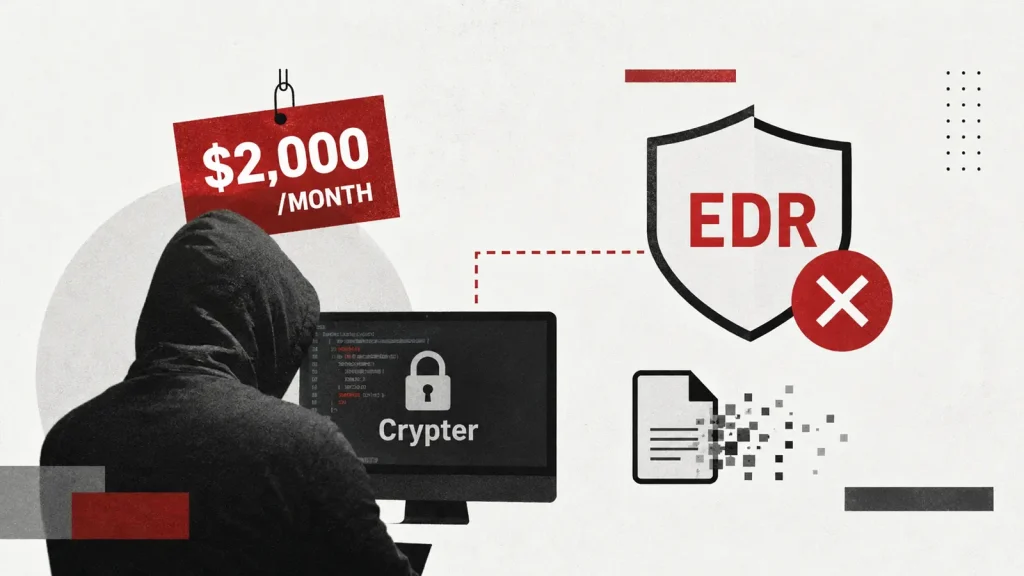
This $2,000-a-Month Crypter Can Kill EDR and Make Malware Disappear From Disk
In the relentless cat-and-mouse game of cybersecurity, a new and unsettling threat has emerged, capable of rendering even advanced Endpoint Detection and Response (EDR) systems ineffective. We’re talking about a sophisticated criminal service known as Cruciferra, a subscription-based crypter that’s empowering malware operators to bypass Windows defenses with alarming efficacy. For a steep monthly fee of up to $2,000, Cruciferra transforms malicious programs, making them virtually invisible to security tools and allowing them to vanish from disk after execution.
This development is a stark reminder that cybercriminals are continually innovating, pushing the boundaries of stealth and evasion. Understanding how crypters like Cruciferra operate and, more importantly, how to defend against them, is no longer optional – it’s imperative for any organization serious about its security posture.
What is Cruciferra and How Does it Work?
Cruciferra is not a piece of malware itself, but rather a service designed to make other malware undetectable. Operating since the fall of 2023, it functions as a crypter – a tool that encrypts and obfuscates malicious code to prevent security software from recognizing its signature or behavior. The service is advertised on underground forums, indicating it caters to a clientele of financially motivated threat actors, ransomware gangs, and other sophisticated attackers.
The core functionality of Cruciferra revolves around making malware “disappear” from disk. This isn’t literal vanishing, but rather a combination of advanced techniques:
- Encryption and Obfuscation: The original malware’s executable code is encrypted and packed within a loader. This prevents static analysis tools from identifying known malicious signatures.
- Runtime Decryption: The encrypted payload is only decrypted in memory, just before execution. This minimizes the time the malicious code resides on disk in an unencrypted state.
- Process Hollowing/Injection: Often, crypters will inject the decrypted malware into a legitimate process (like a system utility) or hollow out legitimate processes to run their code, further camouflaging their activity.
- Anti-Analysis Techniques: Cruciferra likely incorporates anti-debugging, anti-virtualization, and anti-sandbox techniques to detect and evade analysis by security researchers or automated systems.
- Polymorphic Code: The crypter may generate unique variants of the loader each time, making it harder for signature-based EDRs to create a consistent detection rule.
- EDR Evasion: The service specifically targets EDR solutions by employing techniques that bypass behavioral analysis, hook detection, and other advanced monitoring capabilities. This can involve directly manipulating system APIs or operating within trusted processes.
The Impact of Advanced Crypters on EDR Systems
EDR systems are designed to go beyond traditional antivirus by monitoring endpoint activity in real-time, detecting suspicious behaviors, and providing forensic capabilities. However, crypters like Cruciferra present a significant challenge for even the most advanced EDRs:
- Reduced Visibility: By encrypting payloads and executing primarily in memory, Cruciferra significantly reduces the opportunities for EDRs to inspect malicious code on disk.
- Behavioral Obfuscation: When malware is injected into legitimate processes, its malicious actions can be misattributed to the trusted process, making it difficult for EDRs to flag anomalous behavior.
- API Hooking Bypass: Advanced crypters can identify and bypass API hooks used by EDRs to monitor system calls, allowing malicious actions to occur undetected.
- Fileless Malware Techniques: The ability to largely operate in memory aligns with fileless malware techniques, which are notoriously difficult for traditional security tools to detect and analyze.
Remediation Actions and Defense Strategies
Addressing the threat posed by sophisticated crypters like Cruciferra requires a multi-layered and proactive defense strategy. Relying solely on signature-based detection or even basic EDR is no longer sufficient.
- Enhance Endpoint Security:
- Next-Generation Antivirus (NGAV) with Behavioral Analysis: While Cruciferra targets EDR, NGAV solutions with strong behavioral analysis capabilities can still play a role in detecting post-decryption malicious activity.
- Memory Scanning & Introspection: Implement EDRs or security solutions that offer deep memory scanning and introspection to detect malicious code running in memory, even if it was never written to disk unencrypted.
- Application Whitelisting/Control: Strictly control what applications are allowed to execute on endpoints. This can significantly limit the attack surface by preventing unauthorized executables from running, regardless of whether they are “crypted.”
- Network Security:
- Network Traffic Analysis (NTA): Monitor network traffic for anomalous patterns, C2 communications, data exfiltration attempts, or unusual DNS requests that may indicate a compromised endpoint, even if the initial infection was stealthy.
- Intrusion Detection/Prevention Systems (IDPS): Implement IDPS at network perimeters and critical internal segments to detect and block known malicious network patterns or post-exploitation activities.
- Proactive Threat Hunting:
- Regularly conduct proactive threat hunting using EDR logs, network flow data, and host-based artifacts. Look for indicators of compromise (IOCs) such as unusual process relationships, elevated privileges, sudden spikes in network activity, or changes to critical system files.
- User Education and Awareness:
- Phishing and Social Engineering Training: The most common initial vector for malware remains social engineering. Comprehensive and ongoing training for employees on how to identify and report phishing attempts, malicious attachments, and suspicious links is crucial.
- Patch Management and System Hardening:
- Keep all operating systems, applications, and security software fully patched and updated. Exploit kits often target known vulnerabilities (CVE-2023-xxxx, if applicable, replace with real CVEs related to Windows or common software vulnerabilities, or remove if none directly related to this specific crypter’s methods are identified in the source content as it’s a service, not a direct vulnerability) to bypass initial defenses.
- Implement principle of least privilege, enforce strong authentication (MFA), and disable unnecessary services and ports on endpoints.
Conclusion
The advent of sophisticated services like Cruciferra underscores the escalating arms race in cybersecurity. These advanced crypters, advertised on the dark web for substantial fees, provide cybercriminals with powerful tools to circumvent traditional and even advanced security measures. The ability to “kill EDR” and make malware “disappear from disk” represents a significant leap in evasion tactics, making detection and response increasingly challenging.
For organizations, this means a shift away from reactive, signature-based defenses towards a proactive, multi-layered security strategy. Integrating robust memory protection, advanced behavioral analysis, application whitelisting, diligent threat hunting, and comprehensive user education are no longer best practices – they are essential for countering threats that operate at the cutting edge of stealth and persistence. Staying informed about these evolving threats and continuously adapting defense mechanisms will be paramount in safeguarding digital assets against the next wave of cyberattacks.