LLMjacking Attack Uses Leaked AWS IAM Key to Steal Paid AI Model Access
The Silent Threat: LLMjacking and the Peril of Leaked AWS IAM Keys
The landscape of cloud security is perpetually shifting, with new attack vectors emerging as technology evolves. A recent and particularly insidious threat, dubbed LLMjacking, highlights how quickly attackers can pivot from a simple leaked credential to illicitly profiting from advanced AI models. This sophisticated intrusion method, brought to light by FortiGuard Labs, demonstrates a critical vulnerability in cloud environments: the compromise of AWS Identity and Access Management (IAM) keys. For IT professionals, security analysts, and developers, understanding LLMjacking is no longer optional; it’s essential for safeguarding valuable cloud resources and preventing unauthorized access to cutting-edge AI services.
What is LLMjacking?
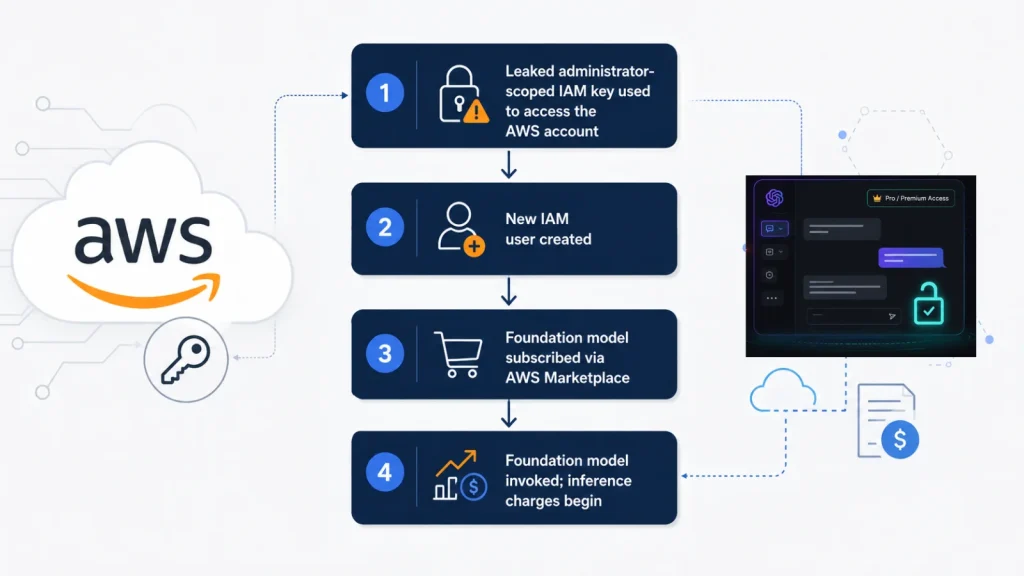
LLMjacking describes a type of cyberattack where threat actors hijack access to premium, paid Large Language Models (LLMs) or other AI services by exploiting leaked cloud credentials. In the incident investigated by FortiGuard Labs, attackers leveraged a compromised AWS IAM access key to gain unauthorized entry into a cloud environment. Crucially, this particular key possessed AdministratorAccess permissions, granting the attackers carte blanche over the victim’s AWS resources. With such extensive privileges, they could then access and utilize expensive AI models, effectively turning the victim’s infrastructure into their personal, free computational engine for AI tasks.
This technique underscores a significant concern: the monetization of stolen credentials extends beyond traditional data theft or resource abuse. It now encompasses the illicit consumption of costly, advanced AI capabilities, directly impacting an organization’s financial bottom line and intellectual property.
The Anatomy of the Attack: Leaked AWS IAM Keys
The core of the LLMjacking attack lies in the exploitation of a leaked AWS IAM access key. IAM keys, consisting of an access key ID and a secret access key, are fundamental for programmatic interaction with AWS services. When these keys are exposed—whether through misconfigured code repositories, compromised developer machines, or insecure storage—they become a golden ticket for attackers. In the FortiGuard Labs case, the leaked key was not only active but also possessed “long-lived” status, meaning it had been active for an extended period, and crucially, granted AdministratorAccess. This level of permission is the most dangerous, allowing attackers to create, modify, and delete virtually any resource within the AWS account, including access to billing information and, pertinently, expensive AI services.
The ability to maintain access over a prolonged period amplifies the risk, providing attackers ample time to map out the environment, escalate privileges further if needed, and exploit resources like premium AI models without immediate detection.
Monetizing AI: How Attackers Profit
The financial incentive behind LLMjacking is straightforward: free access to expensive computational resources. Premium AI models, especially large language models, can incur substantial usage costs. By hijacking legitimate access, attackers can:
- Run AI-powered tasks for their own malicious purposes: This could include generating phishing content, creating sophisticated malware, or conducting intelligence gathering.
- Offer AI services to others for a fee: Essentially, they operate a shadow AI-as-a-Service, using the compromised infrastructure to fulfill requests from third parties, pocketing the profits.
- Develop and test their own AI models: Bypassing the significant investment in infrastructure and compute power required for AI development.
This transforms the victim’s cloud environment into an unwilling participant in a sophisticated revenue-generating scheme, often undetected until billing anomalies surface.
Remediation Actions: Securing Your AWS Environment Against LLMjacking
Preventing LLMjacking requires a multi-layered approach to AWS security, focusing heavily on IAM best practices and continuous monitoring. There is no specific CVE associated with this attack type as it exploits misconfigurations and leaked credentials rather than a software vulnerability, but the principles of strong access control are paramount.
Proactive Measures:
- Implement Least Privilege: Grant only the permissions necessary for users and applications to perform their tasks. Avoid using
AdministratorAccessfor service accounts or long-lived credentials. Regularly review and audit IAM policies. - Regular IAM Key Rotation: Rotate access keys frequently (e.g., every 90 days) and immediately revoke any keys that are no longer in use or suspected of compromise.
- Multi-Factor Authentication (MFA): Enforce MFA for all AWS users, especially those with privileged access.
- Secure Code Practices: Never hardcode AWS credentials directly into application code. Utilize AWS IAM roles for applications running on EC2 instances or other AWS services. Store credentials securely using AWS Secrets Manager or environment variables.
- Vulnerability Scanning of Code Repositories: Implement automated tools to scan code repositories (e.g., GitHub, GitLab) for inadvertently exposed AWS access keys or other sensitive credentials.
- Cloud Security Posture Management (CSPM): Deploy CSPM tools to continuously monitor your AWS environment for misconfigurations, overly permissive IAM policies, and exposed resources.
- AWS CloudTrail and CloudWatch Monitoring: Enable CloudTrail for comprehensive logging of API calls and user activity. Configure CloudWatch alarms to detect unusual activity, such as excessive API calls from a single key, access from unusual geographic locations, or sudden spikes in AI service usage.
- Service Control Policies (SCPs): For AWS Organizations, use SCPs to centrally manage permissions for all accounts in your organization, enforcing guardrails that prevent actions like the creation of overly permissive IAM policies.
- Incident Response Plan: Develop and regularly test an incident response plan specifically for credential compromise and unauthorized access to cloud resources.
Detection and Response Tools:
| Tool Name | Purpose | Link |
|---|---|---|
| AWS IAM Access Analyzer | Identifies resources shared with an external entity. | https://aws.amazon.com/iam/features/analyze-access/ |
| AWS CloudTrail | Provides a history of AWS API calls for account activity. | https://aws.amazon.com/cloudtrail/ |
| AWS GuardDuty | Intelligent threat detection for your AWS accounts and workloads. | https://aws.amazon.com/guardduty/ |
| AWS Security Hub | Provides a comprehensive view of your security alerts and security posture. | https://aws.amazon.com/security-hub/ |
| TruffleHog | Open-source tool for finding leaked credentials in Git repositories. | https://github.com/trufflesecurity/trufflehog |
Conclusion: Fortifying Your Cloud Perimeter Against AI Hijacks
The LLMjacking attack serves as a stark reminder that even seemingly isolated security lapses, like a single leaked AWS IAM key, can have profound and costly repercussions. In an era where AI models are becoming central to business operations, securing access to these resources is paramount. By rigorously applying the principle of least privilege, enforcing stringent credential management, and leveraging AWS’s robust suite of security tools, organizations can significantly reduce their attack surface. Proactive monitoring and a swift incident response capability are not just best practices; they are essential defenses against sophisticated cloud intrusions like LLMjacking, ensuring that your valuable AI assets remain under your control.