Hackers Use Invisible Unicode Characters to Evade Phishing Detection in Millions of Emails
The Invisible Threat: How Unicode Characters are Fueling a New Wave of Phishing Attacks
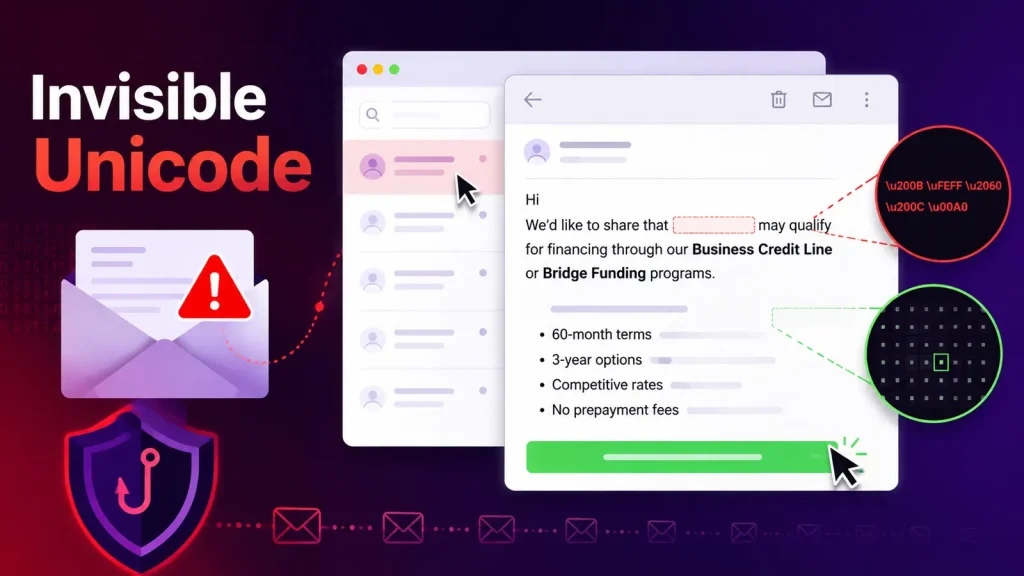
Imagine receiving an email that, at first glance, seems perfectly legitimate. It offers you a loan, discusses funding, or extends a credit opportunity. Your security filters scan it, your antivirus gives it a nod, yet beneath the surface, a malicious payload lies in wait. This isn’t a hypothetical scenario; it’s the stark reality of a sophisticated new phishing campaign where attackers are leveraging invisible Unicode characters to bypass traditional detection mechanisms in millions of emails. As cybersecurity professionals, understanding these subtle but powerful evasion tactics is paramount to protecting our organizations and users.
The Stealthy Unicode Evasion Tactic Explained
The core of this advanced phishing technique lies in the clever manipulation of Unicode. Attackers are embedding invisible Unicode characters within words to disrupt the very systems designed to identify suspicious language. For instance, a word like “payment” could have an invisible character strategically placed within it, rendering it “pay[invisible character]ment” to an automated system. To the human eye, it appears completely normal, but to a security solution looking for specific keywords or patterns, it’s a garbled string that doesn’t match its threat intelligence database.
This subtle alteration is enough to fool many email filters and security gateways. These systems are typically trained to recognize known malicious keywords, domains, or phishing patterns. By introducing an unrenderable or invisible character, the attackers effectively create a unique string that bypasses these checks without alerting the recipient. The result? Finance-themed phishing messages, designed to elicit sensitive information or drive recipients to malicious sites, are landing directly in inboxes at an alarming scale, entirely undetected by traditional defenses.
Why Invisible Unicode Characters Are So Effective
The effectiveness of this method stems from several key factors:
- Human Imperceptibility: The characters are, by design, invisible. Users see what appears to be a normal, harmless word, making them far more likely to engage with the email.
- Security System Blind Spots: Many established security solutions rely on pattern matching and keyword analysis. Invisible characters introduce noise into these patterns, effectively breaking the detection logic.
- Scale of Impact: Because this technique is so difficult to detect, attackers can push campaigns at massive scales, increasing their chances of success even with a low conversion rate. Millions of emails can be delivered without triggering automated alerts.
- Exploiting Trust: The finance-themed nature of these attacks preys on the immediate concerns and needs of individuals, such as loans, funding, or credit, making recipients more susceptible to the lure.
Remediation Actions: Fortifying Your Defenses
Combating these stealthy attacks requires a multi-layered approach that goes beyond traditional keyword filtering. Here are actionable steps organizations can take:
- Advanced Email Security Gateways (ESG): Implement ESGs with advanced behavioral analysis and machine learning capabilities that can detect anomalies in email content, even with invisible characters. These systems should analyze the rendered content alongside the raw email structure.
- Deep Content Inspection: Configure email filters to perform deeper content inspection, including decoding Unicode characters and analyzing the structural integrity of words. This can involve normalizing text before scanning for known threats.
- User Education and Training: Conduct regular, realistic phishing simulations and training programs. Educate users about the subtle signs of phishing, emphasizing the importance of verifying sender authenticity and scrutinizing links, even if the email content appears legitimate.
- Domain Name System (DNS) Security: Utilize DNS filtering to block access to known malicious domains, even if a user is tricked into clicking a phishing link.
- Implement DMARC, DKIM, and SPF: Strengthen email authentication protocols (Domain-based Message Authentication, Reporting, and Conformance – DMARC, DomainKeys Identified Mail – DKIM, and Sender Policy Framework – SPF) to prevent spoofing and ensure that legitimate emails originate from authorized senders.
- Regular Software Updates: Ensure all email clients, security software, and operating systems are regularly updated to patch known vulnerabilities that attackers could exploit in conjunction with these phishing tactics.
- Security Information and Event Management (SIEM) Integration: Integrate email security logs with your SIEM system for centralized monitoring and anomaly detection, enabling faster response to potential compromises.
Recommended Tools for Enhanced Detection
To further bolster defenses against such sophisticated phishing attacks, consider leveraging the following types of tools:
| Tool Name | Purpose | Link |
|---|---|---|
| Proofpoint Email Protection | Advanced threat protection, URL defense, and attachment sandboxing. | https://www.proofpoint.com/us/products/email-protection |
| Mimecast Email Security | Comprehensive cloud email security, archiving, and continuity. | https://www.mimecast.com/products/email-security/ |
| Cofense PhishMe | Phishing simulation and security awareness training platform. | https://cofense.com/product-services/phishme/ |
| Valimail (DMARC as a Service) | Automated DMARC enforcement and reporting to prevent email impersonation. | https://www.valimail.com/ |
| Microsoft Defender for Office 365 | Integrated threat protection for email, links, and collaboration tools. | https://www.microsoft.com/en-us/security/business/microsoft-365-defender/microsoft-defender-for-office-365 |
Conclusion
The use of invisible Unicode characters in phishing campaigns serves as a stark reminder that cyber adversaries are constantly evolving their tactics. What appears innocuous to the human eye can be a critical blind spot for automated security systems. Organizations must adopt a proactive and adaptive cybersecurity posture, moving beyond signature-based detection to leverage advanced behavioral analytics, robust email authentication, and continuous security awareness training. By understanding these subtle evasion techniques and implementing comprehensive defensive strategies, we can significantly reduce our exposure to these increasingly sophisticated threats.