Hacked Thai College Website Abused to Redirect Google Searchers to Illegal Online Casino
The Silent Compromise: How a Hacked Thai College Website Redirected to an Illegal Online Casino
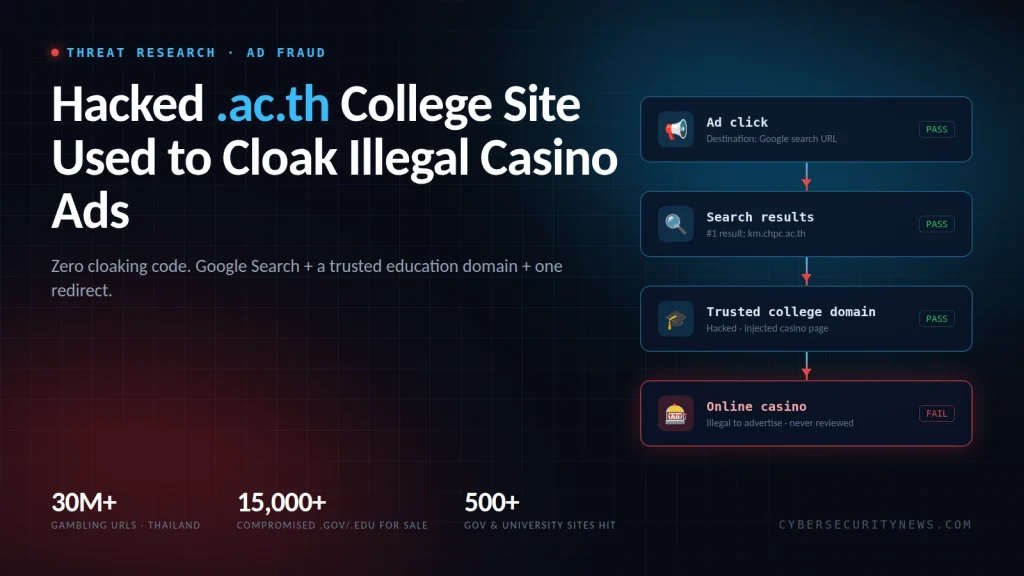
The digital landscape is a constant battleground, and even seemingly innocuous websites can become instruments of illicit activity. A recent discovery by anti-fraud platform ADEX has shed light on a sophisticated scheme where a compromised Thai college website was silently exploited to redirect Google search users to an illegal online casino. This incident highlights critical vulnerabilities in web security and sophisticated evasion tactics employed by cybercriminals.
This campaign is particularly noteworthy for its ability to achieve full ad cloaking without deploying any traditional cloaking code. Such techniques mirror those observed in operations designed to bypass stringent Google Ads screening processes, indicating a high level of sophistication and an understanding of detection mechanisms.
The Anatomy of the Attack: Sophisticated Evasion and Redirection
The core of this operation involved the surreptitious compromise of an educational institution’s website. Educational domains, often perceived as trustworthy, can be lucrative targets for threat actors seeking to leverage their established reputation and search engine authority. Once compromised, the attackers injected malicious scripts or configurations that silently rerouted specific search engine users.
What makes this attack stand out is the absence of overt cloaking code. Traditional cloaking often involves serving different content to search engine bots versus human users based on user-agent strings or IP addresses. The method employed here suggests a more nuanced approach, potentially leveraging server-side redirects, compromised DNS records, or subtle content alterations that only trigger for specific referral sources or user profiles, thus evading common detection methods used by search engines and security tools.
The objective was clear: to drive traffic to an illegal online casino. By exploiting the legitimate search engine rankings of the compromised college website, the attackers could funnel unsuspecting users directly to their illicit gambling platform, bypassing advertising costs and direct scrutiny.
Mirroring Google Ads Evasion Tactics
ADEX’s observation that this campaign mirrored evasion tactics seen in Google Ads screening is crucial. Google invests heavily in detecting and preventing malicious advertisements, including those promoting illegal activities like online gambling. Threat actors constantly innovate to circumvent these defenses. The techniques used in this college website compromise—achieving cloaking without explicit code—suggest a similar level of ingenuity aimed at remaining undetected by automated systems.
This could involve techniques such as:
- Conditional Redirections: Redirecting only users coming from specific Google search queries or those exhibiting particular browser characteristics.
- IP-based Filtering: Serving the malicious content only to users whose IP addresses are not associated with Google’s crawlers or known security scanners.
- Time-based Redirections: Activating the redirection only during specific periods to avoid continuous scanning.
- Browser Fingerprinting: Analyzing various browser attributes to differentiate legitimate users from bots or security tools.
Such tactics underscore the arms race between cybercriminals and security professionals, where each new defense prompts a new offensive strategy.
Remediation Actions for Compromised Websites
For any organization, especially educational institutions, the compromise of a website can have significant reputational and operational consequences. Prompt and thorough remediation is paramount. There is no specific CVE associated with this broad type of attack, as it typically involves exploiting various underlying vulnerabilities rather than a single flaw.
- Isolate and Identify: Immediately take the compromised website offline or isolate it from the network to prevent further redirection and potential lateral movement by attackers.
- Conduct a Comprehensive Audit: Perform a detailed security audit of the entire web server, including all files, databases, and configurations. Look for unauthorized changes, new files, modified .htaccess rules, and suspicious database entries.
- Review Access Logs: Scrutinize server access logs, web application logs, and database logs for any anomalous activity, unauthorized logins, or suspicious HTTP requests leading up to the compromise.
- Patch and Update: Ensure all web application software (CMS, plugins, themes), server operating system, and related components are fully patched to their latest stable versions. This often addresses vulnerabilities that attackers exploit.
- Remove Backdoors: Thoroughly scan for and remove any installed backdoors, web shells, or persistent access mechanisms left by the attackers.
- Change Credentials: Reset all administrative passwords, database credentials, FTP accounts, and API keys associated with the website.
- Implement Strong Access Controls: Enforce the principle of least privilege. Review and restrict access permissions to critical directories and files.
- Web Application Firewall (WAF): Deploy and configure a WAF to protect against common web-based attacks, including SQL injection, cross-site scripting (XSS), and directory traversal.
- Regular Backups: Maintain regular, offsite, and verified backups of the website and database. This allows for a clean restoration in case of compromise.
- Educate Users: Train website administrators and content managers on secure coding practices, recognizing phishing attempts, and the importance of strong, unique passwords.
Tools for Detection and Mitigation
| Tool Name | Purpose | Link |
|---|---|---|
| Sucuri SiteCheck | Online scanner for malware, blacklisting, and common website vulnerabilities. | https://sitecheck.sucuri.net/ |
| Wordfence Security | WordPress security plugin for endpoint firewall, malware scan, and login security. | https://www.wordfence.com/ |
| OpenVAS/Greenbone Vulnerability Manager | Comprehensive vulnerability scanner for network and web application security. | https://www.greenbone.net/ |
| ModSecurity (WAF) | Open-source Web Application Firewall that protects against various web attacks. | https://www.modsecurity.org/ |
| Maldet (Linux Malware Detect) | Malware scanner for Linux environments, designed to detect web shells and backdoors. | https://www.rfxn.com/projects/linux-malware-detect/ |
Key Takeaways
This incident with the hacked Thai college website serves as a stark reminder that no digital asset is entirely safe from exploitation. The sophistication of the evasion tactics employed—achieving ad cloaking without visible code—underscores the evolving nature of cyber threats. Organizations must prioritize robust security measures, continuous monitoring, and prompt remediation strategies. Educational institutions, in particular, should recognize their unique position as attractive targets and fortify their defenses against sophisticated adversaries seeking to leverage their online presence for illicit gain.