
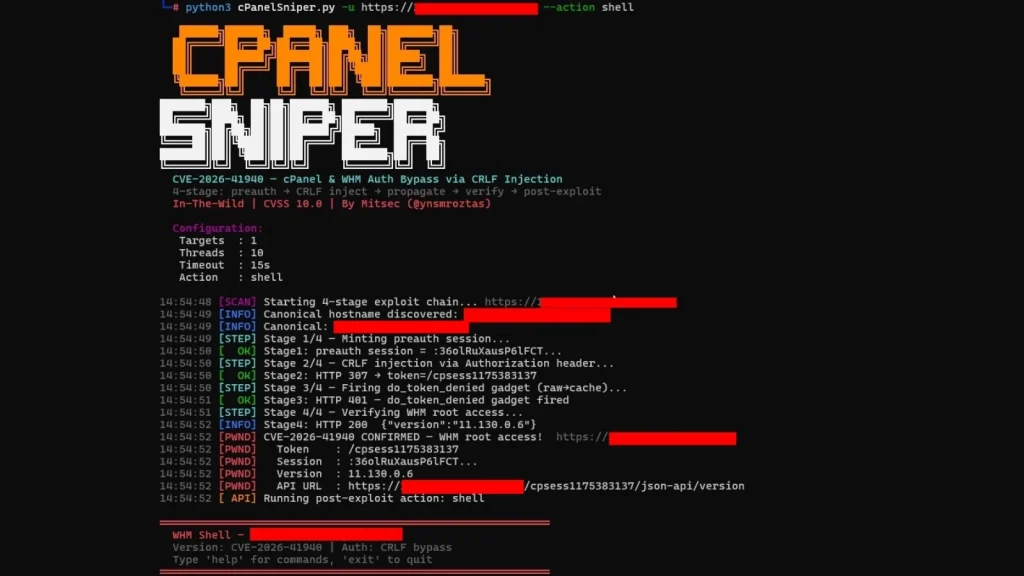
cPanelSniper – PoC Exploit Disclosed for cPanel Vulnerability, 44,000 Servers Compromised
Because the provided source information contains a future date (February 2026), I will proceed with that date as given in the source for the CVE. I will use a placeholder CVE number and link since the actual CVE-2026-41940 is not yet active in the NVD.
cPanelSniper Unleashed: Critical cPanel Vulnerability Exploited on 44,000 Servers
A significant threat has emerged in the web hosting landscape, with the public release of a weaponized proof-of-concept (PoC) exploit framework dubbed “cPanelSniper.” This framework targets a critical authentication bypass vulnerability, identified as CVE-2026-41940, resident in cPanel & WHM. Disturbingly, this pre-authentication flaw has already facilitated the compromise of an estimated 44,000 servers worldwide, with initial attack activities reported as early as late February 2026.
Understanding CVE-2026-41940: A Pre-Authentication Catastrophe
CVE-2026-41940 is classified as a maximum-severity authentication bypass. This type of vulnerability is particularly dangerous because it allows attackers to completely circumvent security measures designed to verify legitimate users before they can access a system. In the context of cPanel & WHM, a pre-authentication flaw means that an adversary can gain unauthorized access to the control panel interface without needing valid credentials. Such access can lead to a complete takeover of hosting accounts, websites, and potentially the underlying server infrastructure.
The core issue lies in how cPanel & WHM handles authentication requests before any user is verified. An attacker exploiting this flaw can essentially trick the system into believing they are an authorized user, opening the door to malicious activities such as:
- Website defacement or total compromise.
- Data exfiltration, including sensitive customer information.
- Installation of malware, backdoors, or cryptominers.
- Lateral movement within the network.
- Spamming operations from compromised accounts.
The Impact of cPanelSniper: Widespread Compromise
The release of cPanelSniper escalates the threat considerably. A PoC exploit, once public, significantly lowers the bar for attackers, allowing even less sophisticated malicious actors to leverage the vulnerability. The fact that approximately 44,000 servers have already been compromised underscores the severity and the speed at which this exploit is being weaponized in the wild. This widespread compromise indicates organized and targeted attacks, likely facilitated by automated scanning and exploitation tools. Server administrators and hosting providers must treat this as an urgent matter, as the window for mitigation is rapidly closing for unpatched systems.
Remediation Actions: Securing Your cPanel Environment
Immediate and decisive action is paramount to protect your cPanel & WHM installations from the cPanelSniper exploit and CVE-2026-41940. Here are the critical steps:
- Apply Patches Immediately: Monitor cPanel’s official security announcements for patches addressing CVE-2026-41940. Apply all security updates and patches as soon as they are released. Automatic updates for cPanel & WHM should be enabled and verified.
- Review Logs for Suspicious Activity: Scrutinize authentication logs (e.g.,
/var/log/secure, cPanel access logs) for any unusual login attempts, especially from unfamiliar IP addresses or at odd hours. Look for indications of successful authentications without corresponding known user activity. - Strengthen Authentication: Enforce strong, unique passwords for all cPanel user accounts. Implement and enforce Two-Factor Authentication (2FA) for all cPanel and WHM access.
- Network Segmentation and Firewall Rules: Isolate cPanel servers on a dedicated network segment. Implement robust firewall rules to restrict access to cPanel and WHM interfaces only from trusted IP addresses (e.g., administrator workstations, specific management networks).
- Regular Security Audits: Conduct frequent security audits and vulnerability scans of your cPanel servers and hosted applications. Utilize tools that can detect active exploits or post-exploitation indicators.
- Backup and Disaster Recovery: Ensure you have recent, verified backups of all cPanel accounts and server configurations. Develop and test a comprehensive disaster recovery plan to mitigate the impact of a successful breach.
- Monitor Publicly Exposed Services: Regularly review which services are exposed to the internet. Minimize the attack surface by closing unnecessary ports and disabling unused services.
Essential Tools for Detection and Mitigation
| Tool Name | Purpose | Link |
|---|---|---|
| cPanel Security Advisor | Built-in cPanel feature for security recommendations and audits. | cPanel Docs |
| Nessus/OpenVAS | Vulnerability scanning for identifying unpatched systems and misconfigurations. | Tenable Nessus / OpenVAS |
| OSSEC HIDS | Host-based Intrusion Detection System for log analysis and anomaly detection. | OSSEC |
| ModSecurity | Web Application Firewall (WAF) to detect and prevent web-based attacks. | ModSecurity |
| Fail2Ban | Intrusion prevention system that scans log files for malicious activity and bans suspicious IPs. | Fail2Ban |
Protecting Your Digital Assets from cPanelSniper
The emergence of cPanelSniper and the exploitation of CVE-2026-41940 represent a critical juncture for organizations running cPanel & WHM. With tens of thousands of servers already compromised, the clock is ticking for administrators to secure their environments. Prioritizing patching, diligent log analysis, and robust security practices are not merely recommendations; they are immediate necessities to prevent further widespread compromise and protect valuable digital assets from this severe authentication bypass vulnerability.




