Critical MLflow SSRF Vulnerability Exploited by Hackers in the Wild
Urgent Alert: Critical MLflow SSRF Vulnerability Actively Exploited in the Wild
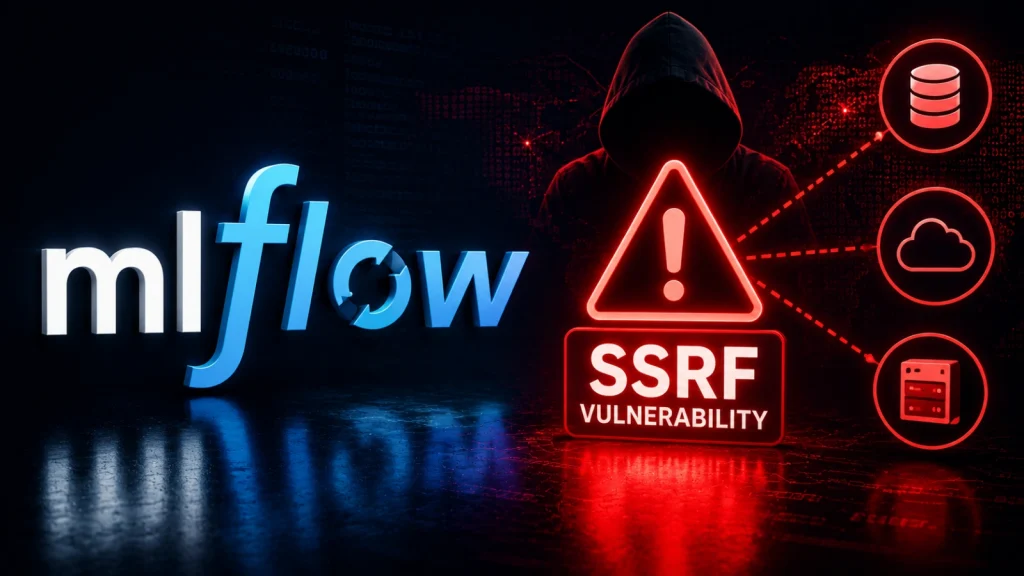
In the dynamic landscape of machine learning operations (MLOps), MLflow stands as a cornerstone, empowering data engineering and machine learning teams to streamline experiment tracking, code packaging, and model deployment. However, a severe and unauthenticated Server-Side Request Forgery (SSRF) vulnerability, CVE-2026-64849, with a critical CVSS 3.1 score of 9.3, is currently under active exploitation by threat actors. This flaw directly impacts all MLflow versions prior to 2.1.1, posing a significant risk to organizations leveraging this popular open-source platform.
Understanding the MLflow SSRF Vulnerability (CVE-2026-64849)
The core of this vulnerability lies in its ability to allow an unauthenticated attacker to force the MLflow server to make arbitrary requests to other internal or external systems. In an SSRF attack, the attacker manipulates the application to perform requests on their behalf. This can lead to a multitude of malicious activities, including:
- Accessing Internal Resources: Threat actors can probe internal networks, accessing sensitive data stores, internal APIs, or administrative interfaces that are otherwise protected from external access.
- Port Scanning: The vulnerability can be leveraged to scan internal ports of machines within the network, mapping out potential attack surfaces.
- Bypassing Firewalls: Since the requests originate from a trusted internal server, firewalls designed to protect internal resources from external threats can be bypassed.
- Exfiltrating Data: Malicious requests can be crafted to extract sensitive information from vulnerable internal services.
- Executing Remote Code: In some scenarios, SSRF can be chained with other vulnerabilities to achieve remote code execution (RCE) on the MLflow server or other connected systems.
The unauthenticated nature of CVE-2026-64849 makes it particularly dangerous, as it requires no prior compromise of user credentials or sessions to initiate an attack.
Why MLflow is a Prime Target for SSRF Exploitation
MLflow’s widespread adoption across diverse industries and its role in managing critical machine learning workflows make it an attractive target. Data engineering and ML teams often deal with sensitive datasets, proprietary models, and intellectual property. A successful SSRF exploit could compromise these assets, leading to data breaches, intellectual property theft, or disruption of critical ML pipelines.
The current active exploitation indicates that threat actors are aware of the potential rewards and are actively scanning for vulnerable MLflow instances. Organizations running unpatched versions are at immediate risk.
Remediation Actions: Patching and Mitigation Strategies
Given the critical nature and active exploitation of CVE-2026-64849, immediate action is paramount. The primary and most effective remediation is to upgrade MLflow to a patched version.
- Upgrade MLflow: All MLflow users are urged to upgrade to version 2.1.1 or later. This version contains the necessary security fixes to address the SSRF vulnerability.
- Network Segmentation: Implement strict network segmentation to isolate MLflow deployments from sensitive internal systems. This limits the blast radius of an SSRF attack even if the vulnerability is exploited.
- Principle of Least Privilege: Ensure that the MLflow server and its underlying services operate with the minimum necessary privileges to perform their functions.
- Input Validation and Sanitization: While patching is the definitive solution, good security hygiene dictates robust input validation and sanitization for all user-supplied inputs, especially those used in URL construction.
- Web Application Firewalls (WAFs): Deploy WAFs to detect and block suspicious requests that might indicate an attempted SSRF attack. Configure WAFs to scrutinize outgoing requests from the MLflow server.
- Monitor Outbound Traffic: Continuously monitor outbound network traffic from your MLflow server for unusual patterns or connections to unexpected internal or external destinations.
Tools for Detection and Mitigation
| Tool Name | Purpose | Link |
|---|---|---|
| OWASP ZAP | Web application security scanner for identifying SSRF and other vulnerabilities. | https://www.zaproxy.org/ |
| Burp Suite | Comprehensive platform for web security testing, including manual and automated SSRF detection. | https://portswigger.net/burp |
| Nessus | Vulnerability scanner capable of detecting out-of-date software and known vulnerabilities like CVE-2026-64849. | https://www.tenable.com/products/nessus |
| Snort/Suricata | Intrusion Detection/Prevention Systems (IDS/IPS) for monitoring network traffic for suspicious activity indicative of SSRF. | https://www.snort.org/ / https://suricata-ids.org/ |
The Imperative of Proactive Security
The exploitation of CVE-2026-64849 underscores the critical importance of maintaining up-to-date software versions and implementing a robust security posture, especially for platforms that are integral to core business operations like MLflow. Organizations must prioritize regular vulnerability scanning, timely patching, and comprehensive security audits to safeguard their valuable data and systems from evolving cyber threats.