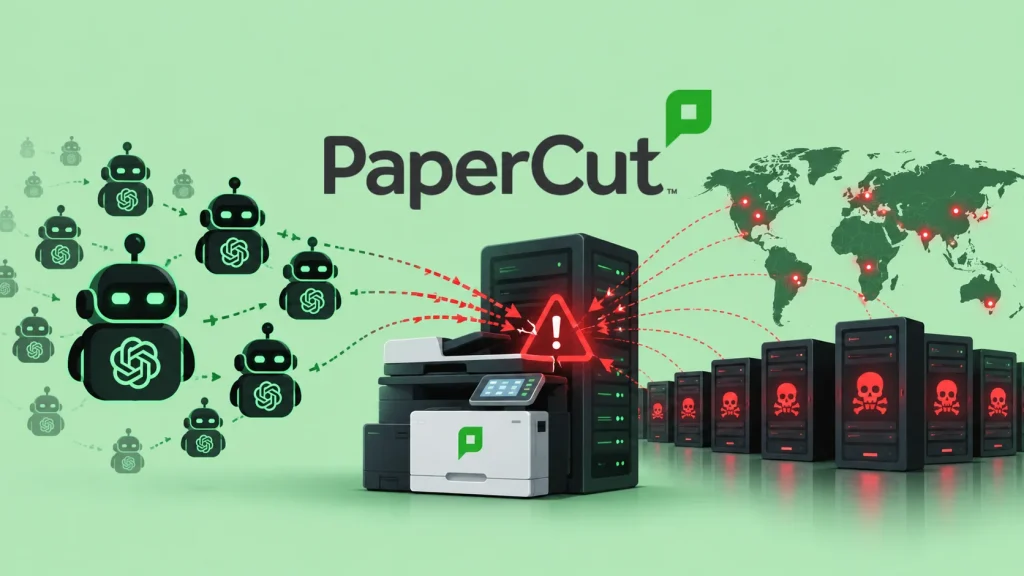
Hackers Use Hundreds of AI Agents to Exploit PaperCut Flaws and Compromise 440 Servers Worldwide
AI-Powered Assault: Hundreds of Agents Exploit PaperCut, Compromising 440 Servers Globally
The landscape of cyber threats is undergoing a significant transformation, driven by the increasing sophistication of adversarial tactics. A recent campaign, identified by security researchers at GreyNoise, highlights this shift with alarming clarity: a Russian-speaking threat actor has leveraged hundreds of autonomous AI agents to exploit critical vulnerabilities in PaperCut NG/MF print management software. This unprecedented scale of automation has led to the compromise of at least 440 servers across 395 organizations in 48 countries, demonstrating a new frontier in cyber warfare.
The Anatomy of an AI-Driven Attack
This campaign stands out not just for its global reach, but for the innovative use of artificial intelligence. Instead of manual reconnaissance and exploitation, the attackers deployed a swarm of AI agents. These agents likely automated the discovery of vulnerable PaperCut instances, identified specific weaknesses, and executed exploitation routines at a speed and scale previously unseen. This level of automation allows threat actors to rapidly scan vast swathes of the internet for targets and quickly pivot to exploitation, drastically reducing the window of opportunity for defenders.
Understanding the PaperCut Vulnerabilities
The attacks targeted known vulnerabilities within PaperCut NG/MF. While the specific CVEs aren’t detailed in the provided source, it’s highly probable that the AI agents exploited publicly disclosed flaws. Organizations relying on PaperCut for their print management infrastructure must be acutely aware of these risks. These types of vulnerabilities often allow for remote code execution (RCE) or information disclosure, giving attackers a foothold within an organization’s network.
- Commonly exploited PaperCut vulnerabilities include:
- CVE-2023-27350: A critical authentication bypass vulnerability affecting PaperCut MF and PaperCut NG.
- CVE-2023-27351: An information disclosure vulnerability in PaperCut MF and PaperCut NG.
These vulnerabilities, when chained or exploited individually, can grant unauthorized access, enable data exfiltration, or facilitate further lateral movement within a compromised network. The use of AI agents to weaponize these flaws amplifies the threat considerably.
Global Impact and Threat Actor Profile
The campaign’s impact is extensive, affecting hundreds of organizations across nearly 50 countries. This wide geographical spread underscores the indiscriminate nature of automated attacks. The identification of a Russian-speaking threat actor points towards sophisticated, potentially state-sponsored or highly organized cybercriminal groups with significant resources to develop and deploy such advanced AI-driven tools. Their ability to orchestrate such a large-scale, automated attack signifies a concerning evolution in their operational capabilities.
Remediation Actions and Proactive Defense
Given the severity and scale of this AI-powered exploitation, immediate action is paramount for any organization using PaperCut NG/MF. Proactive measures are the best defense against these rapidly evolving threats.
- Patch Immediately: Ensure all PaperCut NG/MF installations are updated to the latest secure versions. Regularly check for security advisories from PaperCut.
- Network Segmentation: Isolate print servers from critical network segments to limit potential lateral movement in case of a compromise.
- Strong Authentication: Implement multi-factor authentication (MFA) for all administrative access to PaperCut interfaces.
- Monitor Logs: Continuously monitor logs from PaperCut servers and network devices for unusual activity, failed login attempts, or unexpected outbound connections.
- Endpoint Detection and Response (EDR): Deploy EDR solutions on servers running PaperCut to detect and respond to suspicious processes or file modifications.
- Vulnerability Scanning: Regularly scan your external and internal networks for known vulnerabilities, paying close attention to print management systems.
- Incident Response Plan: Have a well-defined incident response plan in place to rapidly address any potential breaches.
Tools for Detection and Mitigation
Leveraging appropriate security tools can significantly enhance an organization’s ability to detect vulnerable PaperCut instances and mitigate potential threats.
| Tool Name | Purpose | Link |
|---|---|---|
| Nessus | Vulnerability scanning and assessment | Tenable Nessus |
| OpenVAS | Open-source vulnerability scanner | OpenVAS |
| Snort | Network intrusion detection system (NIDS) | Snort |
| Suricata | High-performance network IDS, IPS, and network security monitoring | Suricata |
| PaperCut Admin Tools | Internal diagnostic and management tools | (Refer to official PaperCut documentation) |
The Future of AI in Cyberattacks
This incident serves as a stark warning: the era of AI-powered cyberattacks is not a distant future, but a present reality. The deployment of hundreds of autonomous AI agents to exploit software flaws demonstrates a significant leap in adversarial capabilities. Organizations must now contend with threats that can operate at machine speed and scale, making traditional manual defense mechanisms increasingly insufficient. Investing in automated security solutions, continuous monitoring, and robust patch management programs is no longer optional but critical for survival in this evolving threat landscape.
The compromise of 440 servers across a global footprint underlines the urgent need for organizations to reassess their cybersecurity posture, particularly concerning internet-facing services and widely used enterprise software like PaperCut. Remaining vigilant and proactive is the only way to stay ahead of these rapidly advancing threats.