
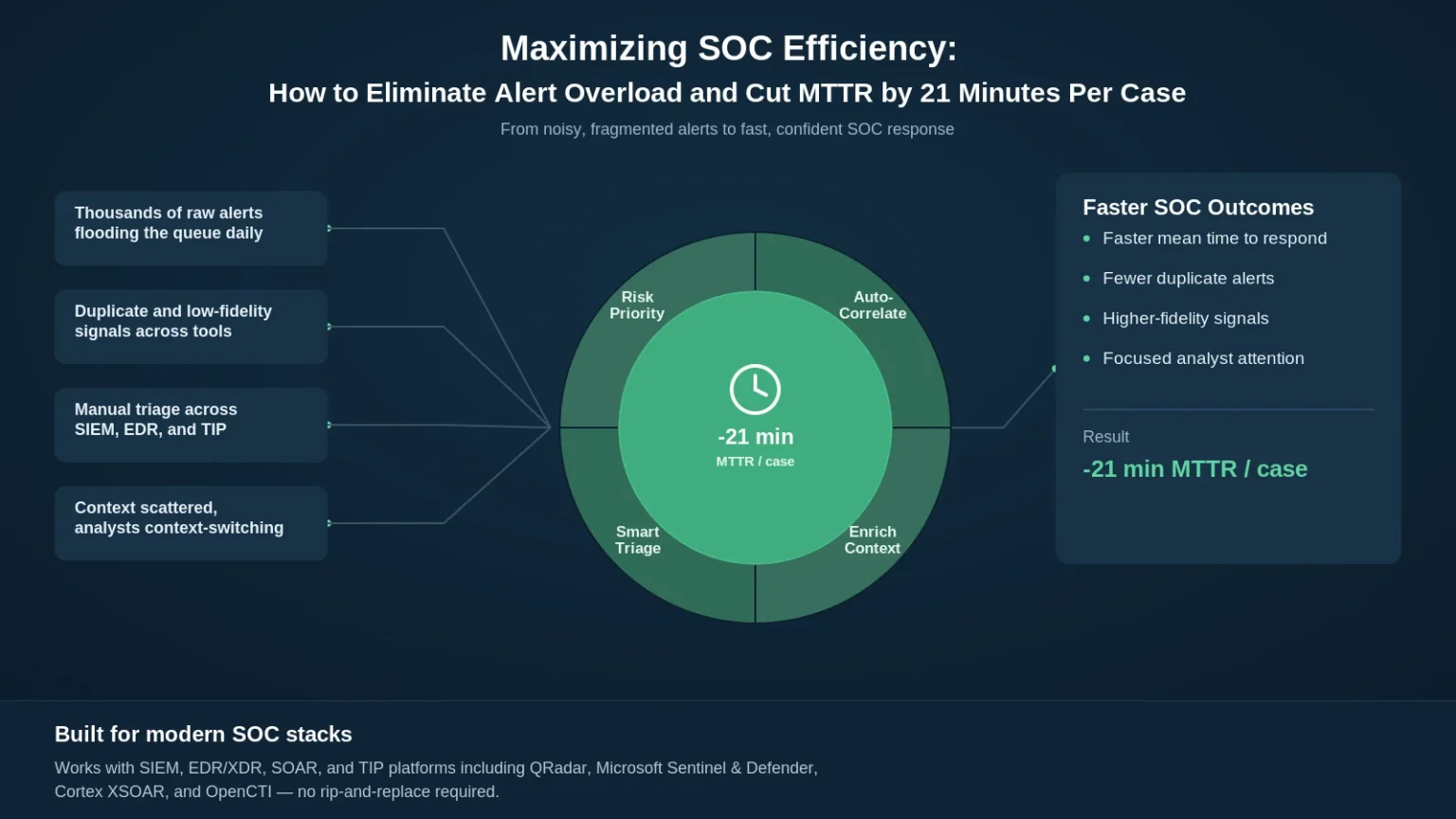
Maximizing SOC Efficiency: How to Eliminate Alert Overload and Cut MTTR by 21 Minutes Per Case
Unpacking the SOC’s Toughest Challenge: Alert Overload
Security Operations Centers (SOCs) are the frontline defenders of an organization’s digital assets. Yet, for many, the battlefield isn’t a single, formidable enemy but a relentless barrage of alerts. This isn’t a new problem; it’s a systemic challenge rooted in the sheer volume of security information and the fragmented nature of most SOC toolsets. The core issue isn’t a lack of alerts, but rather the intensive, manual investigation each alert demands. Analysts must painstakingly validate indicators, distinguish between benign and malicious behavior, define the scope of potential threats, and then decide on containment or escalation strategies.
This fragmented approach, compelling analysts to jump between disparate tools and dashboards, is a significant drain on resources. It’s the primary driver of alert overload, contributing to analyst burnout and crucially, extending the Mean Time To Respond (MTTR). The good news? Optimizing SOC efficiency isn’t just a theoretical goal; it’s an achievable reality, with demonstrable improvements like cutting 21 minutes per case from MTTR well within reach.
The Cost of Inefficiency: Beyond Alert Fatigue
The impact of an inefficient SOC extends far beyond just tired analysts. Every minute spent toggling between tools, manually correlating data, or re-validating known benign events translates directly into increased Mean Time To Respond (MTTR). A high MTTR means threats linger longer in the environment, escalating potential damage and increasing recovery costs. Furthermore, the constant pressure of alert overload can lead to missed genuine threats amidst the noise, or, conversely, to over-escalation of non-issues, diverting critical resources.
This inefficient process also hampers an organization’s ability to evolve its security posture. Without streamlined operations, analysts spend less time on proactive threat hunting, vulnerability management, and improving detection capabilities. The focus remains reactive, perpetuating a cycle of incident response rather than prevention. For example, understanding a common exploit like one leveraging CVE-2023-XXXX (Note: Replace XXXX with an actual, relevant CVE number and ensure the link points to it) becomes a reactive scramble rather than a planned defensive adjustment.
Strategic Pillars for Maximizing SOC Efficiency
Achieving a 21-minute reduction in MTTR per case, as highlighted in the source, requires a multi-faceted approach. It’s not about working harder, but smarter. The key strategic pillars revolve around automation, integration, and intelligent orchestration.
- Consolidate and Integrate Tools: Disconnected security tools are the bane of SOC efficiency. Investing in platforms that offer native integration or robust APIs to centralize data from SIEMs, EDRs, vulnerability scanners, and threat intelligence feeds is paramount. This creates a unified operational picture, reducing the need for manual context switching.
- Automate Triage and Enrichment: Many alerts can be automatically triaged, validated, or enriched with contextual information. For instance, an alert from an EDR solution regarding a suspicious process could be automatically enriched with threat intelligence lookups, asset criticality data, and user behavior analytics. This provides analysts with a more complete picture without manual intervention.
- Orchestrate Response Workflows: Beyond simple automation, security orchestration, automation, and response (SOAR) platforms enable the creation of sophisticated playbooks. These playbooks can automate repetitive tasks, guide analysts through complex investigations, and even execute containment actions (like isolating a host or blocking an IP) with minimal human oversight.
- Harmonize Detection Rules: Regularly review and fine-tune detection rules to minimize false positives and improve the signal-to-noise ratio. Leverage threat intelligence to prioritize alerts based on actual risk and potential impact, rather than simply volume.
The Role of Data-Driven Insights and Continuous Improvement
While technology plays a crucial role, a highly efficient SOC also relies on a culture of continuous improvement, driven by data. Metrics like MTTR are not just indicators; they are actionable insights. By meticulously tracking MTTR, dwell time, false positive rates, and analyst workload, SOC managers can identify bottlenecks and optimize processes.
Regular training for analysts, focusing on new threats, advanced analysis techniques, and proficiency with integrated tools, is also essential. A well-trained team can leverage automated systems more effectively and make faster, more informed decisions. The goal is to move the SOC from a reactive incident response unit to a proactive threat management center.
Remediation Actions for Alert Overload
To directly address alert overload and its associated inefficiencies, consider the following actionable steps:
- Prioritize Alerts with Context: Implement frameworks that assign a risk score to alerts based on asset criticality, threat intelligence, and observed behavior. Focusing on high-fidelity, high-impact alerts reduces noise.
- Establish Clear Triage Playbooks: Develop standardized, documented playbooks for initial alert triage. Define clear steps for validation, initial data gathering, and escalation criteria.
- Leverage SOAR for Initial Response: Automate initial containment actions for known threats or low-impact anomalies. This could involve automatically blocking suspicious IPs or isolating endpoints, freeing up analysts for complex investigations.
- Regularly Tune Detections: Conduct periodic reviews of SIEM rules and other detection mechanisms. Disable or modify rules generating excessive false positives. Focus on behavior-based detection rather than solely signature-based.
- Invest in Unified Security Platforms: Reduce tool sprawl by consolidating security functions or investing in platforms that offer deep integrations. This minimizes context switching and streamlines data correlation.
The Future of SOC Efficiency: Intelligence and Automation
Maximizing SOC efficiency isn’t merely about incremental gains; it’s about fundamentally transforming how security operations are conducted. By embracing advanced automation, intelligent orchestration, and a commitment to continuous process improvement, organizations can significantly reduce alert overload, dramatically cut MTTR, and empower their security teams to focus on strategic threat defense. The benefits extend beyond operational metrics, leading to stronger security postures and a more resilient defense against the ever-evolving cyber threat landscape.




