
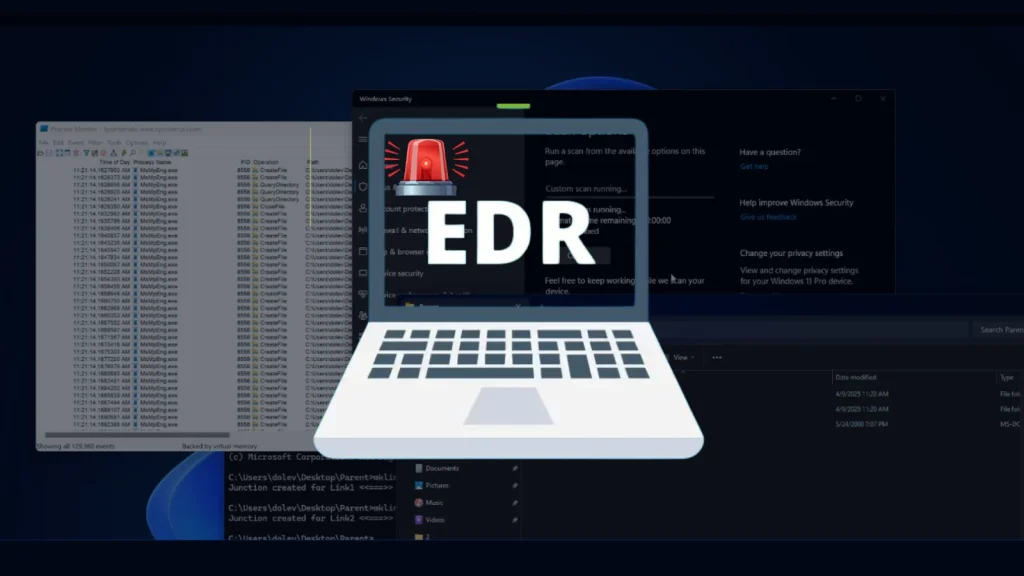
New GhostTree Attack Causing EDR Products to Hang and Leave Files Unscanned
Endpoint Detection and Response (EDR) solutions are the digital bulwarks against an ever-evolving threat landscape. They stand as a critical last line of defense, designed to catch what perimeter defenses miss. But what happens when these sophisticated tools are themselves outsmarted, lulled into a state of suspended animation while malicious payloads slip by undetected?
Recent discoveries by Varonis Threat Labs shed light on a concerning new evasion technique dubbed GhostTree. This novel attack exploits a fundamental feature of Windows file systems—NTFS junctions—to create recursive directory loops. The result? EDR products become ensnared in an infinite scanning cycle, effectively hanging and failing to scrutinize critical files that could harbor malware. This development signals a significant challenge for organizations relying on EDR for their cybersecurity posture.
Understanding the GhostTree Attack Mechanism
The ingenuity of GhostTree lies in its exploitation of NTFS junctions. For those unfamiliar, NTFS junctions are essentially advanced symbolic links or shortcuts within the Windows file system. They allow a directory to point to another directory, even on a different volume, making it appear as a subdirectory of the original path. Applications traverse these junctions seamlessly, often without realizing they’ve been redirected.
GhostTree weaponizes this functionality by creating a recursive directory loop. Imagine a directory, let’s call it “A,” containing a junction that points back to “A” itself. When an EDR scanner attempts to recursively scan directory “A,” it encounters the junction, follows it back to “A,” and continues in an endless loop. This consumes significant system resources, causing the EDR agent to hang, crash, or enter a resource-intensive state where it effectively ceases to function correctly, leaving other files on the system unexamined.
While the specific technical details of GhostTree’s full attack chain are still under analysis, the core principle is clear: weaponizing legitimate system features to create a denial-of-service condition for security agents. This isn’t a vulnerability in a traditional sense, like CVE-2023-XXXXX (placeholder for hypothetical CVE if one were assigned to the conceptual flaw), but rather an abuse of operating system design that has profound implications for detection.
Impact on EDR Products and System Security
The immediate and most critical repercussion of a GhostTree attack is the functional paralysis of EDR products. When an EDR agent is stuck in an infinite loop, it is unable to perform its core functions:
- Real-time scanning: New files, especially malicious ones, will not be scanned upon creation or modification.
- Behavioral analysis: The agent’s ability to monitor process activity and identify suspicious behaviors will be severely degraded or halted.
- Telemetry collection: Critical security logs and forensic data that the EDR solution typically gathers may not be recorded, hampering incident response efforts.
- Quarantine and remediation: If the EDR cannot detect threats, it certainly cannot contain or remediate them.
This creates a gaping blind spot for organizations. While the EDR system appears to be running, it’s effectively compromised, providing a false sense of security. Attackers can then leverage this window of opportunity to deploy additional malware, establish persistence, exfiltrate data, or execute further stages of their attack without fear of detection from the primary endpoint security solution.
Remediation Actions and Mitigations
Addressing the GhostTree technique requires a multi-faceted approach, combining proactive measures with enhanced monitoring. Since this exploits Windows functionality rather than a software bug, traditional patching may not be sufficient.
- Implement Robust NTFS Junction Monitoring: Organizations should establish mechanisms to monitor the creation and modification of NTFS junctions, especially in critical system directories or user profiles. Unexpected or rapid creation of junctions should trigger alerts for investigation.
- File System Integrity Checks: Regularly scheduled or event-triggered integrity checks of the file system can help identify deliberately formed recursive loops. Tools that map directory structures can highlight these anomalies.
- Enhanced EDR Heuristics: While specific EDR solutions may be vulnerable, vendors are likely to update their heuristics to specifically detect and break out of recursive junction loops. Organizations should ensure their EDR software is always up-to-date.
- Behavioral Anomaly Detection: While the EDR itself might hang, other system monitoring tools might detect the unusual resource consumption or CPU spikes associated with an EDR agent trapped in a GhostTree loop. Look for unusual process behavior in your SIEM.
- Least Privilege and Application Whitelisting: Limiting the ability of users and applications to create junctions can greatly reduce the attack surface. Application whitelisting can prevent unauthorized executables from creating such structures in the first place.
- Regular EDR Health Checks: Implement a routine process to verify the operational status of EDR agents across endpoints beyond simply checking if the service is running. This could involve trying to manually scan a known test file to confirm responsiveness.
Relevant Tools for Detection and Mitigation
While direct countermeasures for GhostTree are evolving, several categories of tools can aid in detection, analysis, and prevention:
| Tool Name | Purpose | Link |
|---|---|---|
| Sysinternals Junction | Command-line utility to create, delete, and list NTFS junctions. Useful for forensic analysis and testing. | Microsoft Learn |
| PowerShell FSLog Book (or similar) | Scripting for advanced file system monitoring, including junction and symlink enumeration. | (Varies by script/repository – example: GitHub search “PowerShell NTFS junction monitor”) |
| SIEM Solutions (e.g., Splunk, Elastic, Sentinel) | Centralized logging and correlation to detect unusual EDR agent behavior (high CPU, memory), or creation of suspicious file system objects. | Splunk, Elastic, Microsoft Azure Sentinel |
| File Integrity Monitoring (FIM) Solutions | Monitors changes to critical system files and directories, including the creation of junctions. | (Various commercial and open-source FIM tools available) |
Conclusion
The GhostTree attack underscores a critical lesson in cybersecurity: attackers will continually find innovative ways to exploit the underlying mechanisms of operating systems, even those designed for legitimate purposes. This technique effectively neuters EDR solutions by trapping them in an infinite loop, leaving systems vulnerable to further compromise. Organizations cannot afford to overlook this sophisticated evasion method.
By understanding how GhostTree leverages NTFS junctions and implementing robust monitoring, proactive remediation strategies, and ensuring EDR solutions are continuously updated, security teams can significantly enhance their defenses. The battle for endpoint security is a perpetual one, and staying ahead means anticipating and mitigating even the most subtle forms of system abuse.




