
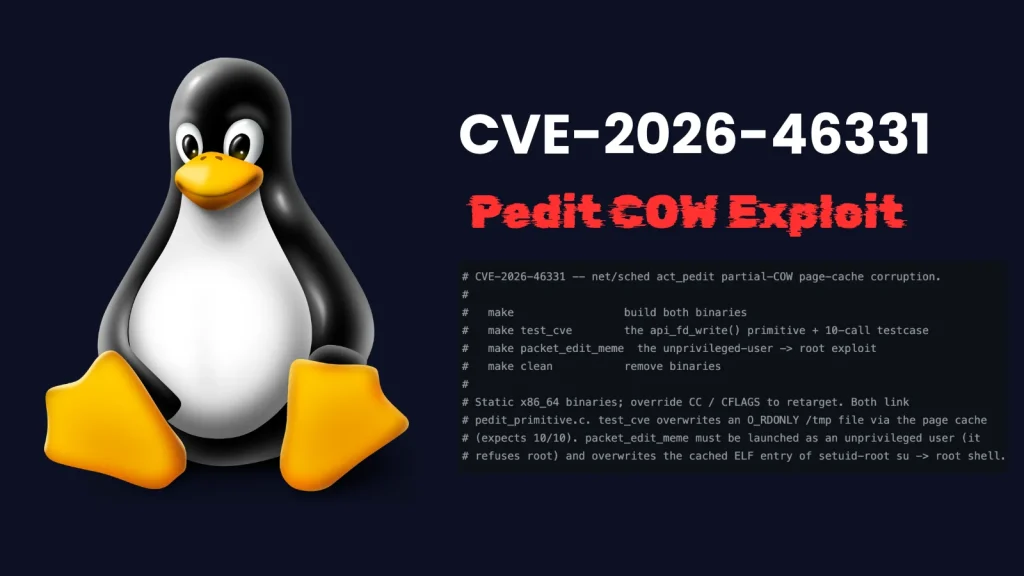
New Linux pedit COW Exploit Allows Attackers to Gain System Root Access
A severe Linux kernel vulnerability, dubbed packet_edit_meme, has come to light, threatening the security of numerous Linux distributions. This critical flaw combines a Copy-on-Write (COW) page-cache corruption with the net/sched subsystem’s act_pedit component, allowing unprivileged local attackers to elevate their privileges to full root access. Organizations and individual users alike must pay immediate attention to this exploit, as its potential impact is profound.
Understanding the pedit COW Exploit
The packet_edit_meme exploit leverages a dangerous combination of two attack vectors. At its core is a Copy-on-Write (COW) page-cache corruption vulnerability. COW is a fundamental memory optimization technique in modern operating systems, where pages are initially shared and only duplicated (copied) when one of the processes attempts to modify them. A flaw in this mechanism can lead to unintended memory writes, allowing an attacker to corrupt data that should otherwise be protected.
This COW corruption is then paired with the net/sched subsystem’s act_pedit component. The act_pedit action is part of the Linux traffic control (TC) framework, designed for packet manipulation. By exploiting the COW flaw, an attacker can manipulate how the kernel handles packet editing, ultimately gaining control over critical system operations. This combination provides a powerful pathway for privilege escalation, moving from a low-privileged user account to complete root access.
Impact and Verified Distributions
The implications of a root access exploit are severe. An attacker gaining root can:
- Install arbitrary software, including malware or backdoors.
- Modify system configurations, potentially disabling security measures.
- Access, modify, or delete any data on the system.
- Create new user accounts with elevated privileges.
- Launch further attacks against other systems within a network.
The packet_edit_meme exploit has been verified against actively maintained enterprise and consumer kernels as recently as June 2026, indicating its ongoing relevance and danger. While specific distributions aren’t listed in the initial disclosure, the broad nature of a kernel vulnerability of this type suggests that most, if not all, major Linux distributions running affected kernel versions are at risk. This includes widely used distributions in server environments, cloud deployments, and desktop systems.
Technical Details and Exploit Chain
While the full technical disclosure is complex, the core of the exploit hinges on the attacker’s ability to trigger a race condition or a specific sequence of operations that corrupts the COW page-cache. This corruption then allows the attacker to craft specific input to the net/sched subsystem, particularly through the act_pedit module, leading to arbitrary write primitives within the kernel space. An arbitrary write primitive within the kernel is the holy grail for local privilege escalation, as it allows an attacker to overwrite critical kernel data structures, such as a user’s credentials or function pointers, to elevate their privileges.
For more in-depth technical analysis, security researchers and system administrators should refer to the official disclosures and detailed write-ups that will inevitably follow. At this stage, awareness of the underlying mechanisms—COW corruption and act_pedit manipulation—is crucial.
Remediation Actions
Addressing this vulnerability requires prompt and decisive action:
- Kernel Updates: The most critical step is to apply the latest kernel updates provided by your distribution vendor. These updates will contain patches specifically designed to fix the underlying COW corruption and prevent the exploitation of
act_pedit. Regularly check your distribution’s security advisories. - Regular Patching: Implement a robust patch management policy for all Linux systems. This vulnerability underscores the importance of staying current with security updates, especially for critical components like the kernel.
- Minimize Privileges: Adhere to the principle of least privilege. Ensure that users and services operate with the minimum necessary permissions. This limits the damage an attacker can inflict even if they compromise a low-privileged account.
- Security Monitoring: Enhance logging and monitoring for unusual system behavior, particularly concerning process creation, user privilege changes, or unexpected kernel messages. Anomaly detection systems can help identify attempted exploitation.
- Consider SELinux/AppArmor: While not a direct fix for the kernel flaw, Mandatory Access Control (MAC) systems like SELinux or AppArmor can provide an additional layer of defense by restricting what even a compromised process can do on the system, potentially mitigating the impact of a successful exploit.
Tools for Detection and Mitigation
While direct detection tools for this specific exploit might emerge, several existing cybersecurity tools can assist in maintaining system security and identifying potential compromises:
| Tool Name | Purpose | Link |
|---|---|---|
| Nessus | Vulnerability Scanning & Patch Management Verification | https://www.tenable.com/products/nessus |
| OpenVAS | Open-Source Vulnerability Scanner | https://www.greenbone.net/en/community-edition/ |
| Lynis | Security Auditing and Hardening Tool | https://cisofy.com/lynis/ |
| osquery | OS-level SQL-powered Operating System Analytics | https://osquery.io/ |
| Auditd | Linux Auditing System for Security Events | https://access.redhat.com/documentation/en-us/red_hat_enterprise_linux/7/html/security_guide/chap-system_auditing |
Looking Ahead
The packet_edit_meme pedit COW exploit serves as a stark reminder of the continuous challenges in kernel-level security. The increasing complexity of operating system kernels means that subtle flaws, when chained together, can lead to devastating consequences. Prioritizing timely patching, robust security practices, and continuous monitoring are paramount for defending against such sophisticated attacks. Stay informed, stay patched, and secure your Linux systems.




