
New Phishing-to-RMM Attacks: How Analysts Can Detect Trusted-Tool Abuse Early
Unmasking the Impostors: Detecting Phishing-to-RMM Attacks Early
In the evolving threat landscape, attackers relentlessly seek new avenues to breach defenses. A particularly insidious tactic gaining traction is the use of phishing to deploy legitimate Remote Monitoring and Management (RMM) tools. This method presents a unique challenge for cybersecurity analysts: how do you distinguish malicious activity when the tools themselves are trusted, and the initial breach is often disguised as routine interaction?
Recent research by ANY.RUN has shed light on a new wave of these sophisticated phishing-to-RMM campaigns. Threat actors are leveraging meticulously crafted fake Microsoft, Adobe, and OneDrive login pages to trick users into downloading and executing legitimate RMM software like ScreenConnect and LogMeIn Rescue. The core difficulty for analysts lies in the inherent legitimacy of the tools and their underlying infrastructure in isolation. Effective detection hinges on recognizing the entire attack chain, from the initial lure to the RMM’s execution and subsequent outbound connections.
The Deceptive Lure: How Phishing Fuels RMM Abuse
The initial phase of these attacks relies heavily on social engineering. Attackers design convincing phishing pages that mimic widely used services. These pages often present scenarios requiring immediate action, such as a “failed login attempt,” “document sharing notification,” or a “software update.” Once a user enters their credentials or clicks a malicious link, they are unknowingly initiating a chain of events that leads to the deployment of an RMM tool.
- Impersonation: High-fidelity replicas of popular brand pages (e.g., Microsoft 365, Adobe, OneDrive).
- Urgency & Fear: Messages designed to provoke a quick, unthinking response from the user.
- Credential Theft: Capturing user credentials, which can then be used to further compromise accounts, or in some cases, directly trigger RMM download.
Trusted Tools, Malicious Intent: The RMM Dilemma
Remote Monitoring and Management tools are indispensable for IT professionals. They enable remote support, system maintenance, and efficient management of distributed infrastructures. However, their legitimate functionality makes them attractive targets for abuse by attackers. Once an RMM tool is installed through phishing, it grants the attackers persistent, unfettered access to the compromised system. This access can be used for:
- Data Exfiltration: Stealing sensitive information.
- Lateral Movement: Spreading to other systems within the network.
- Further Malware Deployment: Installing ransomware or other malicious payloads.
- Command and Control (C2): Establishing a persistent C2 channel, often blending in with legitimate network traffic.
Detection is particularly challenging because the RMM executable itself is not inherently malicious; it’s a signed, legitimate application. This sidesteps many traditional endpoint protection mechanisms that focus on known malware signatures.
Connecting the Dots: Early Detection Strategies for Analysts
Detecting these sophisticated attacks requires a holistic approach, focusing on anomalies across the entire kill chain rather than isolated events. Analysts must become skilled at “connecting the dots” between seemingly disparate indicators.
- Email & Web Traffic Analysis:
- Unusual Sender Patterns: Scrutinize emails from external domains impersonating internal or trusted external services.
- Typosquatting & Subdomain Abuse: Look for subtle misspellings in URLs or use of unusual subdomains.
- Redirect Chains: Investigate complex redirect paths that lead to unexpected download sites.
- Unexpected Downloads: Monitor for downloads of executable files (.exe, .msi, .hta) directly from non-standard or unexpected web sources, especially after clicking a link in an email.
- Endpoint Detection and Response (EDR) & Logging:
- RMM Installation Anomalies: Identify RMM tool installations that do not align with official IT deployment policies or scheduled maintenance. Look for installations triggered by non-admin users or from unusual installation paths.
- Process Tree Analysis: Trace the parent process of an RMM tool. Was it launched by a browser, a document reader, or an unexpected script?
- Unusual Network Connections: Monitor outbound connections from RMM tools. Are they connecting to known, legitimate RMM servers, or are they communicating with suspicious IPs or domains?
- Behavioral Analytics:
- First-Time Seen Connections: Alert on RMM tools initiating connections to new or previously unseen external IPs or ports.
- Frequent or Long-Duration Connections: Legitimate RMM use is often intermittent. Persistent, long-duration connections might indicate ongoing unauthorized access.
- Resource Consumption & Activity Spikes: While not definitive, sudden spikes in CPU, memory, or network activity associated with an RMM tool, especially outside of business hours, warrant investigation.
- Threat Intelligence & Sandboxing:
- Indicators of Compromise (IoCs): Regularly update threat intelligence feeds with known phishing domains, IP addresses, and file hashes associated with these campaigns.
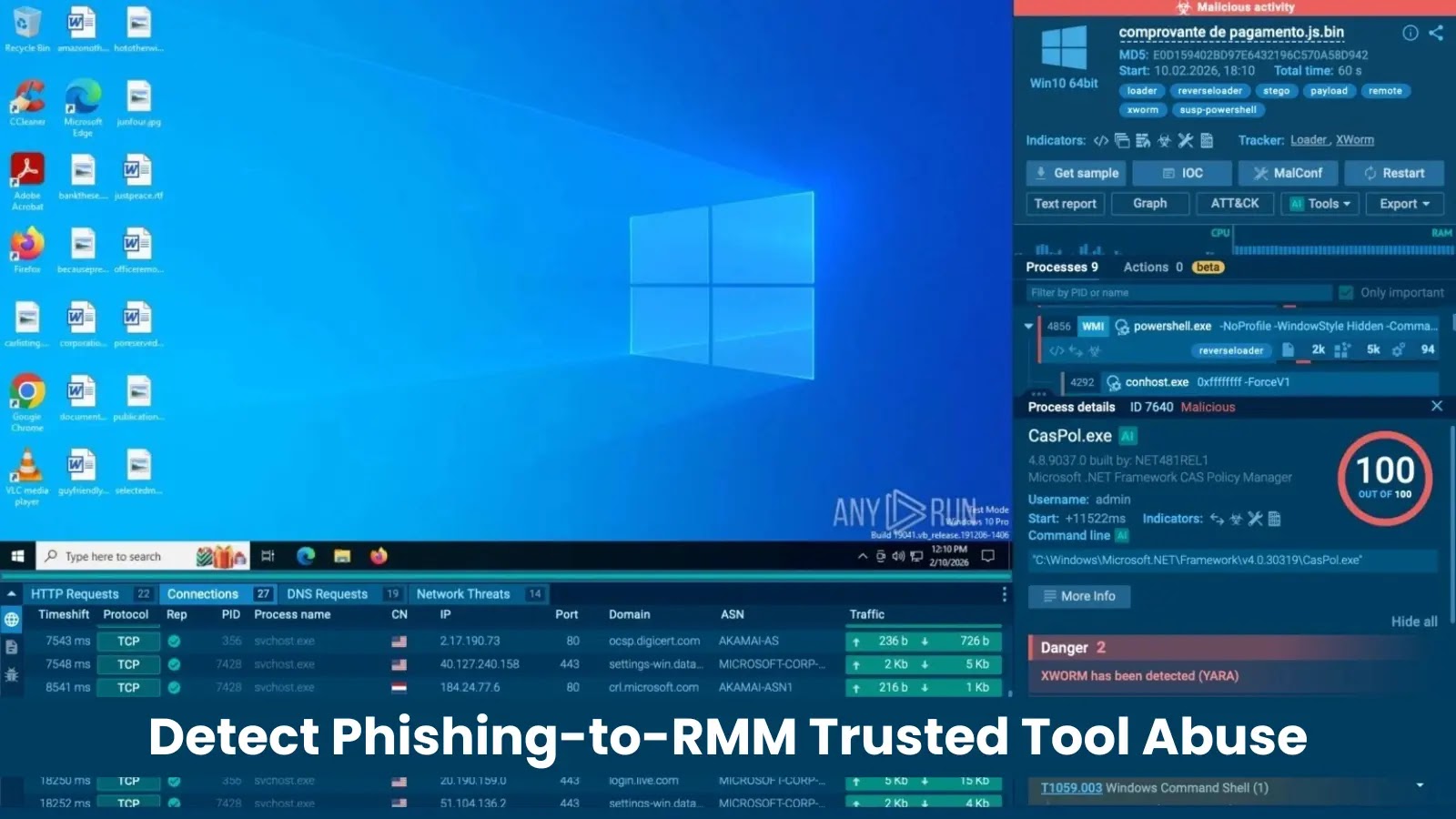
- Sandbox Analysis: Utilize sandbox environments like ANY.RUN to detonate suspicious files and analyze their full execution chain, revealing hidden behaviors and network communication. This can often expose the RMM deployment before it impacts production systems.
Remediation Actions for Phishing-to-RMM Attacks
Responding swiftly and comprehensively is crucial once such an attack is detected. Proactive measures coupled with a robust incident response plan are essential.
- Isolation & Containment: Immediately isolate the compromised endpoint from the network to prevent lateral movement and further data exfiltration.
- Account Compromise Remediation: If credentials were stolen via phishing, force password resets for the affected user across all systems and services. Implement multi-factor authentication (MFA) aggressively.
- RMM Tool Removal: Securely uninstall the unauthorized RMM tool from the affected system. Ensure all associated files, registry entries, and scheduled tasks are removed.
- Forensic Analysis: Conduct a thorough forensic investigation to determine the full scope of the compromise, including initial access vector, attacker activities, and any data accessed or exfiltrated.
- Threat Hunting: Proactively search for similar indicators of compromise (IoCs) across your network to identify other potentially compromised systems or users.
- User Education & Awareness: Reinforce ongoing security awareness training, emphasizing the risks of phishing, suspicious links, and the importance of verifying unexpected requests for remote access.
- Endpoint Security Enhancements: Strengthen endpoint security controls to detect and prevent unauthorized tool installations. Implement application allow-listing/block-listing where feasible to restrict execution of non-approved software.
Essential Tools for Detection and Mitigation
A layered security approach, leveraging specialized tools, significantly enhances an organization’s ability to combat these advanced threats.
| Tool Name | Purpose | Link |
|---|---|---|
| Endpoint Detection and Response (EDR) | Real-time threat detection, investigation, and response on endpoints. | N/A (Vendor specific, e.g., CrowdStrike, SentinelOne) |
| Security Information and Event Management (SIEM) | Aggregates and analyzes log data from various sources for threat detection and compliance. | N/A (Vendor specific, e.g., Splunk, IBM QRadar) |
| Sandbox Analysis (e.g., ANY.RUN) | Safe environment to detonate and analyze suspicious files and URLs. | https://any.run/ |
| Email Security Gateway (ESG) | Filters malicious emails, including phishing attempts, before they reach user inboxes. | N/A (Vendor specific, e.g., Proofpoint, Mimecast) |
| Network Detection and Response (NDR) | Monitors network traffic for anomalies and potential threats. | N/A (Vendor specific, e.g., Darktrace, Vectra AI) |
The Full Picture: Connecting the Chain
The rise of phishing-to-RMM attacks underscores a critical shift in adversary tactics – the abuse of trust. For cybersecurity analysts, the challenge is no longer just identifying malicious code, but understanding the malicious intent behind legitimate actions. By vigilantly monitoring the entire attack chain – from the initial phishing lure and user interaction to RMM tool execution and subsequent network communications – organizations can significantly improve their early detection capabilities. Continuous training, robust tooling, and a mindset focused on behavioural anomalies are key to unmasking these sophisticated impostors before they inflict significant damage.




