New ZcopyReaper Linux Kernel Vulnerability Enables Privilege Escalation Attacks
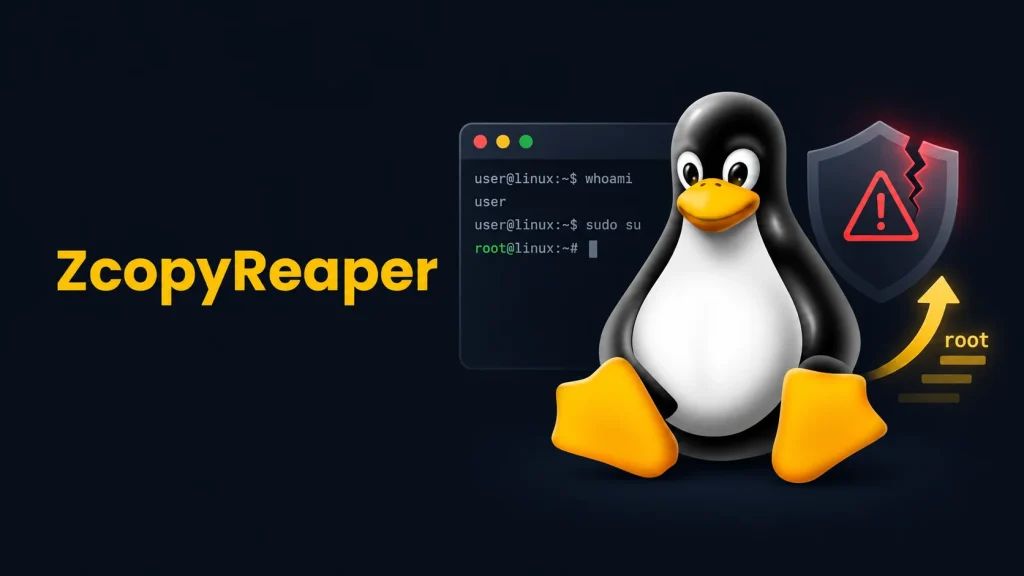
A critical new Linux kernel vulnerability, dubbed ZcopyReaper, has emerged, posing a significant threat to system security. This flaw allows unprivileged local attackers to elevate their privileges, potentially seizing root-level control over affected systems. For IT professionals, security analysts, and developers, understanding the intricacies of ZcopyReaper is paramount to safeguarding Linux environments.
Understanding the ZcopyReaper Linux Kernel Vulnerability
The ZcopyReaper vulnerability, officially tracked as CVE-2026-43502, was uncovered and demonstrated by security researchers at NebuSec. Their proof-of-concept exploit, aptly named ZcopyReaper, highlights the severity of the issue. At its core, the vulnerability resides within the Reliable Datagram Sockets (RDS) zero-copy send path of the Linux kernel.
The RDS zero-copy send path is designed to optimize data transfer by minimizing data copying between user space and kernel space. While this mechanism enhances performance, the ZcopyReaper vulnerability exploits a flaw in its implementation, enabling an attacker to manipulate kernel memory and ultimately gain elevated privileges. This type of privilege escalation attack is particularly dangerous as it can transform a low-privilege user into a superuser, allowing them to execute arbitrary code, modify system configurations, or even install backdoors.
Technical Deep Dive: How ZcopyReaper Exploits RDS
The vulnerability has been present in the Linux kernel since a specific version, indicating a long-standing potential for exploitation. The attack vector leverages the zero-copy semantics of RDS, which typically involves mapping user-space buffers directly into kernel space for efficient data transmission. The ZcopyReaper exploit likely manipulates this mapping or the associated memory management, leading to a condition where an attacker can write to arbitrary kernel memory locations or execute code within the kernel’s context.
Successful exploitation of CVE-2026-43502 hinges on an unprivileged local attacker being able to execute specific code that triggers the flawed behavior in the RDS zero-copy path. Once triggered, the attacker can then escalate their privileges, effectively bypassing standard security controls and gaining full control over the compromised Linux system. This makes ZcopyReaper a critical concern for any organization relying on Linux-based infrastructure.
Affected Linux Kernel Versions
While specific affected kernel versions were mentioned as existing “since Linux version […]” in the source, it is crucial for administrators to consult official advisories and vendor patches. Generally, newer kernel versions are more likely to contain the fix, but older, unpatched systems remain highly vulnerable. Regular vulnerability scanning and patch management are essential to identify and mitigate exposure.
Remediation Actions for ZcopyReaper
Addressing the ZcopyReaper vulnerability, CVE-2026-43502, requires prompt action. The primary remediation strategy involves updating the Linux kernel to a patched version. System administrators should:
- Apply Kernel Updates: Monitor official distributions for security advisories and apply the latest kernel updates as soon as they are available. These updates will contain the necessary patches to fix the flaw in the RDS zero-copy send path.
- Regular Patch Management: Implement a robust and consistent patch management policy across all Linux systems. This helps ensure that critical vulnerabilities are addressed promptly.
- Least Privilege Principle: Enforce the principle of least privilege, ensuring that users and applications only have the minimum necessary permissions to perform their functions. This limits the impact of a successful privilege escalation.
- System Monitoring: Deploy intrusion detection systems (IDS) and security information and event management (SIEM) solutions to monitor for suspicious activity and potential exploitation attempts.
- Disabling RDS (if not required): If the Reliable Datagram Sockets (RDS) protocol is not essential for your system’s operation, consider disabling it to remove the attack surface entirely. Consult your system documentation and application requirements before doing so.
Tools for Detection and Mitigation
Leveraging appropriate tools can aid in identifying vulnerable systems and fortifying defenses against threats like ZcopyReaper.
| Tool Name | Purpose | Link |
|---|---|---|
| OpenVAS / Greenbone Vulnerability Management | Comprehensive vulnerability scanning to identify outdated kernels and other security flaws. | https://www.greenbone.net/ |
| Nessus | Enterprise-grade vulnerability scanner offering detailed reports on system vulnerabilities, including kernel-related issues. | https://www.tenable.com/products/nessus |
| Lynis | Security auditing tool for Linux systems, capable of identifying misconfigurations and potential vulnerabilities. | https://cisofy.com/lynis/ |
| Livepatching Solutions (e.g., KernelCare, Ksplice) | Apply kernel security updates without requiring a system reboot, minimizing downtime for critical systems. | https://kernelcare.com/ https://www.oracle.com/linux/ksplice/ |
Key Takeaways for Linux System Security
The discovery of ZcopyReaper, CVE-2026-43502, underscores the continuous need for vigilance in cybersecurity. Privilege escalation vulnerabilities within the Linux kernel represent a severe threat, as they can lead to complete system compromise. Proactive patch management, thorough vulnerability scanning, and adherence to security best practices are indispensable for maintaining the integrity and confidentiality of Linux-based systems. Organizations must prioritize the timely application of security updates to mitigate the risk posed by ZcopyReaper and similar kernel-level vulnerabilities.