
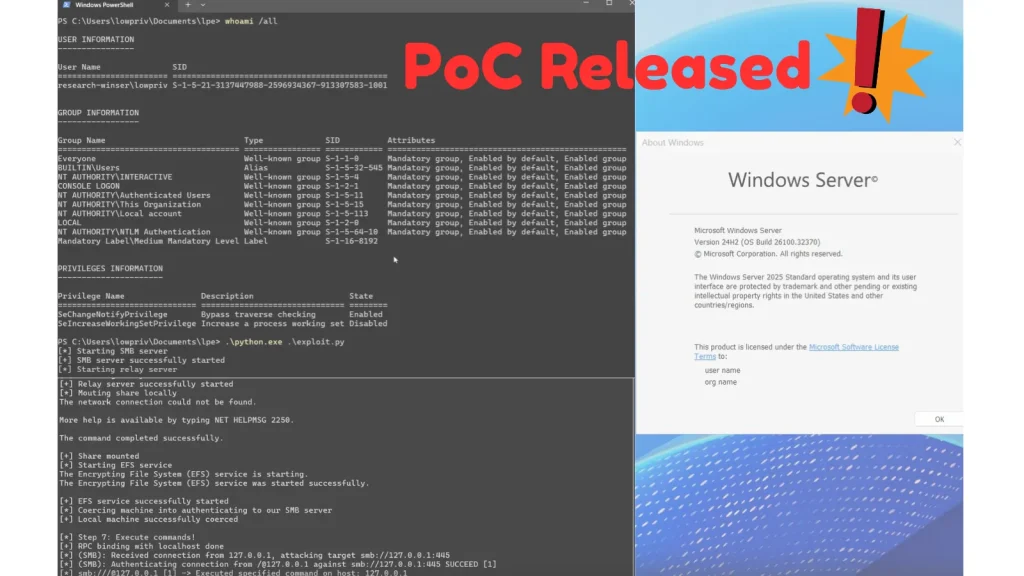
PoC Released for NTLM Reflection Bypass Flaw that Enables SYSTEM Access on Windows Server
The cybersecurity landscape has once again been rattled by the emergence of a new NTLM reflection bypass flaw, demonstrating the persistent challenge of securing Microsoft Windows Server environments. A working proof-of-concept (PoC) exploit has recently surfaced, allowing for SYSTEM-level access on Windows Server 2025. This development, tracked as CVE-2026-24294, underscores that even after previous high-profile NTLM reflection issues were addressed, fundamental design weaknesses can continue to be exploited.
This article delves into the implications of this new NTLM vulnerability, explaining how it operates and, critically, what organizations can do to protect their critical infrastructure.
Understanding NTLM Reflection Attacks
NTLM (NT LAN Manager) is an authentication protocol suite used in Microsoft operating systems. While it has largely been superseded by Kerberos in modern Active Directory environments, NTLM remains present for backward compatibility and in certain scenarios. NTLM reflection attacks exploit weaknesses in how NTLM handles authentication challenges. In essence, an attacker intercepts an NTLM authentication attempt, reflects it back to the victim (or another service), and tricks the victim into authenticating against a malicious service controlled by the attacker.
The previous, highly publicized NTLM reflection issue, CVE-2025-33073, highlighted the significant risks posed by such vulnerabilities. While a patch was released for CVE-2025-33073, the new CVE-2026-24294 demonstrates a bypass to these previous mitigations, achieving the same critical outcome: SYSTEM-level compromise.
CVE-2026-24294: The NTLM Reflection Bypass Explained
The newly identified vulnerability, CVE-2026-24294, operates as a reflection bypass. This means that existing hardening measures designed to prevent NTLM reflection are circumvented. The critical aspect of this flaw is its ability to grant SYSTEM-level access on Windows Server 2025. Achieving SYSTEM privileges is the ultimate goal for many attackers, as it grants full control over the compromised system, allowing for data exfiltration, lateral movement, and the deployment of further malicious payloads.
The release of a working PoC is particularly concerning. It democratizes the exploit, making it accessible to a wider range of threat actors, from financially motivated cybercriminals to advanced persistent threats (APTs). This significantly increases the immediate risk to organizations running vulnerable Windows Server 2025 instances.
Impact of SYSTEM-Level Access
When an attacker gains SYSTEM-level access through CVE-2026-24294, the ramifications are severe:
- Complete System Takeover: Attackers can execute arbitrary code, modify system configurations, install backdoors, and effectively own the server.
- Data Breach: All data stored on the compromised server becomes accessible, leading to potential data exfiltration and compliance violations.
- Lateral Movement: With SYSTEM privileges, attackers can leverage the compromised server as a foothold to move deeper into the network, potentially compromising an entire domain.
- Service Disruption: Malicious actors can disrupt critical services, leading to operational downtime and significant financial losses.
Remediation Actions
Given the severity of CVE-2026-24294, immediate action is paramount. While a specific patch for CVE-2026-24294 may still be pending from Microsoft, several proactive measures can significantly reduce exposure to NTLM reflection attacks in general:
- Enable Extended Protection for Authentication (EPA): EPA enhances the security of NTLM and Kerberos authentication by binding authentication credentials to specific channels. Ensure EPA is configured and enabled where applicable.
- Enforce SMB Signing: Requiring SMB signing (Server Message Block signing) prevents relay attacks on SMB traffic by verifying the integrity of communications. This is a critical defense mechanism.
- Disable NTLM entirely (where possible): For environments that strictly use Kerberos, consider disabling NTLM authentication altogether. This eliminates the attack surface completely.
- Implement Least Privilege: Ensure that services and applications run with the absolute minimum necessary privileges. This limits the blast radius should a service be compromised.
- Network Segmentation: Isolate critical servers and services with network segmentation to prevent lateral movement even if a server is breached.
- Regular Patching: Stay vigilant for Microsoft security updates. Apply all security patches promptly, especially those related to authentication and Windows Server components.
- Monitor Authentication Logs: Implement robust logging and monitoring for suspicious NTLM authentication attempts or failures, which could indicate an ongoing attack.
Detection and Assessment Tools
Organizations should leverage various tools to detect potential NTLM reflection vulnerabilities and monitor for related activity:
| Tool Name | Purpose | Link |
|---|---|---|
| Nmap (NSE Scripts) | Network discovery and vulnerability scanning, including NTLM related scripts. | https://nmap.org/ |
| Responder | LLMNR, NBT-NS, and mDNS poisoning, NTLM relay attacks tool. | https://github.com/lgandx/Responder |
| Impacket (ntlmrelayx.py) | Python collection for network protocols, including NTLM relay capabilities for testing. | https://github.com/SecureAuthCorp/impacket |
| Wireshark | Network protocol analyzer for deep inspection of NTLM traffic. | https://www.wireshark.org/ |
| Microsoft Baseline Security Analyzer (MBSA) (Deprecated) / PowerShell scripts | Historically, MBSA checked for security configurations. Modern configurations often require custom PowerShell scripts to check NTLM settings. | N/A (for MBSA); PowerShell is built into Windows. |
Conclusion
The release of a PoC for CVE-2026-24294, an NTLM reflection bypass flaw granting SYSTEM access on Windows Server 2025, is a serious reminder of the ongoing challenges in securing enterprise environments. While Microsoft continues to harden its authentication mechanisms, fundamental design elements can still present avenues for exploitation. Organizations must prioritize applying recommended mitigations, maintaining robust monitoring, and staying informed about the latest threat intelligence to defend against these sophisticated attacks. Proactive defense and a multi-layered security approach are essential to protect critical Windows Server infrastructure from compromise.




