
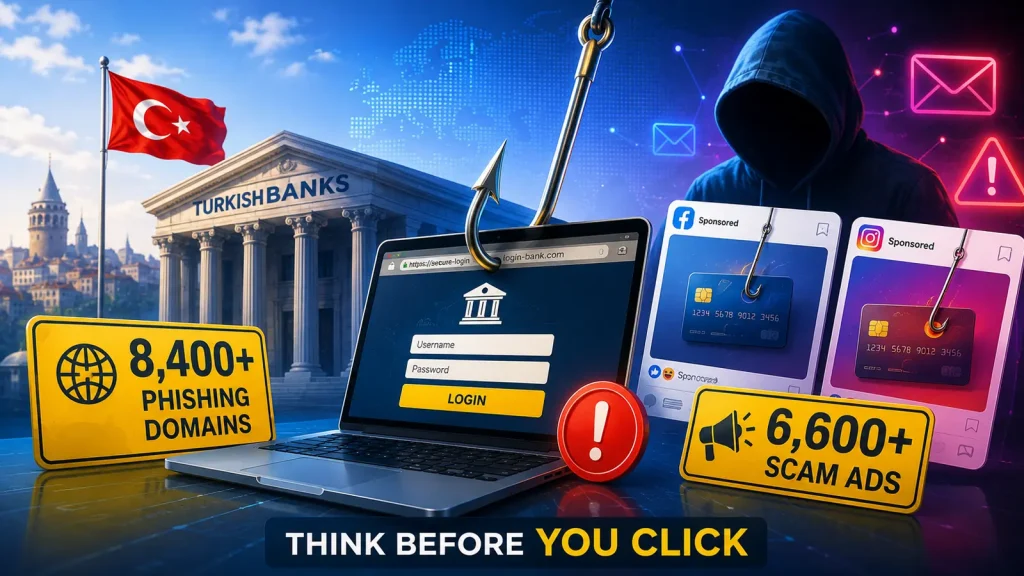
Turkish Banks Targeted by 8,400 Phishing Domains and 6,600 Social Media Scam Ads
Unprecedented Phishing Onslaught: Turkish Banks Under Siege by 8,400 Malicious Domains and 6,600 Social Media Scams
The digital financial landscape is a constant battleground, and recent intelligence reveals a formidable and highly organized threat targeting customers of Turkish banks. A massive fraud campaign, characterized by an astonishing 8,400 phishing domains and an additional 6,600 fraudulent social media advertisements, is actively exploiting trusted financial brands to deceive users. This coordinated effort aims to steal credentials, promote fake loan offers, and execute various scams designed for rapid financial gain, underscoring the sophisticated and large-scale tactics employed by today’s cybercriminals.
Anatomy of a Large-Scale Financial Fraud Campaign
This operation stands out not just for its breadth but also for its rapid deployment, indicating a well-resourced and agile threat actor. The primary objective is clear: leverage the trust associated with established Turkish banking institutions to illicitly acquire sensitive customer information and funds. The scale of this attack necessitates a deep dive into the mechanisms used and the implications for both financial institutions and their customers.
Phishing Domains: The Digital Bait
The core of this attack vector lies in the deployment of thousands of phishing domains. These domains are meticulously crafted to mimic legitimate banking websites, often incorporating subtle misspellings or alternative top-level domains (TLDs) to fool unsuspecting users. Once a user lands on one of these fraudulent sites, they are typically prompted to enter personal banking details, including usernames, passwords, and multi-factor authentication codes. These harvested credentials are then swiftly used to gain unauthorized access to authentic bank accounts, leading to direct financial losses for victims.
- Credential Theft: The most straightforward and common outcome, where users unknowingly surrender their login details.
- Fake Loan Offers: Scammers entice users with incredibly attractive loan terms, demanding upfront “processing fees” or “insurance payments” that are never returned.
- Malware Distribution: While not explicitly mentioned in this context, phishing sites are frequently used as conduits for distributing malware, leading to further compromise of user devices.
Social Media Scams: Amplifying the Reach
Complementing the vast network of phishing domains are thousands of fraudulent advertisements disseminated across popular social media platforms. These ads often leverage emotional triggers, such as urgent financial needs or exclusive high-return investment opportunities, to lure victims. By posing as official bank accounts or legitimate financial advisors, these scams spread rapidly through user feeds, directing victims to the aforementioned phishing domains or engaging them in direct messaging scams.
- Impersonation: Scammers create fake social media profiles or ad campaigns that closely resemble those of legitimate banks, building a false sense of trust.
- Urgency and Scarcity: Ads often create a false sense of urgency, pressuring users to act quickly before an “opportunity” expires.
- Targeted Demographics: Scammers may use publicly available information or sophisticated profiling techniques to target individuals more susceptible to specific financial lures.
Remediation Actions and Protective Measures
Addressing such a widespread and dynamic threat requires a multi-faceted approach involving financial institutions, cybersecurity professionals, and individual users. Proactive defense and rapid response are paramount.
- For Financial Institutions:
- Proactive Domain Monitoring: Continuously scan for newly registered domains that bear similarity to official banking domains or trademarks. Implement automated takedown requests for identified phishing sites.
- Enhanced Anomaly Detection: Utilize advanced behavioral analytics and AI-driven systems to detect unusual login patterns or transaction anomalies that might indicate compromised credentials.
- User Education Campaigns: Regularly educate customers on identifying phishing attempts, safe browsing practices, and verified communication channels. Emphasize never clicking on suspicious links or sharing credentials.
- Social Media Monitoring: Actively monitor social media platforms for fraudulent advertisements and impersonating accounts, initiating immediate reporting and takedown procedures.
- Implement DMARC, DKIM, and SPF: Strengthen email authentication protocols to prevent email spoofing, making it harder for attackers to send phishing emails disguised as coming from the bank.
</ul >
- For Users:
- Verify URLs: Always double-check the URL before entering any sensitive information. Look for “https://” and the padlock icon, but remain vigilant for subtle misspellings.
- Be Skeptical of Unsolicited Communications: Approach emails, SMS messages, or social media messages asking for personal financial information with extreme caution, even if they appear to be from your bank.
- Use Multi-Factor Authentication (MFA): Enable MFA on all banking and financial accounts. This adds a critical layer of security, even if your password is compromised.
- Report Suspected Phishing: Report any suspicious emails, websites, or social media ads to your bank immediately. Many banks have dedicated channels for fraud reporting.
- Avoid Clicking Suspicious Links: Instead of clicking links in emails or social media ads, navigate directly to your bank’s official website by typing the URL into your browser.
- Regularly Monitor Account Statements: Review bank and credit card statements frequently for unauthorized transactions.
The Ongoing Battle Against Financial Cybercrime
The sheer volume of phishing domains and social media scam ads targeting Turkish banks highlights the relentless nature of financial cybercrime. While no CVE numbers are directly associated with this type of broad social engineering campaign (as it exploits human vulnerabilities rather than software flaws like CVE-2023-38831), its impact on user trust and financial security is undeniable. Security teams and individuals must remain vigilant, adopting robust security practices and fostering continuous education to mitigate the risks posed by these sophisticated attacks. The proactive identification and swift neutralization of such campaigns are crucial for safeguarding the integrity of digital banking and protecting consumers from financial fraud.




