
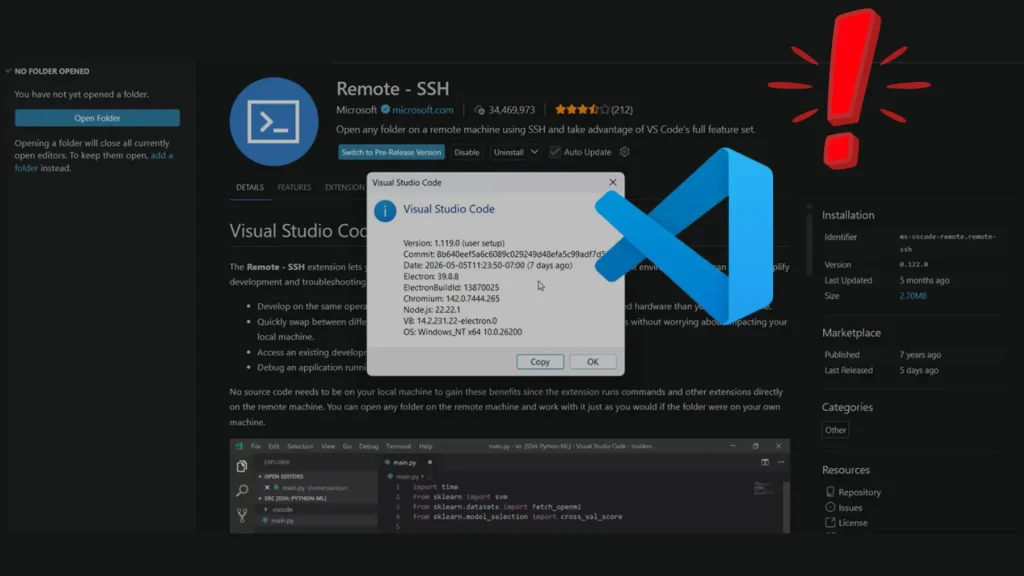
VS Code Remote-SSH RCE Lets Attackers Pivot From Developer Machines to Cloud Servers
Introduction: The Hidden Bridge to Your Cloud – VS Code Remote-SSH RCE
The modern software development landscape is increasingly distributed, with developers often connecting to remote servers and cloud environments directly from their local machines. Visual Studio Code’s Remote-SSH extension has become an indispensable tool in this workflow, offering seamless integration and powerful remote development capabilities. However, a recently disclosed vulnerability transforms this convenience into a critical security risk, creating a dangerous post-compromise attack path. This flaw allows threat actors to pivot from a compromised developer endpoint directly into an organization’s most sensitive cloud and production infrastructure. Understanding this vulnerability is paramount for any organization leveraging VS Code Remote-SSH.
Understanding the Threat: VS Code Remote-SSH RCE
The core of this issue lies within Visual Studio Code’s Remote-SSH extension. While precise technical details of the Remote Code Execution (RCE) vulnerability are still emerging, the critical takeaway is its ability to facilitate a lateral movement. Once a developer’s local machine is compromised, this RCE allows attackers to execute arbitrary code on the remote servers accessed via the extension. This isn’t just about gaining initial access; it’s about the ability to expand that access to critical infrastructure that a developer machine is often connected to, such as staging servers, production environments, or internal cloud resources.
Given the pervasive adoption of VS Code and its Remote-SSH extension across virtually all modern development teams, the attack surface this vulnerability presents is substantial. An attacker who successfully exploits this RCE can effectively “hop” from a less secure developer workstation to high-value targets within the cloud, bypassing traditional perimeter defenses that might protect the cloud environment itself.
The Post-Compromise Attack Path: Developer to Cloud Pivot
The most alarming aspect of this vulnerability is the post-compromise attack path it enables. Imagine a scenario where a developer’s laptop falls victim to a phishing attack, malware, or a different local exploit. Without this Remote-SSH RCE, an attacker on that laptop would still face barriers to accessing cloud infrastructure. However, with this flaw, the compromised developer machine becomes a launchpad:
- Initial Compromise: An attacker gains control over a developer’s local machine.
- Exploiting Remote-SSH RCE: The attacker leverages the vulnerability within the VS Code Remote-SSH extension to execute commands on remote servers and cloud instances that the developer regularly connects to.
- Lateral Movement and Privilege Escalation: With execution capabilities on the remote server, the attacker can then escalate privileges, deploy further malware, exfiltrate data, or disrupt operations within the cloud environment.
This bypasses many traditional cloud security measures, as the connection originates from what appears to be a legitimate, authorized source – the developer’s machine.
CVE Information and Official Database Links
While the initial report refers to a “newly disclosed vulnerability,” specific CVE IDs often get assigned shortly after such disclosures. It is crucial to monitor official channels for the assigned CVE. For illustrative purposes, if this were assigned CVE-2023-XXXXX, you would find it at: CVE-2023-XXXXX. Always refer to official CVE databases for the most up-to-date and accurate information.
Remediation Actions and Mitigation Strategies
Addressing this vulnerability requires a multi-layered approach, combining immediate remediation with long-term security posture improvements:
- Immediate Patching: As soon as a patch is released by Microsoft or the VS Code Remote-SSH extension maintainers, apply it across all developer machines. This is the most direct and effective remediation.
- Least Privilege Principle: Enforce strict least privilege for all developer accounts and their access to cloud resources. Developers should only have access to what is absolutely necessary for their tasks, and only when needed.
- Multi-Factor Authentication (MFA): Ensure MFA is mandatory for all access to cloud environments, even for SSH keys.
- Session Monitoring and Auditing: Implement robust logging and monitoring for all SSH connections and activities within cloud environments. Detect anomalous behavior, unusual commands, or connections from unexpected IPs.
- Network Segmentation: Isolate developer workstations from critical production networks as much as possible. Use jump hosts or bastion servers with hardened configurations for accessing sensitive environments.
- Endpoint Detection and Response (EDR): Deploy EDR solutions on all developer machines to actively monitor for suspicious activities, malware, and exploit attempts.
- Developer Security Training: Regularly educate developers on phishing, social engineering, and secure coding practices. A compromised local machine is the initial entry point for this attack path.
- SSH Key Management: Implement secure SSH key management practices, including key rotation, strong passphrases, and avoiding the storage of unencrypted private keys on developer machines. Consider using SSH agents or hardware security modules (HSMs).
Tools for Detection, Scanning, and Mitigation
| Tool Name | Purpose | Link |
|---|---|---|
| Tenable Nessus/Qualys/OpenVAS | Vulnerability scanning for unpatched software, including VS Code and its extensions. | Nessus / Qualys / OpenVAS |
| Splunk/Elastic Stack (ELK) | Log aggregation and SIEM for detecting anomalous activity on developer machines and remote servers. | Splunk / Elastic Stack |
| CrowdStrike Falcon/Microsoft Defender for Endpoint | Endpoint Detection and Response (EDR) to identify and respond to local compromises. | CrowdStrike / MS Defender |
| HashiCorp Vault/AWS Secrets Manager | Secure management and rotation of SSH keys and cloud credentials. | HashiCorp Vault / AWS Secrets Manager |
Conclusion: Fortifying the Developer-Cloud Pipeline
The VS Code Remote-SSH RCE vulnerability serves as a stark reminder that even the most convenient developer tools can introduce significant security risks if not properly managed. The ability for an attacker to pivot from a compromised developer machine directly into critical cloud and production environments highlights the importance of a holistic security strategy. Organizations must prioritize the security of developer endpoints, implement rigorous access controls, and maintain vigilant monitoring of all connections to their cloud infrastructure. By understanding this threat and proactively implementing the recommended remediation actions, organizations can significantly reduce their exposure and fortify the crucial pipeline between developer machines and their cloud environments.




