
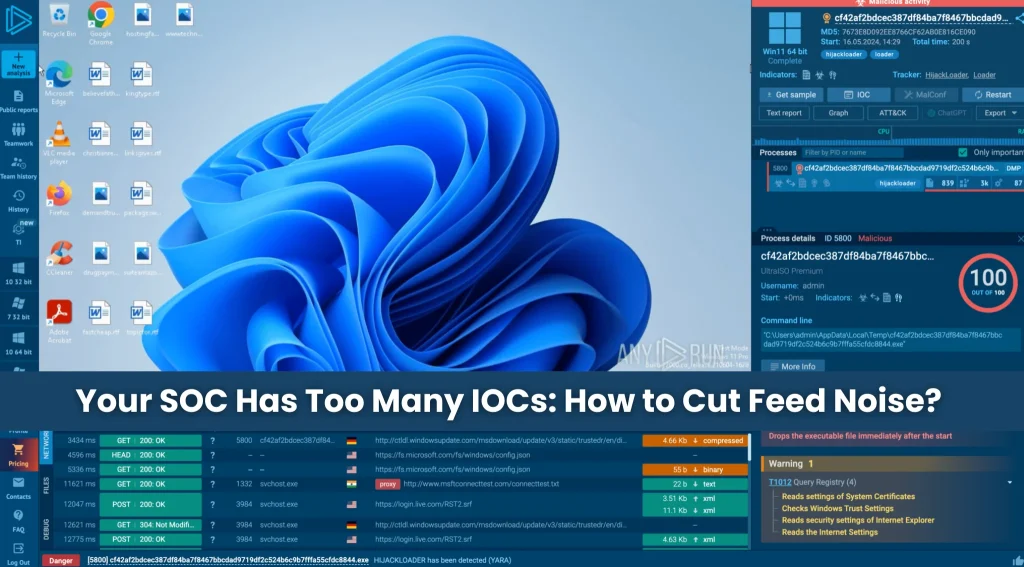
Your SOC Has Too Many IOCs: How to Cut Feed Noise, Prioritize What Matters, and Improve Response
The Deluge of IOCs: When More Becomes Less in Your SOC
Many Security Operations Centers (SOCs) operate under a flawed premise: that more Indicators of Compromise (IOCs) equate to better security. We often see procurement decisions justified by “coverage” metrics, and dashboards proudly displaying IOC counts in the millions. Feeds delivering two million indicators monthly are lauded over those with a mere two hundred thousand. But what if this conventional wisdom is actually hindering your incident response and overwhelming your security analysts?
The reality is that an overwhelming volume of IOCs can create significant “feed noise,” burying critical threats under a mountain of irrelevant data. This leads to alert fatigue, missed detections, and an inefficient security posture. This post will explore why your SOC might have too many IOCs, how to cut through the feed noise, prioritize what truly matters, and ultimately improve your overall security operations.
The Illusion of Coverage: Quantity Over Quality
The problem stems from how many organizations measure threat intelligence. It’s often treated like storage – bigger is better. Vendors aggressively market the sheer volume of indicators their feeds provide, and organizations, in turn, use these figures to justify their investments. However, a high volume of IOCs doesn’t automatically translate to effective threat detection or a stronger security posture.
Consider a scenario where your threat intelligence platform ingests millions of IOCs daily. If a significant portion of these indicators are stale, generic, or irrelevant to your specific threat landscape, your security analysts spend valuable time sifting through false positives and low-priority alerts. This dilutes their focus, slows down response times, and can even lead to legitimate threats being overlooked amidst the constant barrage of notifications.
Understanding Feed Noise and Its Impact
Feed noise refers to the excess of irrelevant or low-fidelity indicators that flood your SOC. This noise can manifest in several ways:
- Stale IOCs: Indicators that are no longer active or have been remediated, yet remain in your threat intelligence feed.
- Generic IOCs: Broad indicators that apply to a vast number of benign activities, leading to high false positive rates.
- Irrelevant IOCs: Indicators for threats that do not apply to your organization’s specific industry, technology stack, or geographical region.
- Duplicate IOCs: The same indicator appearing across multiple feeds, unnecessarily inflating counts.
The impact of this feed noise is substantial:
- Analyst Burnout: Constant exposure to false positives and low-priority alerts leads to fatigue and demotivation among security analysts.
- Delayed Response: Sifting through noise consumes time that could be spent on legitimate incidents, increasing mean time to detect (MTTD) and mean time to respond (MTTR).
- Resource Strain: Storing and processing massive volumes of IOCs requires significant compute and storage resources, increasing operational costs.
- Missed Detections: The sheer volume of alerts can desensitize analysts, making them more likely to overlook critical indicators of actual compromise.
Strategies to Cut Feed Noise and Prioritize Effectively
To move beyond the “more is better” mentality, SOCs need to implement strategies that focus on quality over quantity. This involves a multi-faceted approach to threat intelligence management.
1. Define Your Threat Profile and Context
Before ingesting any threat intelligence, understand what threats are genuinely relevant to your organization. Conduct a thorough risk assessment, identify your critical assets, and understand the geopolitical and industry-specific threats you face. For instance, if your organization doesn’t use a particular software, indicators related to a vulnerability like CVE-2023-XXXXX (placeholder) affecting that software are likely irrelevant.
2. Curate Your Threat Intelligence Feeds
Don’t ingest every IOC from every available feed. Be selective. Evaluate feeds based on:
- Relevance: Does the feed align with your defined threat profile?
- Timeliness: How quickly are new and relevant indicators propagated?
- Accuracy: What is the historical false positive rate?
- Source Reputation: Is the provider reputable and trusted?
Consider using commercial threat intelligence platforms that offer curated feeds tailored to specific industries or attack types.
3. Implement Automation and Orchestration
Leverage Security Orchestration, Automation, and Response (SOAR) platforms to automate the processing and enrichment of IOCs. This can involve:
- Automated Deduplication: Eliminate redundant indicators across feeds.
- Contextual Enrichment: Automatically pull additional context from external sources (e.g., WHOIS, VirusTotal, Shodan) for each IOC.
- Automated Triage: Develop playbooks to automatically prioritize or discard IOCs based on predefined rules and risk scores.
4. Establish a Robust IOC Lifecycle Management
IOCs have a shelf life. Implement processes to regularly review and retire stale indicators. This could involve:
- Time-Based Expiration: Automatically expire IOCs after a certain period if they haven’t been observed or linked to active threats.
- Threat Hunting Feedback: Use insights from threat hunting activities to refine your IOC sets and remove ineffective indicators.
- Analyst Feedback: Empower analysts to flag and remove noisy or irrelevant IOCs directly.
5. Integrate with Internal Telemetry and Systems
The true value of an IOC comes from its context within your environment. Integrate your threat intelligence platform with your SIEM, EDR, and other security tools. This allows you to:
- Correlate IOCs: Check if an incoming IOC has been observed within your network.
- Prioritize Based on Internal Impact: An IOC for a widespread attack might be low priority if your systems aren’t vulnerable, but highly critical if it targets a specific configuration you use.
- Validate IOCs: Use internal logs to confirm if an IOC truly represents malicious activity within your environment.
6. Focus on High-Fidelity IOCs and Behavioral Indicators
Shift focus from merely consuming raw, atomic IOCs (IP addresses, domains, hashes) to prioritizing higher-fidelity indicators and behavioral patterns. While fundamental IOCs are important, behavioral indicators are often more resilient to attacker changes and provide a clearer picture of intent.
- Tactics, Techniques, and Procedures (TTPs): Align your threat intelligence with frameworks like MITRE ATT&CK to understand attacker methodologies. This allows for detection based on how attackers operate, rather than just what tools they use.
- Threat Actor Profiles: Understand the specific threat actors targeting your industry and their common attack patterns.
Remediation Actions: Improving Your SOC’s IOC Effectiveness
To improve your SOC’s handling of IOCs and boost response capabilities, consider these actionable steps:
- Conduct a Threat Intelligence Audit: Regularly review your current threat intelligence sources, their efficacy, and relevance to your organization. Eliminate underperforming or redundant feeds.
- Implement a Threat Intelligence Platform (TIP): If not already in place, invest in a robust TIP that can automate ingestion, enrichment, deduplication, and integration with other security tools.
- Develop Clear Prioritization Frameworks: Create logic and rules within your SIEM or SOAR to assign risk scores to IOCs based on criticality of affected assets, observed frequency, and external context.
- Train Your Analysts: Equip your security analysts with the skills to critically evaluate IOCs, understand their context, and effectively use threat intelligence platforms.
- Establish a Feedback Loop: Ensure there’s a clear mechanism for analysts to report on the accuracy and usefulness of IOCs, feeding this information back into your threat intelligence operations.
| Tool Name | Purpose | Link |
|---|---|---|
| MISP (Malware Information Sharing Platform) | Open-source threat intelligence platform for sharing, storing, and correlating indicators of compromise. | https://www.misp-project.org/ |
| VirusTotal | Aggregates many antivirus products and online scan engines to check for malware and malicious URLs. | https://www.virustotal.com/ |
| ThreatConnect | Commercial Threat Intelligence Platform (TIP) for threat intelligence management, analysis, and automation. | https://threatconnect.com/ |
| Anomali ThreatStream | Enterprise TIP for ingesting, enriching, and operationalizing threat intelligence. |
https://www.anomali.com/products/threatstream |
| Recorded Future | Commercial real-time threat intelligence service leveraging machine learning and human analysis. | https://www.recordedfuture.com/ |
Conclusion: Quality Over Quantity for a Resilient SOC
The notion that “bigger is better” when it comes to Indicators of Compromise is a dangerous misconception that can cripple your SOC’s effectiveness. By prioritizing quality over quantity, intelligently curating your threat feeds, leveraging automation, and focusing on contextual relevance, your organization can significantly reduce feed noise. This strategic shift will empower your security analysts, accelerate incident response, and ultimately build a more resilient and proactive security posture. A refined approach to threat intelligence is not just about managing data; it’s about making every indicator count.




