
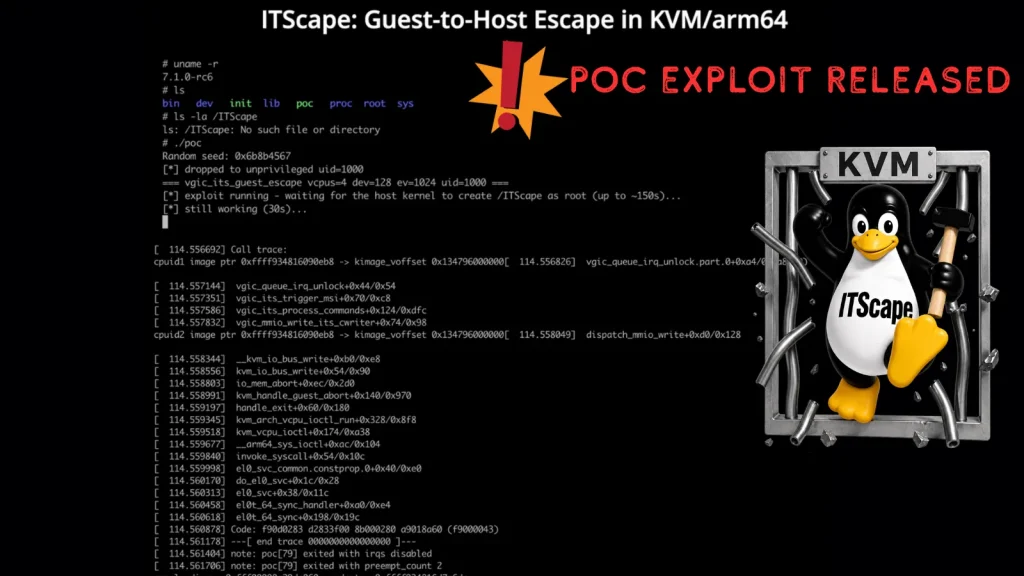
PoC Exploit Released for Guest-to-Host Escape Linux Kernel Vulnerability
Unmasking ITScape: PoC Exploit for Linux Kernel Guest-to-Host Escape Surfaces
The cybersecurity landscape has just been rattled by the public release of a Proof-of-Concept (PoC) exploit for a critical Linux kernel vulnerability, identified as CVE-2026-46316. Dubbed “ITScape,” this flaw presents a significant threat, enabling a guest-to-host escape within KVM environments on arm64 systems. For organizations relying on virtualized infrastructure, this vulnerability represents a nightmare scenario: an attacker breaching the isolation of a virtual machine to compromise the underlying host system with full kernel-level privileges.
This development underscores the relentless innovation of both security researchers and potential adversaries. While the discovery of such vulnerabilities is crucial for improving system security, the public availability of exploit code immediately elevates the risk, necessitating swift action from system administrators and security teams worldwide.
Understanding ITScape: The Guest-to-Host Escape Mechanism
ITScape specifically targets KVM (Kernel-based Virtual Machine) environments running on arm64 architectures. The core danger lies in its ability to facilitate a “guest-to-host escape.” In typical virtualization setups, guest virtual machines are designed to be isolated from the host operating system. This isolation is a fundamental security boundary, preventing malicious activity within a VM from affecting the host or other VMs.
However, ITScape shatters this boundary. An attacker who has achieved code execution within a vulnerable guest VM can leverage this exploit to break free from the virtualized environment. Once on the host, they can execute arbitrary commands with the highest level of privilege—kernel-level. This means complete control over the host system, including access to other virtual machines, sensitive data, and the ability to establish persistent backdoors.
The vulnerability’s impact is further amplified by its target architecture: arm64. As arm64 processors become increasingly prevalent in server environments, cloud infrastructure, and edge computing, a flaw of this nature poses a broad and evolving risk.
The Criticality of PoC Release
The release of a PoC exploit fundamentally changes the threat landscape. Before a PoC, a vulnerability might be theoretical or complex to exploit, limiting its practical abuse to highly sophisticated actors. With a publicly available PoC, the barrier to entry for exploitation drops significantly. Even less-skilled attackers can potentially adapt and deploy the exploit, increasing the likelihood of widespread attacks.
For system administrators, this signals an immediate need for awareness and action. The time between a PoC release and actual attacks can be very short. Therefore, understanding the vulnerability, identifying affected systems, and implementing remediation strategies becomes paramount.
Remediation Actions
Addressing the ITScape vulnerability requires a proactive and systematic approach. Given the severity of a guest-to-host escape, immediate action is crucial:
- Patching and Updates: The most critical step is to apply all available security patches and kernel updates from your Linux distribution vendor as soon as they are released. Monitor official security advisories closely for patches specifically addressing CVE-2026-46316.
- Isolate Critical Workloads: If immediate patching isn’t feasible, consider isolating highly sensitive or critical virtual machines onto host systems that are not currently exposed to untrusted guest environments, or applying additional network segmentation.
- Strengthen Guest VM Security: While the exploit originates from the guest, robust security within guest VMs (e.g., strong access controls, minimal software installations, regular patching of guest OS) can reduce the likelihood of an initial compromise that an attacker would need to then leverage ITScape.
- Monitor KVM Environments: Implement enhanced logging and monitoring specifically for your KVM host systems. Look for anomalous activity, unexpected process executions, or unusual resource utilization that could indicate a compromise or attempted exploitation.
- Network Segmentation: Ensure strict network segmentation between your host infrastructure and guest networks, and between different guest networks themselves. This can help contain the lateral movement of an attacker even if an escape occurs.
- Regular Audits and Penetration Testing: Conduct regular security audits and penetration tests of your virtualized environments, specifically including attempts to test guest-to-host escape scenarios.
Tools for Detection and Mitigation
While direct detection of the exploit in progress might be challenging without specific signatures, several security tools and practices can aid in overall security posture and post-exploitation detection:
| Tool Name | Purpose | Link |
|---|---|---|
| Linux Kernel Live Patching Solutions | Apply kernel security fixes without requiring a reboot, crucial for critical infrastructure. | Kernel.org Livepatch (and vendor-specific solutions like Ksplice for Oracle Linux, Livepatch for Ubuntu) |
| Security Information and Event Management (SIEM) Systems | Consolidate and analyze logs from hosts and guests to detect anomalies and potential compromise indicators. | (e.g., Splunk, ELK Stack, QRadar) |
| Intrusion Detection/Prevention Systems (IDS/IPS) | Monitor network traffic for suspicious patterns, including potential command and control (C2) activity post-exploitation. | (e.g., Snort, Suricata) |
| Vulnerability Scanners | Identify unpatched systems and software versions, though specific ITScape scanning might require an updated signature. | (e.g., Nessus, OpenVAS, Qualys) |
| Host-based Intrusion Detection Systems (HIDS) | Monitor host system calls, file integrity, and process activity for signs of compromise, including unusual kernel-level operations. | (e.g., OSSEC, Wazuh) |
Conclusion
The release of a PoC exploit for CVE-2026-46316, known as ITScape, represents an immediate and tangible threat to KVM environments running on arm64 Linux systems. A guest-to-host escape vulnerability with kernel-level privileges is among the most severe that can affect virtualized infrastructure. Organizations must prioritize applying security patches, enhancing their monitoring capabilities, and thoroughly reviewing their virtualization security posture. Vigilance and rapid response are paramount to defending against this critical vulnerability and maintaining the integrity of virtualized environments.




