New MessiahGPT AI Model Fueling Automated Ransomware and Phishing Attacks
The Rise of MessiahGPT: A New Era of Automated Cybercrime
The cybersecurity landscape is undergoing a significant and alarming transformation. A new service, ominously named MessiahGPT, is actively being marketed on underground forums like BreachForums, signaling a dangerous evolution in how cybercriminals operate. This platform is not merely a tool; it’s an uncensored AI service designed to democratize the creation of sophisticated cyberattack components, from ransomware to advanced social engineering content. Trellix researchers have highlighted MessiahGPT as a prime example of a burgeoning underground economy that offers powerful offensive AI capabilities as an easily accessible, cheap subscription service.
What is MessiahGPT and Why is it Dangerous?
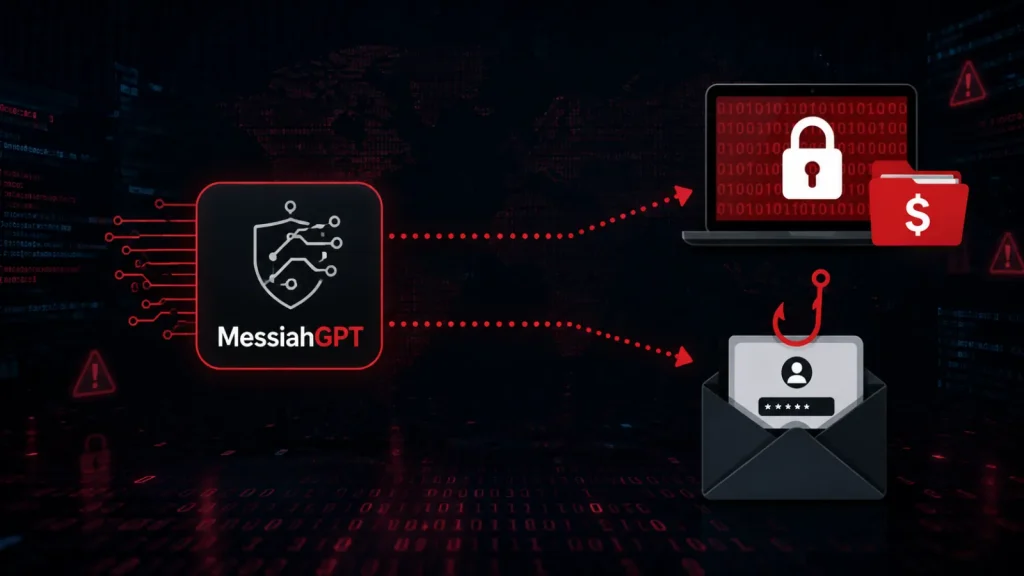
MessiahGPT is advertised as an AI model specifically built without ethical constraints or safety guardrails. Unlike publicly available large language models (LLMs) that typically refuse malicious requests, MessiahGPT’s core purpose is to facilitate cybercrime. Its capabilities reportedly include generating:
- Ransomware variants
- Phishing kits and spear-phishing content
- Information stealers
- Crypters to evade detection
- Rootkits for deep system compromise
- Highly convincing social engineering content
This “uncensored” nature is MessiahGPT’s primary selling point for criminals. It bypasses the ethical programming of legitimate AI, enabling even novice threat actors to craft highly effective and polymorphic attack vectors with unprecedented speed and scale. This significantly lowers the barrier to entry for cybercrime, potentially leading to a surge in automated and personalized attacks.
The Automation of Cyberattack Development
The emergence of services like MessiahGPT represents a critical shift. Traditionally, developing advanced malware or sophisticated phishing campaigns required specialized technical skills and significant time investment. MessiahGPT automates much of this process, providing criminals with an “AI-as-a-service” model for offensive operations. This automation allows for:
- Increased Attack Volume: Threat actors can generate a greater number of unique attack payloads and phishing emails simultaneously.
- Enhanced Evasion: AI can rapidly generate novel malware code, making it harder for signature-based detection systems to identify.
- Hyper-Personalized Phishing: AI-generated social engineering content can be tailored with remarkable precision, increasing the likelihood of successful breaches.
- Reduced Development Costs: A subscription model makes sophisticated tools accessible to a wider range of malicious actors, including those with limited resources.
Implications for Cybersecurity Defenses
The proliferation of AI-driven attack tools necessitates a re-evaluation of current cybersecurity strategies. Organizations must recognize that traditional defenses may be insufficient against AI-generated threats. The sheer volume and adaptability of attacks powered by MessiahGPT-like services demand a more proactive and adaptive defense posture.
Remediation Actions and Proactive Defense Strategies
Defending against AI-fueled cyber threats requires a multi-layered approach focusing on prevention, detection, and rapid response. Organizations should prioritize the following actions:
- Employee Training and Awareness: Intensify training on phishing, social engineering, and recognizing advanced threats. Emphasize verification procedures for suspicious communications, regardless of how legitimate they appear.
- Advanced Email Security Gateways: Implement and continuously update email security solutions with AI-driven threat detection, sandboxing, and URL rewriting capabilities to identify and block sophisticated phishing attempts.
- Endpoint Detection and Response (EDR) / Extended Detection and Response (XDR): Deploy EDR/XDR solutions that leverage behavioral analytics and machine learning to detect anomalous activities and emerging threats that signature-based antivirus might miss.
- Network Segmentation and Zero Trust Architecture: Limit the lateral movement of threats within the network through robust segmentation. Implement Zero Trust principles, verifying every user and device before granting access to resources.
- Patch Management and Vulnerability Scanning: Maintain a rigorous patch management schedule to address known vulnerabilities promptly. Regular vulnerability scanning and penetration testing are crucial to identify and remediate weaknesses before attackers exploit them. (See CVE-2023-XXXX for examples of critical vulnerabilities frequently exploited).
- Multi-Factor Authentication (MFA): Enforce MFA across all systems and services to significantly reduce the risk of account compromise, even if credentials are stolen through phishing.
- Threat Intelligence Integration: Subscribe to and integrate high-quality threat intelligence feeds to stay informed about emerging attack methodologies, indicators of compromise (IoCs), and the activities of criminal AI services.
- Incident Response Plan Review: Regularly review and update your incident response plan to account for AI-powered attacks, ensuring rapid containment and recovery.
The Future of Cyber Warfare: A Constant Evolution
The emergence of MessiahGPT underscores a critical truth: the battle between cyber attackers and defenders is an arms race fueled by technological advancement. As AI becomes more sophisticated, so too will the methods employed by malicious actors. Staying ahead requires vigilance, continuous adaptation, and a proactive investment in advanced security measures. Ignoring these developments risks leaving organizations vulnerable to an increasingly automated and potent threat landscape.