
CRLF-Powered Desync Lets Attackers Poison CDN Cache and Serve XSS to Live Users
Unmasking CRLF-Powered Desync: A Critical Threat to CDN Caches and User Security
In the intricate landscape of web infrastructure, a seemingly minor flaw can cascade into a catastrophic security breach. This is precisely the case with a sophisticated attack vector known as CRLF-Powered Desync. What begins as a limited CRLF injection vulnerability can be escalated to poison Content Delivery Network (CDN) caches, ultimately serving malicious cross-site scripting (XSS) payloads to unsuspecting live users. This article delves into the mechanics of this critical desynchronization attack, its potential impact, and crucial remediation strategies.
Understanding CRLF Injection and HTTP Desynchronization
At its core, the CRLF-Powered Desync attack hinges on the improper handling of encoded carriage return (%0d) and line feed (%0a) characters. These characters, traditionally used to signify new lines in HTTP messages, become potent weapons when an application fails to sanitize them correctly. A successful injection allows an attacker to insert arbitrary HTTP headers or even entire request bodies into a web server’s interpretation of a user’s request.
This manipulation creates a state of HTTP desynchronization. Imagine a web proxy or CDN sitting between a user and the origin server. When a CRLF injection occurs, the proxy and the origin server can interpret the boundaries of an HTTP request differently. The proxy might see one request, while the origin server processes what it believes to be multiple, malformed requests. This discrepancy is the foundation of many powerful web attacks, including request smuggling and, in this specific case, cache poisoning.
The Escalation: From CRLF to Cache Poisoning and XSS
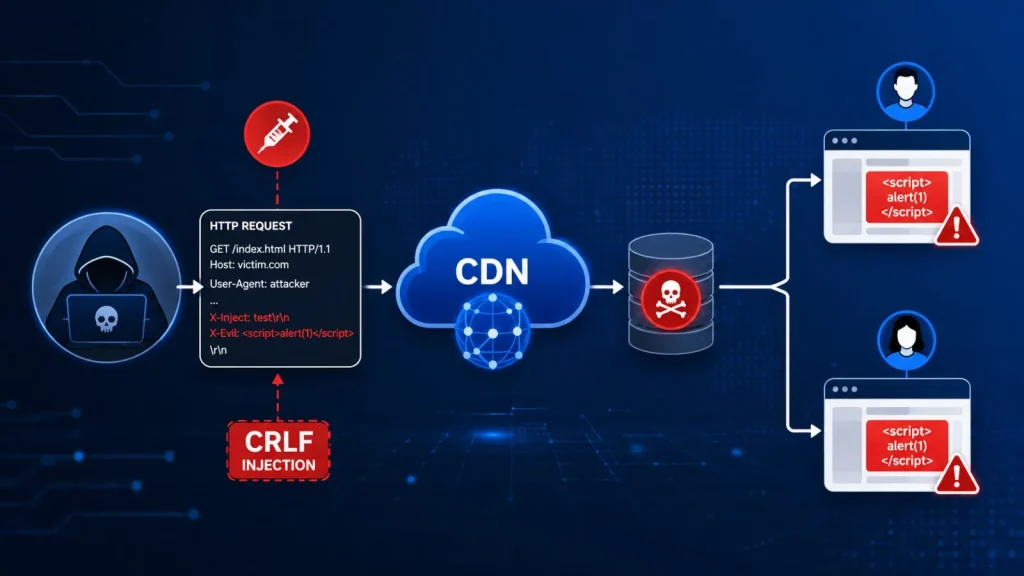
The severity of CRLF-Powered Desync escalates dramatically when it targets CDNs. CDNs are designed to cache static and sometimes dynamic content to improve website performance and reduce load on origin servers. When an attacker successfully desynchronizes the proxy (e.g., CDN) and the origin server, they can trick the CDN into caching a malicious response. Here’s a simplified breakdown:
- An attacker sends a specially crafted request containing CRLF injection.
- The CDN processes part of the request, but due to the desynchronization, the origin server interprets a different, potentially shorter or truncated request.
- The origin server responds to its interpretation of the request.
- The attacker then injects a second, malicious request using the remaining unparsed bytes of the original request, which the CDN (still desynchronized) associates with the legitimate URL.
- The CDN caches this malicious response, often containing an XSS payload.
- Subsequent legitimate users requesting the same resource from the CDN are served the poisoned, XSS-laden content, leading to compromised sessions, data theft, or website defacement.
This attack vector is particularly insidious because it targets the very infrastructure designed to enhance user experience and availability. The XSS payloads are delivered directly from a trusted CDN, making detection and mitigation challenging for end-users.
Remediation Actions
Mitigating CRLF-Powered Desync requires a multi-layered approach, addressing both application-level vulnerabilities and infrastructure configurations:
- Input Validation and Sanitization: Implement stringent input validation on all user-supplied data, specifically filtering or encoding carriage return (
%0d) and line feed (%0a) characters. This is the first and most critical line of defense. - Consistent HTTP Parsing: Ensure that all components in your web stack (proxies, load balancers, CDNs, web servers) utilize consistent HTTP parsing logic. Regularly update and patch these components to address known parsing discrepancies.
- Front-end and Back-end Configuration Alignment: Standardize HTTP header processing across your infrastructure. For instance, if using
Content-Lengthheaders, ensure all components respect them uniformly. - Disable Unnecessary Features: Review and disable any HTTP features or headers that are not strictly necessary for your application’s functionality, especially those that might be prone to interpretation differences.
- Regular Security Audits: Conduct frequent penetration testing and security audits that specifically look for HTTP desynchronization vulnerabilities and CRLF injection points.
- Implement Web Application Firewalls (WAFs): A properly configured WAF can help detect and block requests containing malicious CRLF sequences before they reach the backend servers. However, WAFs should be seen as a complementary defense, not a primary one.
- Content Security Policy (CSP): While not directly preventing cache poisoning, a robust Content Security Policy can significantly mitigate the impact of successful XSS attacks by restricting the sources from which scripts and other resources can be loaded.
Tools for Detection and Mitigation
| Tool Name | Purpose | Link |
|---|---|---|
| Burp Suite Professional | Comprehensive web vulnerability scanner and proxy for manual testing of CRLF injection and HTTP desynchronization. | https://portswigger.net/burp |
| ZAP (OWASP ZAP) | Free and open-source web application security scanner for automated and manual testing. | https://www.zaproxy.org/ |
| HTTP Request Smuggler (extension for Burp Suite) | Specialized tool for detecting and exploiting HTTP request smuggling vulnerabilities, often related to desynchronization. | https://portswigger.net/bappstore/49257ade774a49479b188c039750b38c |
| WAF Solutions (e.g., Cloudflare, Akamai, AWS WAF) | Web Application Firewalls for real-time traffic inspection and blocking of malicious requests. | (Links vary by provider) |
Conclusion
The CRLF-Powered Desync attack serves as a stark reminder that seemingly minor implementation details can have profound security implications. By exploiting inconsistent parsing of fundamental HTTP characters, attackers can bypass traditional defenses, poison CDN caches, and ultimately compromise end-users through XSS. Proactive input validation, consistent infrastructure configuration, and regular security assessments are not merely best practices; they are essential safeguards against such sophisticated threats. Staying informed about emerging attack vectors and continuously refining security postures is paramount for protecting web assets and user trust.




