AWS Certificate Manager to Discontinue Email Validation for Public Certificates
AWS Certificate Manager: The End of Email Validation for Public Certificates
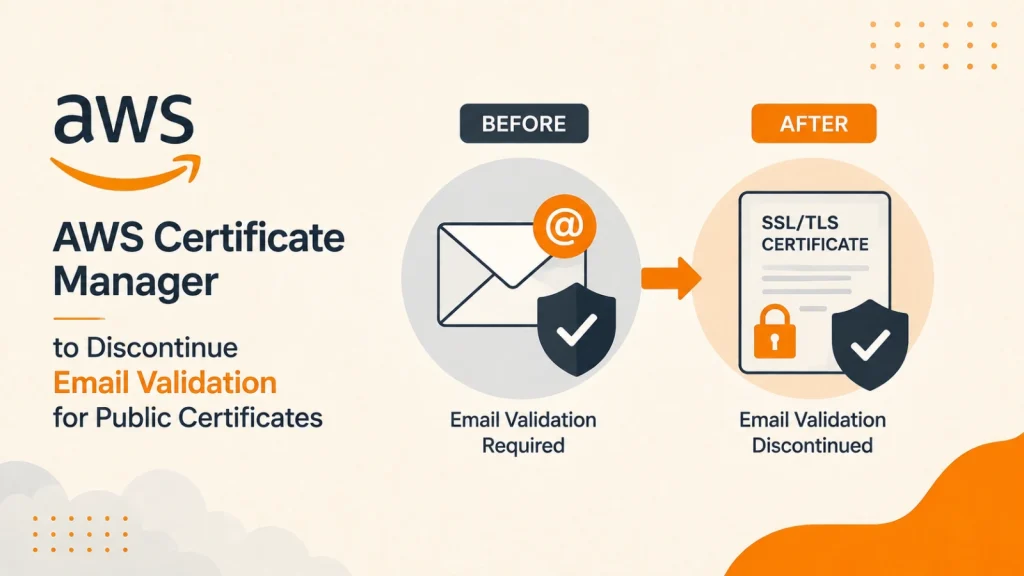
In a significant shift impacting cloud architects, DevOps engineers, and security teams, AWS Certificate Manager (ACM) has announced the permanent discontinuation of email-based domain control validation (DCV) for public certificate renewals. This change, slated for full deprecation by September 30, 2027, aligns AWS cloud infrastructure with stringent global trust mandates established by the Certificate Authority and Browser (CA/B) Forum. This move necessitates a proactive approach to transition legacy certificates and adopt more robust validation methods. Understanding the implications and required actions is crucial for maintaining seamless, secure operations.
Understanding the Shift: Why Email Validation is Being Phased Out
The CA/B Forum, an industry body comprising Certificate Authorities and browser vendors, continuously evolves its baseline requirements to enhance internet security. Email validation, while convenient in its early days, has inherent security limitations. It relies on the security of email systems, which can be vulnerable to phishing, spoofing, and unauthorized access, potentially allowing an attacker to compromise certificate issuance. To bolster the integrity of SSL/TLS certificates and prevent potential abuse, the forum has been pushing for stronger, more verifiable methods of proving domain ownership.
AWS’s decision to deprecate email validation for public certificates in ACM is a direct response to these evolving industry best practices and mandates. It signifies a commitment to maintaining the highest security standards for its users, ensuring that certificates issued through ACM meet global trust expectations. The reference for this critical update can be found at Cyber Security News.
Impact on Existing Public Certificates and Renewal Processes
For organizations currently relying on email validation for their public certificates managed by AWS Certificate Manager, this announcement carries significant implications. While existing certificates validated via email will continue to function until their natural expiration, their renewal process will be impacted. By the September 30, 2027 deadline, all public certificates requiring renewal will need to utilize alternative DCV methods.
Failing to transition to an approved validation method before this deadline could result in:
- Certificate renewal failures, leading to expired SSL/TLS certificates.
- Service outages and website downtime due to invalid certificates.
- Compromised trust with users, as browsers will display security warnings.
- Potential security vulnerabilities if services operate without valid encryption.
Alternative Domain Control Validation (DCV) Methods in ACM
AWS Certificate Manager offers two primary, more secure alternatives to email validation for public certificates:
DNS Validation
DNS validation is the recommended and most commonly used method. It involves adding a CNAME record to your domain’s DNS configuration. ACM provides the specific CNAME record (name and value) that you need to add. Once the record is published and propagated, ACM can verify domain ownership by querying the DNS server for that specific record. This method is highly automated, especially when using Route 53 as your DNS provider, where ACM can automatically create and manage the necessary DNS records for you.
Benefits of DNS Validation:
- Automation: With Route 53, certificate renewals can be fully automated, minimizing manual intervention.
- Scalability: Easily manage validation for a large number of domains and certificates.
- Security: More secure than email validation as it relies on control over DNS records, which is a higher bar for domain ownership.
API Validation (Programmatic)
While not a distinct validation type in ACM’s public certificate offerings, API validation is implicitly utilized when integrating ACM with other AWS services or through automation scripts. For private certificates or specific enterprise scenarios, programmatic methods allow for integrating certificate issuance and validation into existing CI/CD pipelines or infrastructure-as-code (IaC) solutions. This often involves using AWS SDKs or CLI to interact with ACM and other services to fulfill validation requirements.
Remediation Actions and Best Practices for Cloud Professionals
To ensure a smooth transition and avoid disruptions, cloud architects, DevOps engineers, and security teams must take proactive steps. Here’s a structured approach:
- Inventory Existing Certificates: Identify all public certificates in ACM that currently use email validation. Categorize them by expiration date and associated services.
- Prioritize Migration: Start with certificates expiring soonest or those critical to core business functions.
- Transition to DNS Validation:
- For domains hosted on Route 53, enable automatic renewal via DNS validation within ACM. This is often a straightforward setting change.
- For domains hosted with third-party DNS providers, you will need to manually add the CNAME records provided by ACM to your DNS configuration. Automate this process where possible using your DNS provider’s API.
- Update Documentation and Playbooks: Ensure all internal documentation, runbooks, and disaster recovery plans reflect the new certificate validation procedures.
- Educate Teams: Inform and train relevant teams (DevOps, Security, Operations) about the upcoming changes and the new validation processes.
- Implement Monitoring and Alerting: Set up CloudWatch alarms or other monitoring solutions to alert on impending certificate expirations or validation failures.
- Phased Rollout: If managing a large number of certificates, consider a phased rollout of the new validation methods to minimize risk.
- Leverage Infrastructure as Code (IaC): Integrate certificate management and DNS record creation into your IaC tools (e.g., CloudFormation, Terraform) to ensure consistency and repeatability.
There is no specific CVE associated with this deprecation as it is a policy change rather than a vulnerability. However, failure to address this change can lead to security vulnerabilities due to expired certificates.
Conclusion: Securing the Future of Certificate Management
The discontinuation of email validation for public certificates in AWS Certificate Manager marks a significant step forward in enhancing the security posture of cloud-based applications. While it requires a proactive migration effort, this change ultimately strengthens the integrity of SSL/TLS certificates by enforcing more robust domain control validation methods. By embracing DNS validation and integrating certificate management into automated workflows, organizations can ensure continuous security, maintain trust, and avoid service disruptions. This move reinforces the importance of staying abreast of industry mandates and continuously adapting security practices to meet evolving threats and standards.