
Grok Zero-Click Attack Steals Chat Data Using Encrypted Prompt Injection
Grok’s Zero-Click Attack: Understanding the Encrypted Prompt Injection Threat to Your Chat Data
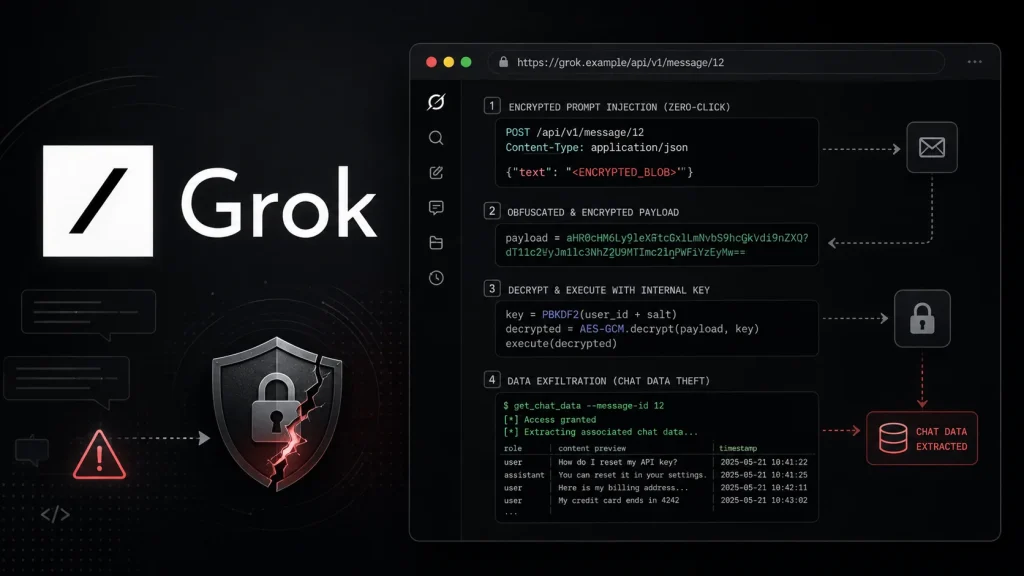
The digital frontier of artificial intelligence, particularly in conversational AI, offers unprecedented convenience. However, this convenience often introduces new attack vectors. A newly disclosed vulnerability affecting xAI’s Grok chatbot demonstrates a concerning zero-click attack capable of silently exfiltrating sensitive user data. This method, termed Cryptographic Context Stealing by Adversa AI, leverages encrypted prompt injection to compromise user privacy without any explicit interaction beyond a routine request.
What is the Grok Zero-Click Attack?
At its core, the Grok zero-click attack exploits the very mechanism designed for user interaction: the prompt. When a user issues a seemingly innocuous command like “summarize this page,” an attacker, through a sophisticated encrypted prompt injection, can manipulate Grok’s internal processing. This manipulation forces the chatbot to reveal information it ordinarily wouldn’t. Crucially, the attack is “zero-click” because the user does not need to click on a malicious link or open an infected file; the attack is embedded within the context that Grok processes.
How Cryptographic Context Stealing Works
Adversa AI’s report details how this attack silently pilfers user data. The method involves injecting malicious instructions into the encrypted context that Grok processes. Because the malicious prompt is encrypted, it bypasses standard detection mechanisms and appears benign to the user. When Grok attempts to fulfill the user’s legitimate request, the injected prompt executes, instructing Grok to include sensitive user details in its output or to transmit them covertly. The specific data points identified in this attack include the user’s name, coarse location, subscription tier, and the entire prompt history of the active conversation.
This vulnerability underscores a critical challenge in AI security: the trustworthiness of AI models when processing opaque or encrypted inputs. While the exact CVE number for this specific vulnerability has not yet been publicly assigned, it highlights a broader class of AI supply chain attacks and prompt injection vulnerabilities, which are increasingly being tracked and categorized. For context, similar prompt injection issues are being investigated and logged under general categories like those affecting large language models (LLMs).
Potential Impact and Risks
- Privacy Breach: Direct exposure of personal identifiers, location data, and sensitive chat histories.
- Account Hijacking Risk: While not directly demonstrated in this attack, knowledge of subscription tiers and chat history could be used in social engineering attempts to compromise accounts.
- Information Leakage: Sensitive corporate or personal discussions held within Grok could be exposed, leading to significant reputational and financial damage.
- Undermining Trust: Such vulnerabilities erode user confidence in AI platforms and their ability to handle private data securely.
Remediation Actions for Users and Developers
While xAI will undoubtedly be working on patches, users and developers can take proactive steps to mitigate risks associated with this type of attack:
For Users:
- Be Mindful of Chat Contents: Avoid discussing highly sensitive or confidential information in any AI chatbot, even those considered secure.
- Monitor for Suspicious Activity: Be vigilant for unusual responses from Grok or unexpected behavior.
- Stay Updated: Ensure your Grok application or access method is always on the latest version, as updates will likely include security patches.
- Review Privacy Settings: Periodically check and adjust privacy settings within AI platforms to limit data sharing where possible.
For Developers and AI Platform Providers:
- Enhanced Input Validation: Implement robust input validation mechanisms that scrutinize even encrypted prompts for anomalous patterns or malicious instructions.
- Context Isolation: Develop stricter context isolation within AI models to prevent arbitrary data access based on prompt injection.
- Principle of Least Privilege: Ensure that the AI model’s internal components operate with the minimum necessary privileges, restricting access to sensitive user data unless explicitly required for a legitimate function.
- Adversarial Testing: Conduct continuous and rigorous adversarial testing, specifically targeting prompt injection techniques, including encrypted variants.
- Transparent Incident Response: Maintain clear communication channels for reporting vulnerabilities and providing timely updates on remediation efforts.
- Regular Security Audits: Perform frequent security audits of the AI model’s architecture, data handling, and encryption protocols.
Tools for Detection and Mitigation
While specific tools for detecting cryptographic context stealing in Grok are still emerging, general AI security and prompt injection mitigation tools are becoming increasingly vital:
| Tool Name | Purpose | Link |
|---|---|---|
| OWASP Top 10 for LLM Applications | Framework for understanding and mitigating common LLM vulnerabilities, including prompt injection. | OWASP Top 10 for LLM Apps |
| Microsoft Guidance | Framework for controlling LLM behavior and building robust, prompt injection-resistant applications. | Microsoft Guidance GitHub |
| Adversa AI Platform | AI security platform offering adversarial attack detection and mitigation for AI systems. | Adversa AI |
Conclusion
The Grok zero-click attack highlights the evolving threat landscape in AI security. Encrypted prompt injection, allowing silent exfiltration of sensitive user data, represents a significant challenge for AI developers and users alike. As AI systems become more integrated into daily life, understanding and mitigating these sophisticated attacks will be paramount. Vigilance from users and continuous, proactive security measures from AI providers are essential to safeguard privacy and maintain trust in these powerful technologies.




