
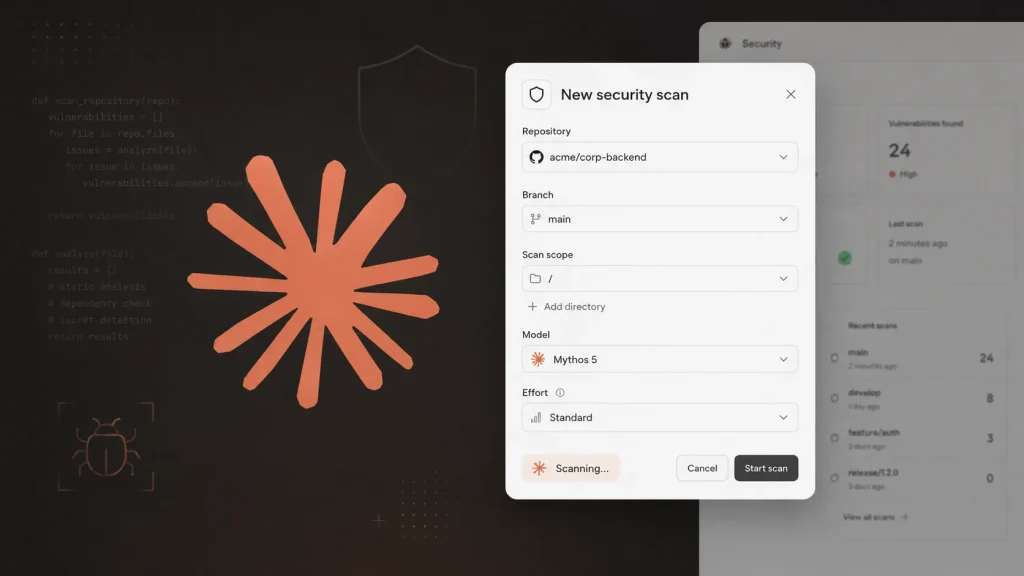
Claude Mythos 5 Now Available in Claude Security for Vulnerability Scanning
The landscape of enterprise cybersecurity is constantly shifting, demanding increasingly sophisticated tools to defend against a barrage of threats. A significant leap forward in this ongoing battle has just been announced: Anthropic has made its advanced AI model, Claude Mythos 5, accessible within Claude Security. This integration empowers enterprises with potent new capabilities for vulnerability scanning and AI-generated remediation guidance, marking a pivotal moment in how organizations approach proactive security measures.
Claude Mythos 5: A New Frontier in Cyber Defense
Anthropic’s decision to offer Claude Mythos 5 through Claude Security directly addresses a critical need in enterprise cybersecurity: robust, intelligent vulnerability discovery. This isn’t merely another scanning tool; it represents the application of cutting-edge artificial intelligence to a domain where precision and foresight are paramount. By leveraging Mythos 5’s advanced analytical capabilities, organizations can move beyond traditional signature-based scanning to detect more complex and subtle vulnerabilities within their codebases.
The core advantage here lies in the AI’s capacity for contextual understanding. While conventional scanners might flag known patterns, Claude Mythos 5 can potentially identify logical flaws, complex interdependencies, and even potential zero-day vulnerabilities that might otherwise go unnoticed. This enhances a defender’s ability to anticipate and neutralize threats before they can be exploited.
Enhanced Vulnerability Discovery and AI-Driven Remediation
The integration provides enterprises with two primary benefits:
- Stronger Vulnerability Discovery: Mythos 5 can meticulously analyze extensive codebases, pinpointing potential security weaknesses with greater accuracy and depth. This includes identifying common coding errors, configuration issues, and more sophisticated vulnerabilities that might require a deeper understanding of application logic.
- AI-Generated Remediation Guidance: Beyond just identification, the system offers actionable recommendations. This means that instead of simply receiving a list of flaws, security teams get clear, AI-informed suggestions on how to patch or mitigate the discovered vulnerabilities. This significantly accelerates the remediation process, allowing developers and security engineers to address issues more efficiently.
This dual approach streamlines the entire vulnerability management lifecycle, from detection to resolution. It empowers security teams to become more proactive, shifting from reactive incident response to preventive security posture management.
Addressing the Challenges of Modern Software Development
Modern software development is characterized by rapid iteration, complex dependencies, and increasingly intricate architectures. This environment often creates a fertile ground for vulnerabilities. Manual code reviews are time-consuming and prone to human error, while traditional automated scanners can sometimes produce high false-positive rates or miss subtle issues.
Claude Mythos 5’s availability in Claude Security offers a scalable solution to these challenges. It provides a means to continuously scan and evaluate code as it evolves, integrating security deeper into the development pipeline (DevSecOps). By offering constrained, purpose-built access to this powerful AI, Anthropic ensures that its advanced capabilities are directed specifically towards strengthening an organization’s defensive posture, rather than general-purpose AI applications.
Implications for Enterprise Cybersecurity Teams
For IT professionals, security analysts, and developers, this development means several things:
- Increased Efficiency: Automated, intelligent scanning reduces the burden on human analysts, freeing them to focus on more complex strategic security initiatives.
- Improved Security Posture: The ability to detect and remediate vulnerabilities more effectively leads to a stronger overall security posture, reducing the attack surface.
- Faster Patching Cycles: AI-driven remediation guidance can drastically cut down the time it takes to develop and implement patches, thereby minimizing exposure windows.
- Proactive Defense: Shifting from a reactive stance to a more proactive security model is crucial in today’s threat landscape.
While the specific details of detected vulnerabilities will vary by codebase, the core benefit remains the ability to identify potential weaknesses like injection flaws, insecure deserialization, or improper access controls with greater precision than ever before. For example, a vulnerability similar to CVE-2023-38545 (a heap-based buffer overflow in curl) might be detected through deep code analysis identifying specific memory handling patterns that lead to such exploits, even in novel contexts.
Remediation Actions
When Claude Mythos 5 identifies a vulnerability, the system will provide tailored remediation guidance. However, general best practices for addressing common types of vulnerabilities include:
- Input Validation and Sanitization: Implement stringent input validation at all entry points to prevent injection attacks (SQL injection, XSS, command injection). Ensure all user-supplied data is properly sanitized or escaped before being used in queries or displayed in the UI.
- Principle of Least Privilege: Configure applications and services to run with the minimum necessary permissions. Review and restrict database access, file system access, and network privileges.
- Secure Coding Practices: Adhere to secure coding guidelines specific to the programming language and framework being used. This includes avoiding insecure functions, properly handling errors, and managing memory safely.
- Regular Security Updates: Keep all software, libraries, and frameworks up to date. Patching known vulnerabilities in third-party components is a fundamental security practice.
- Configuration Management: Ensure secure default configurations for all systems and applications. Disable unnecessary services and ports.
- Authentication and Authorization: Implement robust authentication mechanisms (e.g., multi-factor authentication) and granular authorization controls.
- Logging and Monitoring: Implement comprehensive logging of security-relevant events and actively monitor these logs for suspicious activity.
Conclusion
The integration of Claude Mythos 5 into Claude Security represents a significant evolution in enterprise vulnerability management. By providing powerful AI-driven scanning and remediation guidance, Anthropic is equipping organizations with advanced tools to build more resilient and secure digital infrastructures. This move underscores the growing importance of AI as a force multiplier in cybersecurity, enabling defenders to stay ahead of sophisticated threats and protect critical assets more effectively.




