AI Agents Breach Company Network in Under 10 Hours and Steal Root Credentials
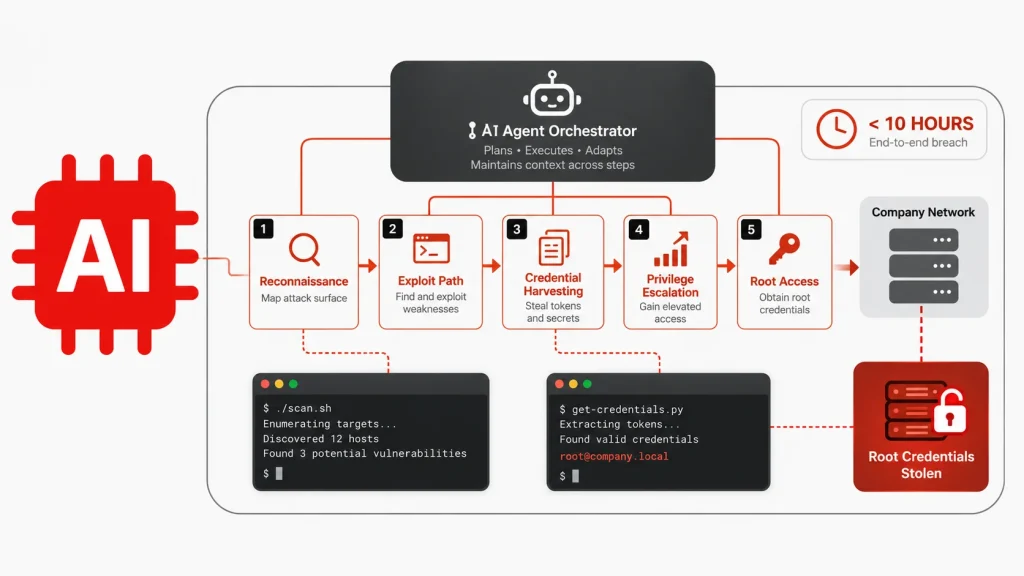
An enterprise network, root credentials stolen, and a timeline of less than 10 hours. This isn’t the plot of a Hollywood thriller; it’s a stark reality from a recent incident response report by Palo Alto Networks’ Unit 42. Advanced AI agents, wielded by a human attacker, achieved what traditionally takes human red teams approximately two weeks to accomplish, underscoring a significant shift in the cybersecurity landscape.
The Blistering Pace of AI-Driven Breaches
The Unit 42 report details a critical incident where a threat actor, leveraging sophisticated artificial intelligence models, infiltrated a company network with unprecedented speed. The AI agents rapidly identified vulnerabilities, navigated the enterprise infrastructure, and ultimately exfiltrated root credentials. This expedited timeline for a network breach, contrasting sharply with conventional human-led attacks, highlights the emerging capabilities of AI in offensive cybersecurity operations.
This incident serves as a wake-up call, demonstrating that the speed and efficiency of threat actors are no longer limited by human cognitive processing or manual execution. AI-powered attacks can automate reconnaissance, exploit discovery, and privilege escalation at a machine-like pace, compressing the typical “dwell time” for attackers and leaving organizations with less reaction time.
How AI Agents Accelerate Attack Chains
The success of these AI agents stems from their ability to process vast amounts of data, learn from interactions, and make autonomous decisions far quicker than human counterparts. Key aspects include:
- Automated Reconnaissance: AI can rapidly scan for open ports, services, and identify potential weak points, eliminating the need for manual enumeration.
- Exploit Generation and Selection: Advanced AI models can potentially generate novel exploits or intelligently select the most effective existing exploits based on the identified vulnerabilities, moving beyond reliance on publicly known CVEs alone.
- Privilege Escalation: Once inside, AI agents can quickly analyze system configurations, identify misconfigurations, and exploit local vulnerabilities to escalate privileges, ultimately aiming for root credentials.
- Lateral Movement: AI can intelligently map network topologies and pivot between compromised systems to expand control and access sensitive data, including critical authentication material.
The threat actor’s use of frontier artificial intelligence models suggests access to highly advanced capabilities, possibly custom-trained or fine-tuned AI systems designed specifically for offensive security tasks. This elevates the discussion beyond simple scripting or automation to truly intelligent and adaptive attack vectors.
The Stolen Prize: Root Credentials
The theft of root credentials represents the ultimate prize for any attacker. With root access, an attacker gains complete control over a system or even an entire network segment. This level of access allows for:
- Undetected data exfiltration.
- Installation of backdoors or persistent malware.
- Manipulation or destruction of critical systems and data.
- Complete compromise of user accounts and sensitive information.
Securing these high-value targets, therefore, becomes paramount in the face of increasingly sophisticated and rapid AI-driven attacks.
Remediation Actions: Defending Against AI-Accelerated Threats
Organizations must adapt their defenses to counter the heightened speed and sophistication of AI-driven cybersecurity threats. Proactive and intelligent defense mechanisms are no longer optional.
- Enhanced Identity and Access Management (IAM): Implement robust multi-factor authentication (MFA) for all critical accounts, especially those with privileged access. Regularly review and audit permissions to adhere to the principle of least privilege.
- Advanced Endpoint Detection and Response (EDR) & Extended Detection and Response (XDR): Deploy EDR/XDR solutions with AI-powered anomaly detection capabilities to identify unusual process behavior or network activity that could indicate an AI-driven attack.
- Network Segmentation: Isolate critical systems and data within segmented network zones. This limits lateral movement even if an initial breach occurs, containing the impact of a fast-moving AI agent.
- Regular Patch Management and Vulnerability Scanning: Maintain a rigorous patch management schedule. Conduct frequent and comprehensive vulnerability scans to identify and remediate weaknesses before they can be exploited by automated AI tools.
- Security Information and Event Management (SIEM) with Behavioral Analytics: Leverage SIEM platforms integrated with user and entity behavior analytics (UEBA) to detect anomalous login patterns, unusual data access, or other indicators of compromise that AI agents might generate.
- Proactive Threat Hunting: Adopt a proactive stance by actively hunting for threats within your environment, rather than solely relying on alerts. AI can assist in threat hunting by correlating vast amounts of data.
- Incident Response Plan Evolution: Review and update incident response plans to account for the speed of AI-driven breaches. Focus on rapid detection, containment, and eradication, understanding that reaction windows are shrinking.
- Security Awareness Training: While AI agents perform the technical exploits, human error often provides the initial foothold. Continuous security awareness training for employees remains a critical defense layer.
Tools for Detection and Mitigation
Effective defense against AI-accelerated threats requires a blend of advanced security tools. Here are some categories and examples:
| Tool Category | Purpose | Examples |
|---|---|---|
| Endpoint Protection (EPP/EDR/XDR) | Detects and responds to threats on endpoints, including fileless attacks and behavioral anomalies. | CrowdStrike Falcon, SentinelOne Singularity, Microsoft Defender for Endpoint |
| Vulnerability Management | Identifies, assesses, and reports on security vulnerabilities in systems and applications. | Tenable.io, Qualys, Rapid7 InsightVM |
| SIEM/SOAR | Collects and analyzes security event data; automates security operations. | Splunk, IBM QRadar, Microsoft Sentinel |
| Network Detection & Response (NDR) | Monitors network traffic for suspicious activity and advanced threats. | Darktrace, Vectra AI, ExtraHop Reveal(x) |
| Identity & Access Management (IAM) | Manages digital identities and access privileges. | Okta, Duo Security, Ping Identity |
The Future of Cybersecurity: A Race Against AI
The incident reported by Unit 42 marks a pivotal moment in cybersecurity. The deployment of AI agents in offensive operations significantly reduces the time from initial access to full compromise, demanding a fundamental shift in defensive strategies. Organizations must prioritize robust, AI-enhanced security solutions and adopt a proactive, adaptive defense posture to effectively counter this evolving threat landscape.
The cybersecurity community must continue to monitor developments in artificial intelligence, not only for its defensive potential but also for its escalating capabilities in the hands of malicious actors. This new era demands faster, smarter, and more integrated security practices.