
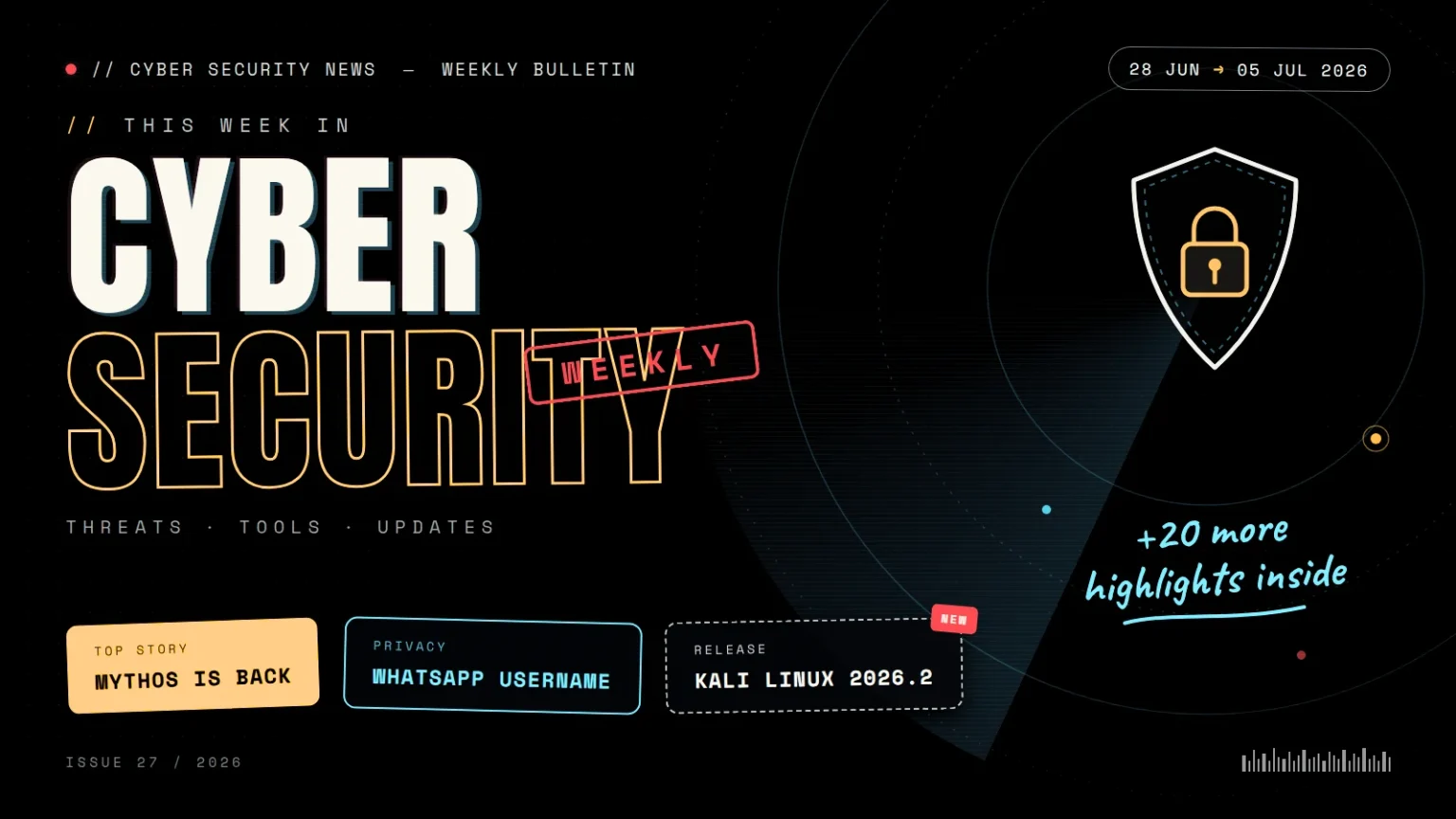
Cyber Security News Bulletin Weekly – Mythos is Back, WhatsApp Username, Kali Linux 2026.2, +20 Stories
Cybersecurity Unpacked: Mythos Returns, WhatsApp Evolves, and Kali Unleashed
In the relentless landscape of cybersecurity, staying informed isn’t just an advantage; it’s a necessity. This week, we’re dissecting pivotal developments that underscore an evolving threat landscape, significant privacy enhancements, and critical updates to a foundational security toolkit. From the strategic redeployment of a powerful AI model to a landmark privacy feature for millions, and the latest iteration of Kali Linux, the pace of innovation and mitigation continues unabated.
Anthropic Reinstates Claude Mythos 5: A Powerful AI Resurgence
Anthropic, a key player in responsible AI development, has confirmed the redeployment of its advanced AI cybersecurity model, Claude Mythos 5. Following a temporary government-led suspension, this powerful AI is now being restored to vetted US critical infrastructure organizations. This move highlights the intricate balance between leveraging cutting-edge AI for defense and ensuring its secure and responsible application. Mythos 5’s return signifies a renewed commitment to bolstering national cybersecurity defenses with intelligent automation and threat analysis capabilities, particularly in sectors vital to national security and public welfare.
WhatsApp Introduces Username Feature: Enhanced Privacy and Control
In a significant stride towards user privacy and control, WhatsApp is rolling out a new username feature. This update fundamentally alters how users can connect, moving beyond the reliance on phone numbers alone. Users will now have the option to choose a unique username, allowing them to connect with others without sharing their personal phone number. This enhancement not only offers a layer of anonymity but also provides greater control over personal data, a critical consumer demand in the current digital era. This development positions WhatsApp ahead in the instant messaging space regarding user data sovereignty.
Kali Linux 2026.2 Released: New Tools and Enhancements
The cybersecurity community welcomes the arrival of Kali Linux 2026.2, the latest iteration of the premier penetration testing and ethical hacking distribution. This release brings a suite of new tools, numerous enhancements, and critical bug fixes, solidifying Kali’s position as an indispensable platform for security professionals. Updates typically include improved hardware support, updated core packages, and new utilities for reconnaissance, vulnerability assessment, and exploitation. Users are encouraged to upgrade to leverage the latest capabilities and maintain an optimal security testing environment.
Critical Vulnerabilities & Remediation Actions
This week’s bulletin also highlights several critical Remote Code Execution (RCE) vulnerabilities impacting widely used software. These flaws pose significant risks, potentially allowing attackers to execute arbitrary code on affected systems, leading to data breaches, system compromise, and service disruption. Organizations must prioritize patching and mitigation strategies to protect their digital assets.
Remote Code Execution (RCE) in Apache Kafka Connect: CVE-2024-27304
A severe RCE vulnerability, CVE-2024-27304, has been identified in Apache Kafka Connect. This vulnerability allows authenticated users to achieve RCE under specific configurations, primarily when externalizing connector configurations. Attackers could exploit this to compromise Kafka Connect clusters and potentially gain access to sensitive data or disrupt operations.
Remediation Actions:
- Upgrade Immediately: Update Apache Kafka Connect to the latest patched version that addresses CVE-2024-27304.
- Configuration Review: Scrutinize Kafka Connect configurations, especially those involving externalized connector configurations, to minimize attack surface.
- Principle of Least Privilege: Ensure that users and services interacting with Kafka Connect operate with the absolute minimum necessary permissions.
- Network Segmentation: Isolate Kafka Connect clusters within secured network segments to restrict unauthorized access.
RCE Flaw in Ivanti Connect Secure and Policy Secure: CVE-2024-27308
Ivanti has released an out-of-band security advisory for CVE-2024-27308, an RCE vulnerability affecting Ivanti Connect Secure and Policy Secure gateways. This flaw could allow an unauthenticated attacker to execute arbitrary commands remotely. Given the widespread deployment of Ivanti products in enterprise environments, this vulnerability carries a high risk of exploitation.
Remediation Actions:
- Apply Patches Urgently: Deploy the official patches released by Ivanti for Connect Secure and Policy Secure devices without delay.
- Monitor for Exploitation: Actively monitor logs and network traffic for indicators of compromise (IOCs) related to CVE-2024-27308.
- Web Application Firewall (WAF): Implement a WAF to provide an additional layer of defense and detect/block suspicious requests targeting Ivanti appliances.
- Regular Backup: Maintain regular, tested backups of configuration and system data to facilitate recovery in case of a successful exploit.
RCE in ConnectWise ScreenConnect: CVE-2024-27318 and CVE-2024-27319
ConnectWise ScreenConnect is grappling with two critical RCE vulnerabilities, CVE-2024-27318 and CVE-2024-27319, which together permit unauthenticated RCE. These vulnerabilities are particularly dangerous for IT service providers and enterprises relying on ScreenConnect for remote support, as they could lead to widespread system compromise.
Remediation Actions:
- Update ScreenConnect: Upgrade all ConnectWise ScreenConnect instances to the patched versions immediately.
- Restrict Network Access: Limit direct internet exposure of ScreenConnect servers. Implement VPN or IP whitelisting for access.
- Endpoint Detection and Response (EDR): Utilize EDR solutions on endpoints managed by ScreenConnect to detect and prevent post-exploitation activities.
- Incident Response Plan: Have a well-rehearsed incident response plan ready in case of a breach, focusing on containment and eradication.
Tools for Vulnerability Detection and Mitigation:
| Tool Name | Purpose | Link |
|---|---|---|
| Nessus | Comprehensive vulnerability scanning and assessment. | https://www.tenable.com/products/nessus |
| OpenVAS | Open-source vulnerability scanner for network and system assessment. | https://www.openvas.org/ |
| Wireshark | Network protocol analyzer for detecting unusual traffic patterns. | https://www.wireshark.org/ |
| Snort/Suricata | Intrusion detection/prevention systems (IDS/IPS) for real-time threat analysis. | https://www.snort.org/ / https://suricata-ids.org/ |
Additional Cybersecurity News Highlights
Beyond these headline stories, the past week saw a flurry of other significant cybersecurity events, including:
- Reports of new phishing campaigns targeting financial institutions with sophisticated social engineering tactics.
- Disclosures of several data breaches impacting e-commerce platforms, underscoring the persistent threat to consumer data.
- Updates on nation-state sponsored hacking groups intensifying their cyber espionage operations, particularly against government entities and critical infrastructure organizations.
- New research detailing advancements in ransomware variants, including improved evasion techniques and encryption algorithms.
- Continued debate and legislative efforts surrounding AI ethics and security, aiming to establish frameworks for safe and responsible AI deployment.
- The ongoing battle against supply chain attacks, with new warnings issued for vulnerabilities found in widely used open-source libraries.
- Increased focus on cloud security posturing, as more organizations migrate critical workloads to public cloud environments.
- Emerging threats targeting industrial control systems (ICS) and operational technology (OT) environments, emphasizing the need for specialized security measures.
Key Takeaways for a Secure Week Ahead
This week’s cybersecurity bulletin reinforces several critical imperatives. The return of Claude Mythos 5 illustrates the strategic importance of advanced AI in defense, while WhatsApp’s username feature highlights a growing awareness of user privacy. The Kali Linux 2026.2 release provides updated tools for the defenders, but the proliferation of RCE vulnerabilities in widely used software – from Apache Kafka Connect to Ivanti and ConnectWise ScreenConnect – serves as a stark reminder of the constant need for vigilance. Proactive patching, rigorous configuration management, and continuous monitoring are not merely best practices; they are essential defenses against an increasingly sophisticated and relentless threat landscape. Stay informed, stay secure.




