
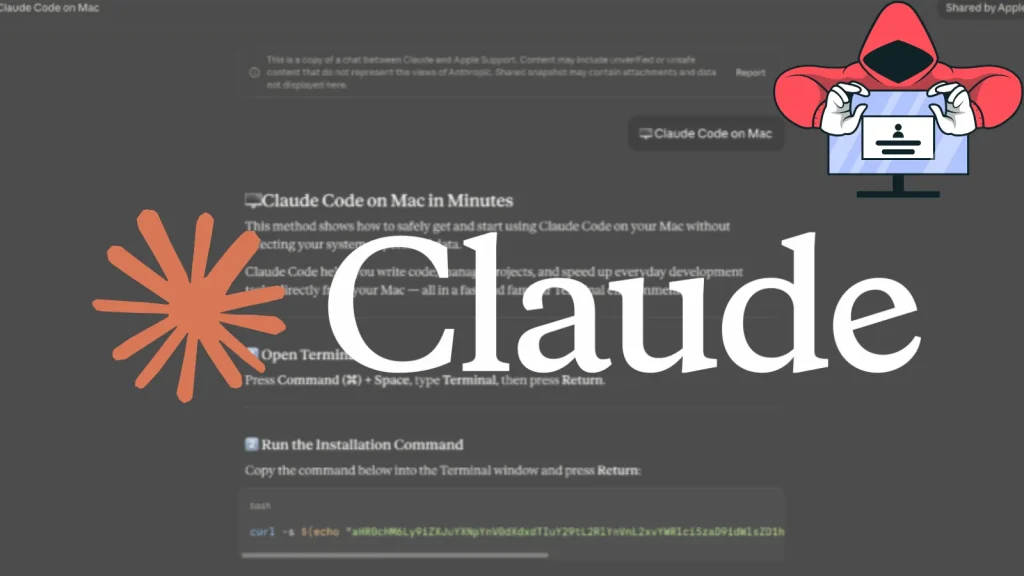
Hackers Abuse Claude.ai Shared Chat Feature to Host the ClickFix Social Engineering Instructions
Crafty Crooks Embrace Claude.ai: How Hackers Leverage Shared Chat for Social Engineering
The digital threat landscape constantly shifts, with adversaries exhibiting a remarkable ability to adapt new technologies for nefarious purposes. A stark example of this evolution is the recent surge in social engineering attacks leveraging trusted Artificial Intelligence platforms. Specifically, a concerning trend has emerged where threat actors are abusing Claude.ai’s shared chat feature to host malicious instructions, such as those for the
ClickFix social engineering campaign. This innovative approach to credential harvesting and data exfiltration poses a significant risk to organizations and individuals alike.
The ClickFix Campaign: A New Frontier in AI-Powered Deception
TrendAI Research recently uncovered a sophisticated campaign demonstrating attackers’ agility. Over seven weeks, they deployed 106 unique malicious hostnames across six distinct waves, constantly rotating infrastructure and experimenting with various AI-themed lures. This rapid iteration and adaptation highlight a dedicated effort to maximize the effectiveness of their social engineering tactics. By embedding their malicious instructions within the seemingly innocuous environment of a shared Claude.ai chat, attackers bypass traditional email and web filtering mechanisms, lending an air of legitimacy to their schemes.
The core of this attack vector lies in manipulating user trust. Users are generally comfortable interacting with AI platforms and tend to perceive content generated or shared within these environments as safe. Hackers exploit this inherent trust, transforming Claude.ai’s shared chat functionality into a covert delivery mechanism for their social engineering narratives. This method effectively transforms a legitimate and widely used AI tool into a launchpad for malicious activity, creating a significant challenge for security teams.
Deconstructing the Abuse: How Shared Chat Becomes a Weapon
The shared chat feature, designed for collaborative purposes and easy dissemination of AI-generated content, becomes a critical vulnerability in this scenario. Here’s a breakdown of how it’s being abused:
- Legitimate Hosting Platform: By hosting instructions on Claude.ai, attackers leverage the platform’s reputation and domain standing. Security tools are less likely to flag a link to claude.ai as malicious, allowing the initial lure to bypass defenses.
- Dynamic Content Delivery: The shared chat allows for dynamic modification of content, enabling attackers to quickly update their instructions or adapt to new security measures.
- Reduced Suspicion: Users encountering a link to a shared AI chat are less likely to be immediately suspicious compared to an unknown website or a suspicious email attachment. The interaction feels more natural and less like a typical phishing attempt.
- Effective Lure Generation: The AI itself can be used to craft compelling and contextually relevant social engineering lures, further enhancing the effectiveness of the attack.
Remediation Actions: Fortifying Defenses Against AI-Powered Social Engineering
Mitigating the risks posed by these evolving AI-powered social engineering attacks requires a multi-layered approach. Organizations and individuals must adapt their security strategies to account for these sophisticated techniques.
- Enhanced User Training: Educate users about the new threat landscape, emphasizing that even trusted platforms can be leveraged for malicious purposes. Train them to recognize the hallmarks of social engineering, regardless of the hosting platform. Focus on critical thinking and verifying requests, even if they appear to originate from a legitimate source.
- Advanced Email and Web Filtering: Implement and regularly update email and web filtering solutions that can detect and block URLs and content associated with known malicious campaigns, even those hosted on legitimate domains. While traditional filters might struggle with reputable AI domains, advanced solutions often employ behavioral analysis.
- Endpoint Detection and Response (EDR) Systems: Deploy robust EDR solutions that can detect suspicious activity post-initial access, such as attempts to execute unfamiliar scripts or access sensitive information.
- Multi-Factor Authentication (MFA): Mandate MFA for all user accounts, especially for access to critical systems and data. Even if credentials are compromised through social engineering, MFA acts as a crucial secondary defense.
- Regular Security Audits: Conduct frequent security audits and penetration testing to identify potential weaknesses in your systems and processes that could be exploited by social engineering attacks.
- Threat Intelligence Integration: Stay updated with the latest threat intelligence on emerging social engineering techniques and indicators of compromise (IOCs). Subscribe to reputable threat intelligence feeds and integrate them into your security operations.
- Zero Trust Architecture: Adopt a Zero Trust security model, where no user or device is inherently trusted, regardless of their location or prior authentication. Verify every access attempt and apply the principle of least privilege.
Currently, there isn’t a specific CVE number assigned directly to the abuse of Claude.ai’s shared chat feature itself, as it’s a social engineering methodology rather than a software vulnerability in the traditional sense. However, the outcomes of such attacks often lead to vulnerabilities being exploited, such as credential compromise. For example, a successful ClickFix attack could lead to unauthorized access, potentially escalating to broader data breaches.
| Tool Name | Purpose | Link |
|---|---|---|
| PhishMe (Cofense) | User awareness and simulated phishing training | https://cofense.com/ |
| Proofpoint Essentials | Advanced email and URL protection | https://www.proofpoint.com/us/products/email-security/essentials |
| CrowdStrike Falcon Insight XDR | Endpoint Detection & Response (EDR) and Extended Detection & Response (XDR) | https://www.crowdstrike.com/products/endpoint-security/falcon-insight-xdr/ |
| Microsoft Defender for Endpoint | Integrated endpoint security, EDR, and vulnerability management | https://www.microsoft.com/en-us/security/business/threat-protection/microsoft-defender-endpoint |
The Evolving Threat: AI’s Dual-Edged Sword
The exploitation of Claude.ai’s shared chat feature for social engineering underscores a critical aspect of modern cybersecurity: the double-edged nature of advanced AI. While these platforms offer immense benefits, their underlying capabilities make them attractive targets and powerful tools for threat actors. As AI becomes more integrated into daily workflows, security professionals must remain vigilant, constantly anticipating and adapting to new attack vectors that weaponize seemingly benign functionalities.
The ClickFix campaign serves as a powerful reminder that relying solely on traditional security perimeters is no longer sufficient. A comprehensive security strategy must now include robust user education, adaptive technical controls, and continuous threat intelligence to effectively combat the ever-evolving tactics of cybercriminals. Staying informed and proactive is paramount in this landscape where innovation is equally leveraged by both defenders and attackers.




