
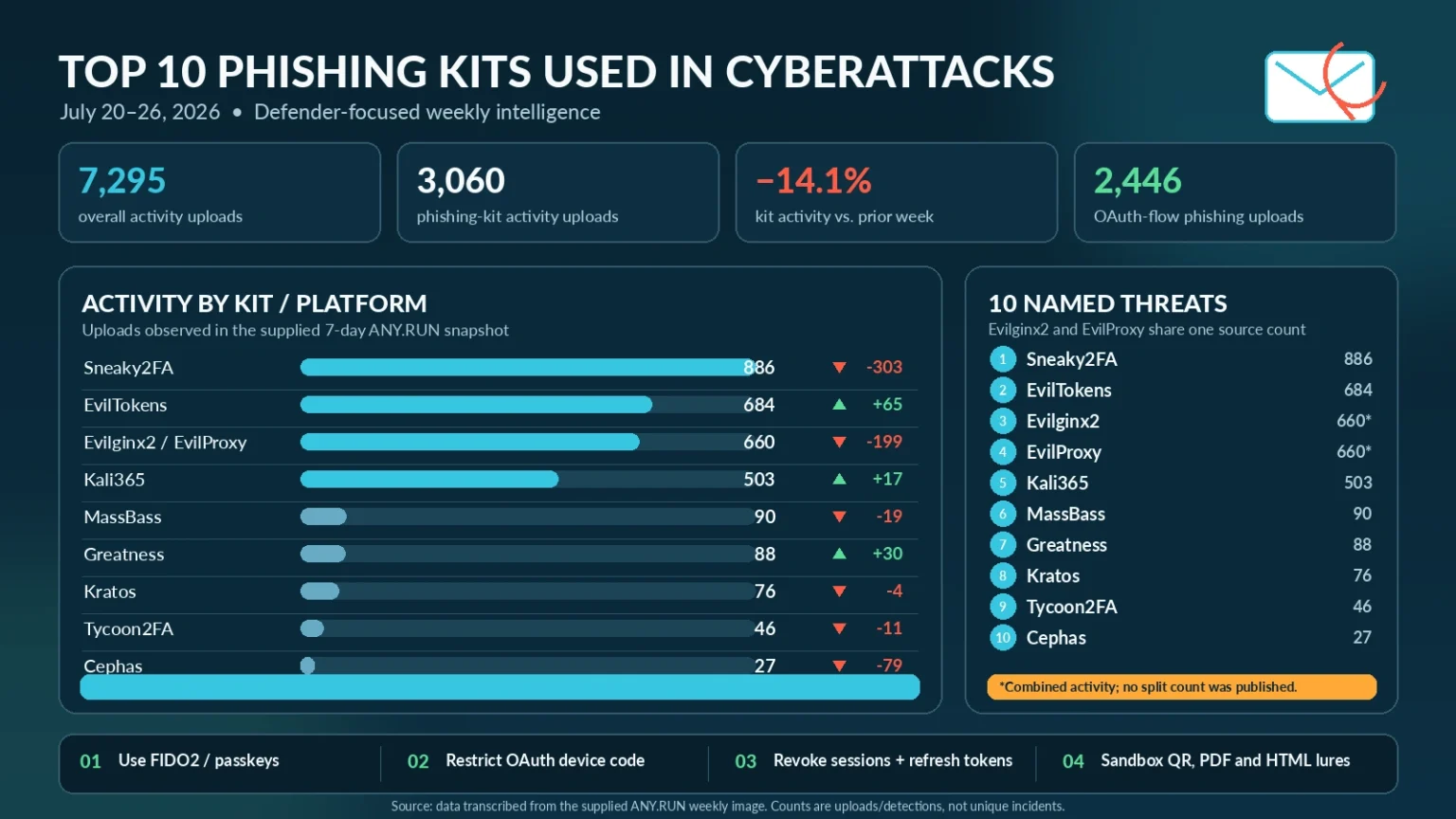
Top 10 Phishing Kits Used by Hackers to Launch Cyberattacks (July 20-26, 2026)
Unmasking the Phishing Epidemic: Top Kits Powering Cyberattacks (July 20-26, 2026)
In the relentless cat-and-mouse game between cyber defenders and attackers, phishing remains a cornerstone of successful cyber exploitation. The week of July 20-26, 2026, witnessed a significant surge in phishing-as-a-service (PhaaS) activity, with a startling 7,295 unique uploads tracked. This alarming spike signals a sophisticated and agile threat landscape where readily available tools empower cybercriminals to launch widespread cyberattacks with unprecedented efficiency.
The primary drivers behind this surge are the pervasive abuse of OAuth device-code flows and highly effective adversary-in-the-middle (AiTM) kits specifically designed to compromise Microsoft 365 identities. Understanding these top-tier phishing kits is no longer optional; it’s critical for bolstering organizational defenses against the next wave of sophisticated social engineering attacks.
The Phishing-as-a-Service (PhaaS) Landscape (July 20-26, 2026)
The sheer volume of PhaaS activity detected during this period underscores a troubling trend: the commoditization of sophisticated phishing capabilities. Instead of developing their own tools, aspiring attackers can readily access advanced kits, lowering the barrier to entry for launching highly effective campaigns. The focus on OAuth device-code flow abuse and AiTM techniques highlights a strategic shift towards targeting advanced authentication mechanisms, particularly within the ubiquitous Microsoft 365 ecosystem.
The attackers aren’t just sending simple credential harvesting pages anymore. They are orchestrating multi-stage attacks that leverage complex authentication processes, making detection and prevention significantly more challenging for users and security professionals alike.
The Rise of Storm-1747 and Tycoon2FA
Among the myriad of cybercriminal groups operating in the PhaaS space, Storm-1747, the prolific operator behind the Tycoon2FA phishing kit, continued to be a significant player. During the analyzed week, Storm-1747 was attributed with 50 unique uploads, although this represented a slight decrease of 6 from the preceding week. This reduction suggests that ongoing law enforcement pressures on their infrastructure may be having some impact, highlighting the importance of collaborative efforts to disrupt these criminal enterprises.
Tycoon2FA is a particularly insidious kit designed to bypass multi-factor authentication (MFA) mechanisms. By acting as a proxy between the victim and the legitimate service, it captures session cookies and other authentication tokens, effectively neutralizing the protection offered by MFA. This makes it a highly valuable tool for adversaries seeking to gain persistent access to high-value accounts.
Addressing the Threat: Remediation Actions
Given the escalating sophistication of phishing kits, a multi-layered defense strategy is paramount. Organizations must prioritize robust security measures to mitigate the risks posed by these threats, particularly those targeting Microsoft 365 environments.
- Implement Strong Multi-Factor Authentication (MFA): While AiTM kits can bypass some MFA implementations, FIDO2/hardware security keys offer the strongest protection against token theft. Educate users on the distinction between authenticator app-based MFA and FIDO2.
- User Education and Awareness Training: Regularly train employees to recognize sophisticated phishing attempts, including those that mimic familiar login prompts or unusual consent requests. Emphasize the dangers of granting permissions to unfamiliar applications.
- Conditional Access Policies: Configure Microsoft 365 Conditional Access policies to restrict access based on device compliance, location, and other risk factors. This can help prevent unauthorized access even if credentials or session tokens are compromised.
- Monitor for Suspicious OAuth Consents: Regularly audit and revoke unusual or suspicious OAuth application consents within your Microsoft 365 tenant. Attackers often leverage legitimate OAuth flows to gain persistent access.
- Endpoint Detection and Response (EDR): Deploy EDR solutions across all endpoints to detect and respond to post-compromise activity, including malicious scripts or unauthorized data exfiltration.
- Email Security Gateways: Implement advanced email security solutions that can detect and block sophisticated phishing emails, including those leveraging URL rewriting and impersonation techniques.
- Security Information and Event Management (SIEM): Integrate security logs into a SIEM system for centralized monitoring and anomaly detection. Look for unusual login patterns, failed authentication attempts, and suspicious access to sensitive resources.
- Regular Security Audits and Penetration Testing: Conduct periodic security audits and penetration tests to identify weaknesses in your defenses and validate the effectiveness of your security controls.
Tools for Detection and Mitigation
Various tools can assist organizations in detecting and mitigating phishing attacks, especially those leveraging advanced kits.
| Tool Name | Purpose | Link |
|---|---|---|
| Microsoft Defender for Office 365 | Advanced threat protection for email and collaboration tools, including anti-phishing capabilities. | https://www.microsoft.com/en-us/security/business/threat-protection/microsoft-defender-for-office-365 |
| PhishMe (by Cofense) | Phishing simulation and security awareness training platform. | https://cofense.com/product-solutions/phishme/ |
| Proofpoint Email Protection | Comprehensive email security gateway with advanced threat defense. | https://www.proofpoint.com/us/products/email-protection |
| KnowBe4 | Security awareness training and simulated phishing platform. | https://www.knowbe4.com/ |
| Okta Identity Cloud | Identity and access management (IAM) platform with advanced MFA and adaptive authentication policies. | https://www.okta.com/ |
Key Takeaways for a Secure Future
The July 20-26, 2026, timeframe served as a stark reminder of the persistent and evolving threat of phishing. The proliferation of PhaaS, particularly advanced AiTM and OAuth device-code flow abuse kits, necessitates a proactive and adaptive security posture. Organizations must move beyond basic email filtering and implement robust, multi-layered defenses that include strong authentication, continuous user education, vigilant monitoring, and strategic use of security technologies. The fight against phishing is ongoing, and staying informed about the latest attacker methodologies, driven by statistics such as these, is crucial for effective defense.




