Hackers Started to Exploit Critical SAP Commerce Cloud, Still No Public PoC
The digital landscape is a constant battleground, where the release of a security patch often signals the start of a new race: defenders patching systems versus attackers attempting to exploit newly disclosed vulnerabilities. A recent development involving SAP Commerce Cloud vividly illustrates this high-stakes dynamic. Just three days after SAP released official security fixes for a maximum-severity flaw, threat actors began actively probing and attempting to exploit the vulnerability. This alarming speed highlights the critical need for immediate action and underscores a disturbing trend: adversaries are leveraging even the briefest window of opportunity, often without the aid of publicly available proof-of-concept (PoC) code.
Rapid Exploitation of SAP Commerce Cloud Flaw
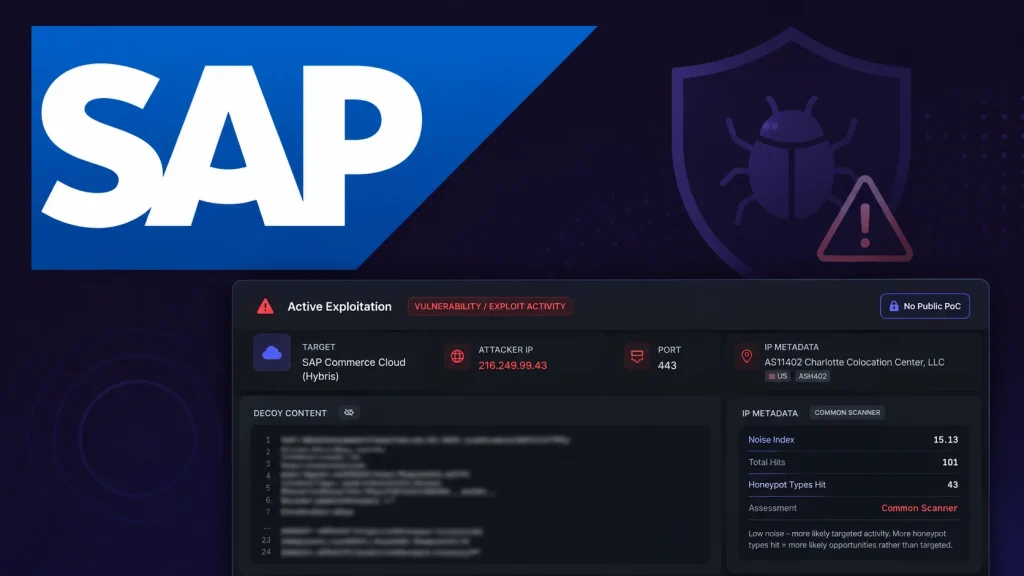
The vulnerability in question, tracked as CVE-2026-58231, affects SAP Commerce Cloud, a vital platform for numerous businesses managing their e-commerce operations. What makes this situation particularly concerning is the immediate hostile activity observed. Cybersecurity researchers, through honeypot telemetry, captured the first wave of unauthenticated remote-execution traffic targeting this flaw. This traffic emerged within a mere 72 hours of the patch release, indicating sophisticated monitoring by threat groups ready to weaponize new disclosures.
The speed of this exploitation attempt suggests that attackers either had prior knowledge of the vulnerability, were actively researching SAP Commerce Cloud for weaknesses, or are employing automated scanning tools that quickly identify systems susceptible to recently patched flaws. Regardless of the method, the implication is clear: the window between patch availability and active exploitation is shrinking rapidly, placing immense pressure on organizations to deploy updates with unprecedented urgency.
The Absence of Public PoC and Its Implications
Perhaps the most striking aspect of this incident is the reported absence of a public Proof of Concept (PoC). Typically, the release of a public PoC significantly accelerates exploitation attempts, as it lowers the barrier to entry for less sophisticated attackers. In this case, attackers initiated their probing and exploitation efforts without such a public guide. This indicates several possibilities:
- Advanced Reconnaissance: Threat actors may have independently discovered the vulnerability or reverse-engineered the patch to understand the underlying flaw.
- Private PoC Development: A PoC may exist and be circulating within closed groups or dark web forums, enabling sophisticated actors to develop their exploits.
- Automated Tooling: Automated vulnerability scanners and fuzzing tools are becoming increasingly adept at identifying exploit pathways, even without explicit PoC code.
The lack of a public PoC should not provide a false sense of security. Instead, it signals a more advanced and persistent threat landscape where attackers are capable of rapid, independent exploit development, making proactive patching even more critical.
Understanding CVE-2026-58231
While specific details about CVE-2026-58231 are still emerging, its classification as a maximum-severity flaw (likely rated 9.8 or higher on the CVSS scale) and the observed remote-execution attempts point to a critical vulnerability. Such flaws typically allow unauthenticated attackers to execute arbitrary code on affected systems, leading to complete system compromise, data exfiltration, or the establishment of persistent backdoors. For e-commerce platforms like SAP Commerce Cloud, this could translate to severe business disruption, financial losses, and significant reputational damage.
Organizations leveraging SAP Commerce Cloud must treat this vulnerability with the highest priority, understanding that a successful exploit could grant attackers full control over their storefronts, customer data, and backend systems.
Remediation Actions
Immediate action is paramount to mitigate the risks posed by CVE-2026-58231. Organizations running SAP Commerce Cloud instances must prioritize the following steps:
- Patch Immediately: Apply the official security fixes released by SAP without delay. This is the most effective and direct mitigation.
- Verify Patch Application: Confirm that the patch has been successfully installed and is active across all relevant SAP Commerce Cloud instances. Do not assume successful deployment; verify it.
- Monitor for Exploitation Attempts: Enhance monitoring of SAP Commerce Cloud environments for any signs of compromise or suspicious activity, particularly unauthenticated remote code execution attempts. Look for unusual process creation, network connections, or file modifications.
- Review Access Logs: Scrutinize access logs for any unauthorized access attempts or indicators of compromise that may have occurred prior to or during the patching window.
- Isolate and Segment: Ensure SAP Commerce Cloud instances are properly segmented within the network, limiting potential lateral movement if a breach occurs.
- Backup Critical Data: Regularly back up all critical data associated with SAP Commerce Cloud and ensure these backups are secure and restorable.
- Incident Response Plan: Have a well-rehearsed incident response plan in place specifically for critical e-commerce systems.
Relevant Tools for Detection and Mitigation
| Tool Name | Purpose | Link |
|---|---|---|
| SAP Security Notes | Official source for patch information and security advisories from SAP. | SAP Support Portal |
| Intrusion Detection/Prevention Systems (IDS/IPS) | Detect and block known exploit patterns and suspicious network traffic. | (Vendor-specific, e.g., Cisco Snort, Palo Alto Networks) |
| Security Information and Event Management (SIEM) | Aggregate and analyze logs for security incidents, including exploitation attempts. | (Vendor-specific, e.g., Splunk, IBM QRadar) |
| Vulnerability Scanners | Identify unpatched systems and other vulnerabilities in your environment. | (Vendor-specific, e.g., Nessus, Qualys, OpenVAS) |
| Web Application Firewalls (WAF) | Protect web applications from common attacks, including remote code execution. | (Vendor-specific, e.g., Cloudflare, Akamai, Imperva) |
Conclusion
The rapid exploitation of CVE-2026-58231 in SAP Commerce Cloud, even without a public PoC, serves as a stark reminder of the relentless nature of cyber threats. Organizations can no longer afford any delay in applying critical security patches. The expectation should be that vulnerabilities will be actively targeted almost immediately upon disclosure. Proactive patching, robust monitoring, and a well-defined incident response strategy are not just best practices; they are essential for survival in an increasingly hostile digital environment.