
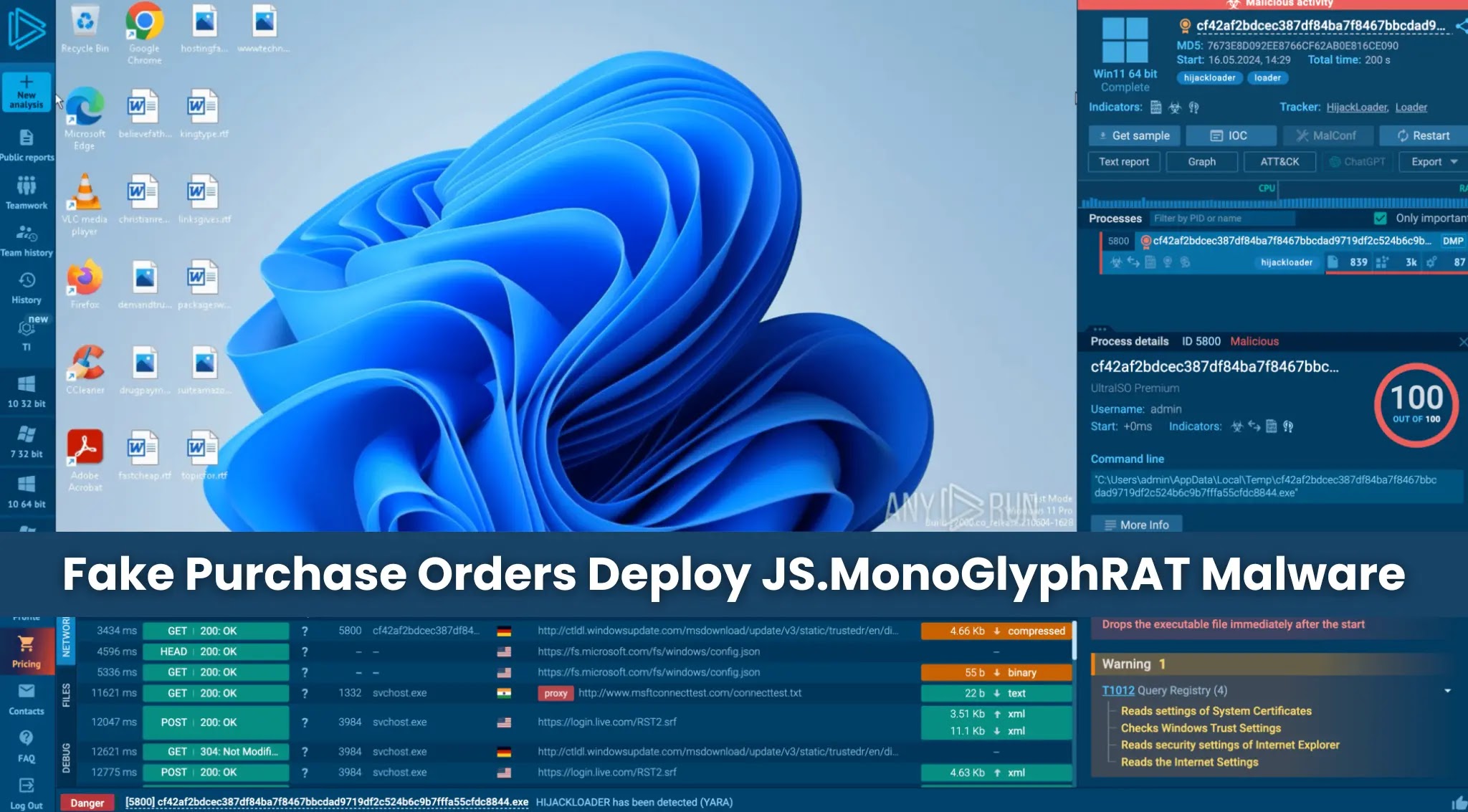
Hackers Use Fake Purchase Orders to Deploy JS.MonoGlyphRAT Targeting US Enterprises
The Silent Menace: JS.MonoGlyphRAT Exploits Fake Purchase Orders in US Enterprises
A disturbing new trend is emerging in the cybersecurity landscape, targeting US businesses with alarming precision. Threat actors are deploying a novel and highly evasive piece of malware, dubbed JS.MonoGlyphRAT, by weaponizing seemingly innocuous business documents like purchase orders, quotes, and requests for proposal. This isn’t just another phishing scam; its stealthy nature allows it to bypass many traditional security defenses, leaving enterprises vulnerable to significant data breaches and operational disruptions.
Cybersecurity researchers have identified this threat as particularly insidious due to its ability to blend seamlessly into everyday business workflows. The initial vector, a fake purchase order, exploits human trust and the high volume of similar legitimate documents processed daily. Once an unsuspecting employee opens the seemingly innocent file, the JS.MonoGlyphRAT begins its covert operations, establishing a foothold within the corporate network.
Understanding JS.MonoGlyphRAT and Its Evasion Tactics
JS.MonoGlyphRAT is a Remote Access Trojan (RAT) specifically designed to evade detection. The “JS” in its name likely refers to JavaScript, often used in initial payload delivery mechanisms or for obfuscation. RATs like MonoGlyph provide attackers with comprehensive control over compromised systems, enabling data exfiltration, further malware deployment, and lateral movement within the network.
The core of its evasion lies in its sophisticated disguise. By masquerading as common business documents, it capitalizes on the human element, which remains the weakest link in many security chains. Furthermore, its execution methods are tailored to bypass signature-based antivirus solutions, often employing obfuscated code or novel infection chains that haven’t yet been cataloged by security vendors.
This malware’s primary targets are US enterprises, suggesting a focus on industrial espionage, financial gain, or disruption of critical business operations. The use of specific document types like purchase orders and RFPs indicates a likely intent to gain access to sensitive financial information, supply chain data, or intellectual property.
The Attack Lifecycle: From Deception to Compromise
The lifecycle of a JS.MonoGlyphRAT attack typically unfolds in several stages:
- Initial Compromise: An email containing a malicious attachment (e.g., a PDF or Microsoft Office document impersonating a purchase order) is sent to an employee.
- Execution: When the employee opens the document, embedded scripts or macros execute the initial payload, often a JavaScript file.
- Payload Delivery: The JavaScript then downloads and executes the main JS.MonoGlyphRAT payload from a command-and-control (C2) server.
- Persistence: The RAT establishes persistence mechanisms (e.g., modifying registry keys, creating scheduled tasks) to ensure it restarts after system reboots.
- Reconnaissance and Exfiltration: Once established, JS.MonoGlyphRAT performs internal reconnaissance, identifies valuable data, and begins exfiltrating it to the attacker’s C2 server.
- Lateral Movement: Attackers often use the compromised machine as a beachhead to move laterally across the network, escalating privileges and compromising additional systems.
Remediation Actions and Proactive Defense
Defending against advanced threats like JS.MonoGlyphRAT requires a multi-layered approach that combines technological solutions with robust human training. As of now, there is no specific CVE associated publicly with JS.MonoGlyphRAT itself, as it’s a newly discovered malware variant rather than a vulnerability in a specific product. However, the attack vectors it exploits often leverage common human and configuration weaknesses.
Technical Controls:
- Email Filtering and Sandboxing: Implement advanced email security gateways with sandboxing capabilities to detect and quarantine malicious attachments before they reach user inboxes.
- Endpoint Detection and Response (EDR): Deploy EDR solutions that can monitor endpoint behavior for
anomalous activities indicative of malware execution, script running, or C2 communication. - Application Whitelisting: Restrict the execution of unauthorized applications and scripts. This can prevent unknown malware like JS.MonoGlyphRAT from running even if it bypasses other defenses.
- Network Segmentation: Isolate critical systems and sensitive data within segmented network zones to limit lateral movement in case of a breach.
- Regular Patching: Ensure all operating systems, applications, and security software are regularly updated and patched to close known vulnerabilities that attackers might exploit.
- Antivirus/Anti-Malware Updates: While JS.MonoGlyphRAT is designed to evade traditional AV, keeping signatures updated provides a baseline defense. Consider next-generation antivirus (NGAV) solutions with behavioral analysis.
Organizational and Human Controls:
- Security Awareness Training: Conduct frequent and engaging training sessions focused on identifying phishing attempts, suspicious email attachments, and the dangers of opening unsolicited documents.
- Principle of Least Privilege: Grant users only the necessary permissions to perform their job functions. This limits an attacker’s reach if an account is compromised.
- Incident Response Plan: Develop and regularly test a comprehensive incident response plan to quickly detect, contain, and eradicate threats.
- Multi-Factor Authentication (MFA): Implement MFA for all critical systems and accounts to prevent unauthorized access even if credentials are stolen.
- Data Backup and Recovery: Maintain regular, secure backups of all critical data to ensure business continuity in the event of a successful attack.
Relevant Tools for Detection and Mitigation:
| Tool Name | Purpose | Link |
|---|---|---|
| Cisco Talos Email Security | Advanced Email Threat Protection & Sandboxing | Cisco Talos |
| CrowdStrike Falcon Endpoint Protection | Next-Gen AV and EDR Capabilities | CrowdStrike Falcon |
| Microsoft Defender for Endpoint | Integrated Endpoint Security Platform | Microsoft Defender |
| Proofpoint Email Security | Email Gateway Defense & Threat Protection | Proofpoint |
| Splunk (SIEM) | Security Information and Event Management | Splunk |
Final Thoughts: Staying Ahead of the Curve
The emergence of JS.MonoGlyphRAT underscores the sophisticated and adaptive nature of modern cyber threats. Attackers are constantly refining their tactics to exploit human vulnerabilities and bypass traditional security measures. Organizations must move beyond basic perimeter defenses and adopt a proactive, threat-informed approach. Regular security audits, continuous employee training, and the deployment of advanced detection and response technologies are no longer optional. Enterprises must prioritize resilience against these stealthy and impactful campaigns to protect their assets and maintain trust.




