
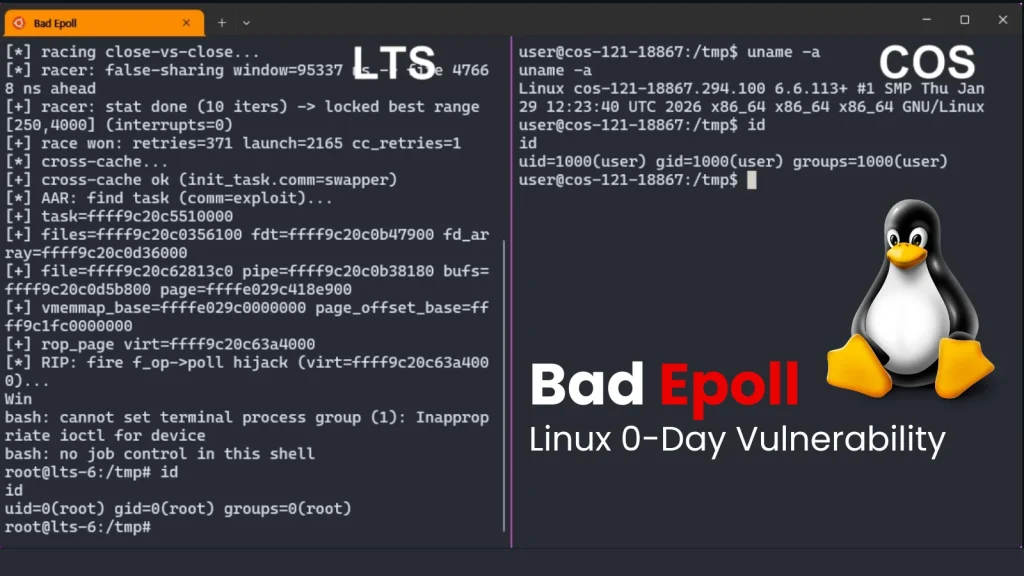
New “Bad Epoll” 0-Day Vulnerability Allows Root Access on Linux Servers and Android Devices
A silent threat has emerged from the depths of the Linux kernel, putting countless systems at risk. Dubbed “Bad Epoll,” this newly discovered zero-day vulnerability (CVE-2026-46242) grants unprivileged local users the ability to seize absolute control, or root access, over vulnerable Linux servers, desktops, and even Android devices. The implications are severe, and understanding this flaw is paramount for maintaining system integrity.
Understanding the Bad Epoll Vulnerability (CVE-2026-46242)
The “Bad Epoll” vulnerability, formally identified as CVE-2026-46242, exploits a critical weak point within the Linux kernel’s epoll subsystem. Epoll is a fundamental component for I/O event notification, allowing applications to efficiently monitor multiple file descriptors to see if I/O is possible. The vulnerability itself is categorized as a use-after-free (UAF) condition, coupled with a race condition during the handling of file descriptors.
Specifically, the flaw occurs within the ep_remove() function. This function is responsible for clearing file->f_ep while operating under file->f_lock. However, the critical error lies in the kernel’s subsequent actions: it continues to process the file descriptor even after it has been freed. An attacker can meticulously time their operations, creating a race condition where they free a file descriptor and then, while the kernel still holds a pointer to the now-freed memory, reallocate that memory for their own malicious purposes. When the kernel then attempts to use the old, now reallocated, pointer, it ends up operating on memory controlled by the attacker, leading to arbitrary code execution with elevated privileges.
Impact of Root Access on Linux and Android Systems
Gaining root access is the ultimate prize for any attacker on a Linux-based system, and the “Bad Epoll” vulnerability delivers exactly that. With root privileges, an attacker can:
- Full System Compromise: Read, write, and execute any file on the system, including sensitive configuration files, user data, and system binaries.
- Data Exfiltration: Steal confidential data, intellectual property, or user credentials.
- Persistent Backdoors: Install persistent malware or backdoors to maintain access even after reboots or patching attempts.
- System Disruption: Shut down services, corrupt data, or render the system inoperable as a form of denial-of-service.
- Lateral Movement: Use the compromised system as a launchpad for further attacks within a network.
- Android Device Hijack: On Android devices, root access means an attacker could install malicious apps, monitor user activity, access personal photos and messages, or completely brick the device.
This level of control poses an existential threat to the integrity and confidentiality of any compromised system.
Remediation Actions and Mitigation Strategies
Given the severity of the “Bad Epoll” zero-day, immediate action is required. While a direct patch from kernel developers is the ultimate solution, several mitigation strategies can help reduce exposure:
- Patching and Updates: Monitor official channels from your Linux distribution vendors (Red Hat, Debian, Ubuntu, etc.) and Android device manufacturers for kernel updates that address CVE-2026-46242. Apply these patches as soon as they become available.
- Principle of Least Privilege: Ensure all user accounts and applications operate with the absolute minimum necessary privileges. This limits the damage an attacker can inflict even if they compromise a low-privileged account.
- Security Enhancements: Implement SELinux or AppArmor for mandatory access control policies. These frameworks can often restrict even root processes from performing certain actions, providing an additional layer of defense against exploitation.
- Regular Auditing and Monitoring: Continuously monitor system logs for suspicious activity, unexpected process behavior, or unauthorized file access. An Intrusion Detection System (IDS) or Security Information and Event Management (SIEM) solution can aid in this.
- Kernel Hardening: Employ kernel hardening techniques where feasible, such as disabling unneeded kernel modules or using features like KASLR (Kernel Address Space Layout Randomization), though KASLR’s effectiveness against UAF can be limited.
- Android Device Caution: For Android users, be wary of sideloading applications from untrusted sources. Keep your device’s operating system updated and only download apps from official app stores.
Detection and Analysis Tools
While the initial fix will come from upstream kernel patches, having the right tools for detection and ongoing analysis is crucial for cybersecurity professionals. Here are some relevant tools:
| Tool Name | Purpose | Link |
|---|---|---|
| AIDE (Advanced Intrusion Detection Environment) | File integrity monitoring to detect unauthorized changes to system files that may indicate compromise. | https://aide.github.io/ |
| Osquery | Operating system instrumentation framework that exposes an operating system as a high-performance relational database. Useful for incident investigation and security monitoring. | https://osquery.io/ |
| Sysdig Falco | Behavioral activity monitor designed to detect anomalous activity, including potential exploit attempts and unauthorized process execution. | https://falco.org/ |
| Lynis | Security auditing tool for Linux, macOS, and Unix-based systems. It performs extensive health checks, including kernel settings and security best practices. | https://cisofy.com/lynis/ |
Conclusion
The “Bad Epoll” 0-day vulnerability (CVE-2026-46242) represents a significant threat to the security posture of Linux servers, desktops, and Android devices. Its ability to grant unprivileged local users root access through a sophisticated race condition and use-after-free flaw underscores the continuous need for vigilance in cybersecurity. Prioritize patching, enforce strong security policies, and deploy robust monitoring solutions to protect your systems from this critical vulnerability and others like it.




