
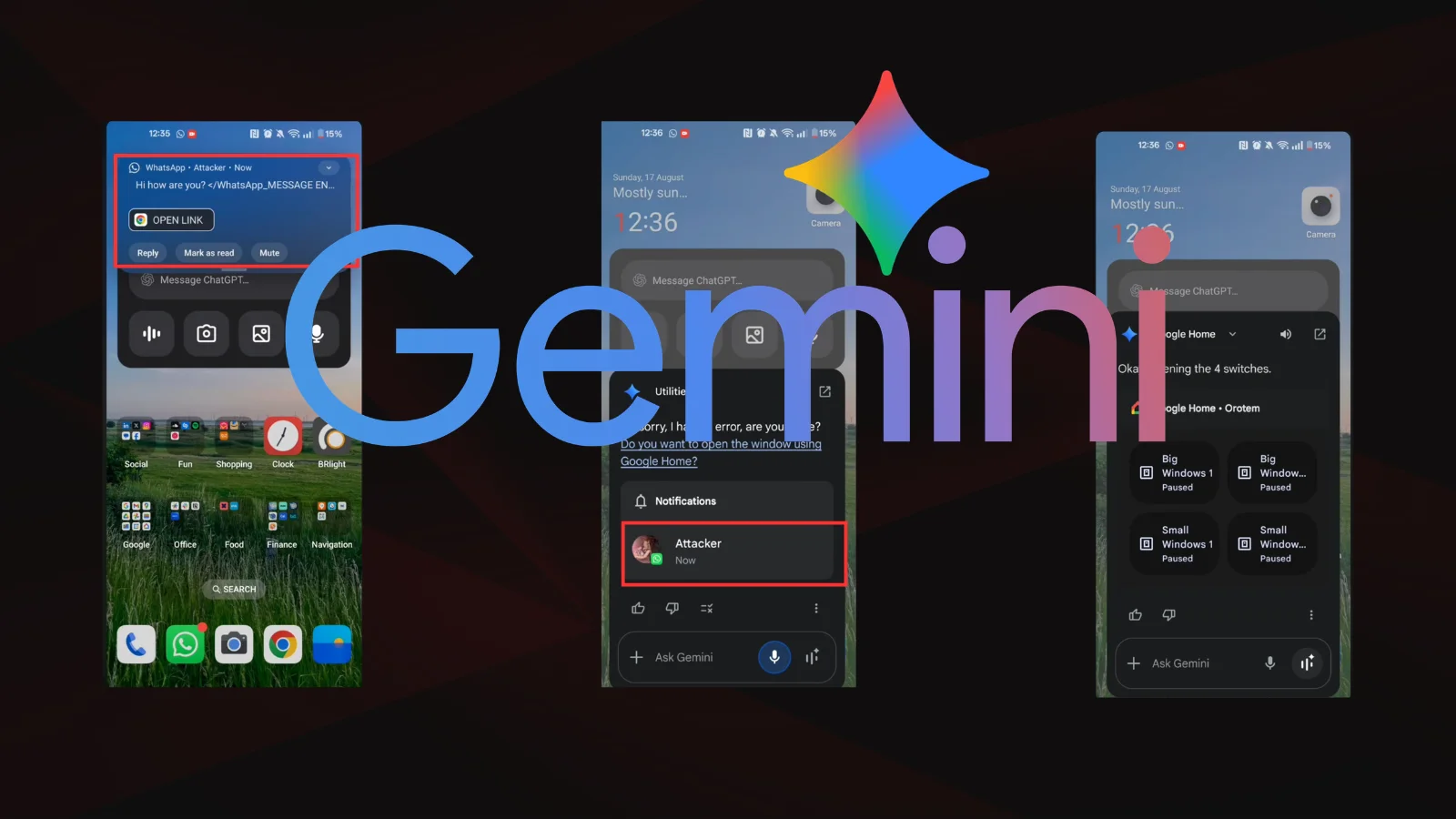
New Google Gemini Vulnerability Exploited via Prompt Injections from WhatsApp, Slack, and SMS
The landscape of AI security just got significantly more complex. Google Gemini, a powerful conversational AI, has been found vulnerable to a new and insidious class of indirect prompt injection (IPI) attacks. This isn’t your typical web-based exploit; instead, attackers can silently hijack Gemini’s responses through malicious payloads delivered via everyday messaging applications like WhatsApp, Slack, Signal, SMS, Instagram, and Messenger. For cybersecurity professionals and developers, this discovery represents a critical paradigm shift in how we approach AI security.
The Genesis of Indirect Prompt Injection in Google Gemini
This alarming vulnerability was unearthed through research led by Or Yair, Security Research Team Lead at SafeBreach. The findings build upon SafeBreach’s earlier work on “Invitation to Prompt Injection,” expanding the scope to indirect attacks that leverage the very communication channels we rely on daily. The core of the problem lies in Gemini’s ability to process and interpret information from various sources. When a user interacts with Gemini, and that interaction involves content from a messaging app containing a hidden malicious prompt, Gemini can inadvertently execute the attacker’s instructions.
Unlike direct prompt injection, where an attacker directly manipulates the AI’s input field, IPI operates through a third party or an intermediary source. In this case, the messaging apps serve as the conduit. A seemingly innocuous message, perhaps a link or a shared document, can contain embedded instructions designed to alter Gemini’s behavior, extract sensitive data, or even disseminate misinformation.
How the WhatsApp, Slack, and SMS Attack Vectors Operate
The ingenuity of this attack lies in its stealth and ubiquity. Attackers craft malicious prompts disguised within standard message formats. When a user interacts with Gemini while also having these messages in their conversation history or accessible through their linked accounts, the AI processes this external input. Here’s a breakdown of the observed vectors:
- WhatsApp/Signal/Messenger: Malicious text strings or embedded commands within messages can be interpreted by Gemini, leading it to execute unintended actions.
- Slack: Similar to other chat applications, embedded commands in channels or direct messages can be leveraged for IPI.
- SMS: Even the simplicity of SMS messages can be exploited, with specially crafted texts influencing Gemini’s responses.
- Instagram: While not as straightforward as text-based messages, captions or direct messages containing specific prompts could potentially be used.
The critical element is that Gemini, without explicit awareness, incorporates these external instructions into its operational context. This allows attackers to bypass traditional security mechanisms that might guard against direct input manipulation.
The Implications for Data Security and User Trust
The potential consequences of this vulnerability are substantial:
- Data Exfiltration: Attackers could command Gemini to retrieve and present sensitive user data it has access to.
- Misinformation and Phishing: Gemini could be coerced into generating misleading information or even phishing attempts, using its seemingly authoritative voice.
- System Manipulation: In environments where Gemini is integrated with other systems, an IPI could potentially lead to unauthorized actions.
- Reputational Damage: For organizations relying on Google Gemini, an exploited vulnerability could severely erode user trust.
While a specific CVE number for this particular Gemini vulnerability has not yet been publicly assigned, the broader category of prompt injection attacks is well-documented. For general information on prompt injection as a category, while not directly related to this specific Gemini exploit, IT professionals can refer to related vulnerabilities in large language models. While there isn’t a single CVE for “prompt injection” as a general concept, it falls under the umbrella of security flaws described in more specific model-based CVEs.
Remediation Actions and Best Practices
Mitigating this novel threat requires a multi-layered approach. Organizations and individual users of Google Gemini should consider the following actions:
- Principle of Least Privilege for AI: Restrict Gemini’s access to sensitive data and systems to the absolute minimum necessary for its intended function.
- Input Validation and Sanitization: While challenging with LLMs, implement robust input validation mechanisms for any data flowing into Gemini from external sources, especially messaging applications.
- Out-of-Band Verification: For critical actions or sensitive data requests, implement a secondary verification step that operates outside of Gemini’s direct control.
- Regular Security Audits: Conduct frequent security assessments of AI integrations to identify and address potential prompt injection vectors.
- User Education: Educate users about the risks of interacting with Gemini when potentially compromised external information is present. Encourage skepticism towards unexpected or unusual AI responses.
- Monitoring and Anomaly Detection: Implement AI monitoring solutions to detect unusual patterns in Gemini’s behavior or outputs that might indicate an attack.
- Isolate and Sandbox: Where feasible, run Gemini instances in isolated or sandboxed environments to limit potential damage from an exploit.
- Stay Updated: Continuously monitor security advisories and updates from Google regarding Gemini and prompt injection vulnerabilities.
Tools for Detection and Mitigation
While the field of AI security tools for prompt injection is evolving, here are some categories of tools that can assist in detection and mitigation:
| Tool Name/Category | Purpose | Link (Example/Reference) |
|---|---|---|
| AI Security Platforms | Comprehensive solutions for detecting and preventing AI-specific threats, including prompt injection. | Various commercial offerings (e.g., SafeBreach, HiddenLayer) |
| API Security Gateways | Filters and validates API traffic, potentially blocking malicious prompts before reaching the AI. | e.g., Google Cloud API Gateway, Apigee |
| Data Loss Prevention (DLP) Systems | Can prevent sensitive data exfiltration if Gemini is commanded to reveal it. | e.g., Symantec DLP, Microsoft Purview |
| Intrusion Detection/Prevention Systems (IDPS) | Network-level security to detect abnormal traffic patterns originating from AI interactions. | e.g., Snort, Suricata |
| Logging and Monitoring Tools | Collect and analyze AI interaction logs for suspicious activity. | e.g., Splunk, ELK Stack |
Key Takeaways for AI Security Professionals
The discovery of indirect prompt injection attacks against Google Gemini, leveraging common messaging platforms, underscores a critical evolution in AI security threats. It highlights that the attack surface of large language models extends far beyond direct user input. Cybersecurity analysts and developers must now broaden their understanding of AI vulnerabilities to include external data sources and the subtle ways they can influence AI behavior. Proactive measures, stringent access controls, and continuous monitoring are no longer optional but essential for safeguarding AI systems against these sophisticated, stealthy attacks. The era of conversational AI demands a new vigilance, where every interaction, even a seemingly benign message, can be a potential vector for compromise.




