
T3MP3ST Security Framework With 35 Tools, Turns AI Coding Agents Into 0-Day Bug Hunters
T3MP3ST: Unleashing AI Agents as Autonomous 0-Day Bug Hunters
The pursuit of zero-day vulnerabilities has traditionally been a highly specialized and resource-intensive endeavor, often relying on expert human red teams or sophisticated, custom-built tools. However, a significant paradigm shift is underway with the introduction of T3MP3ST, an open-source security framework that empowers general-purpose AI coding agents to autonomously hunt for 0-day bugs. This framework radically redefines how we approach vulnerability discovery, offering a potent, scalable solution without the need for bespoke models or extensive cloud infrastructure.
Developed by researcher elder-plinius, T3MP3ST functions not as a new AI model itself, but as an advanced orchestration layer. It seamlessly integrates with existing AI coding agents such as Claude Code, OpenAI’s Codex, and Hermes, transforming them into formidable red-teaming operators. This elegant design eliminates common deployment hurdles, as it requires no new API keys, cloud infrastructure, or additional billing. The implications for cybersecurity operations are profound, democratizing access to advanced offensive security capabilities.
The Architecture of Autonomous Red-Teaming: How T3MP3ST Works
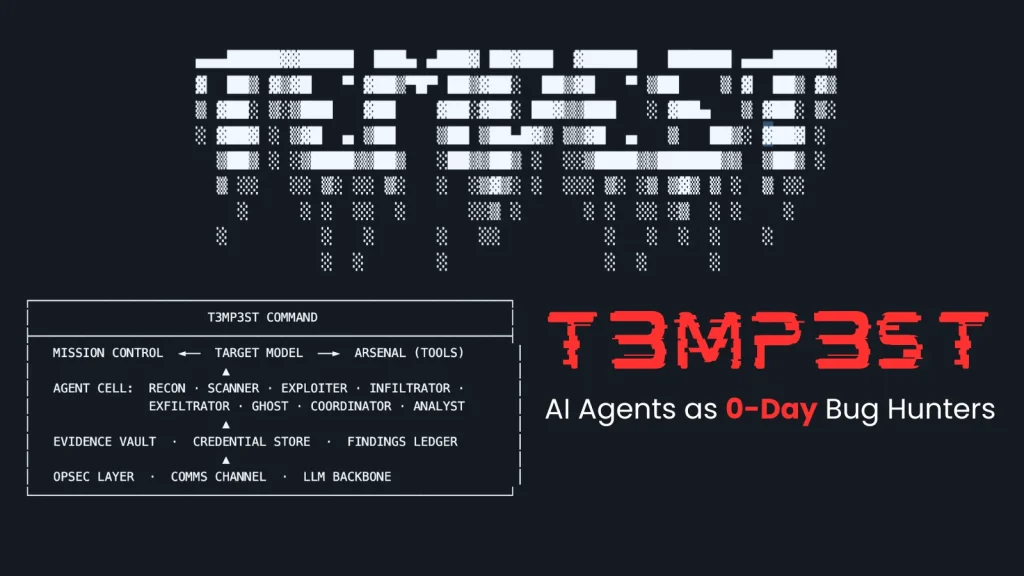
T3MP3ST’s brilliance lies in its ability to coordinate multiple AI agents, treating them as specialized components within a sophisticated vulnerability discovery pipeline. Instead of a single, monolithic AI attempting complex tasks, T3MP3ST assigns specific roles and objectives, leveraging each agent’s strength. This multi-agent approach allows for a division of labor that mimics human red-teaming methodologies, but at an accelerated and automated pace.
The framework’s core comprises 35 integrated tools, each designed to perform a distinct function within the hacking process. These tools range from reconnaissance and enumeration utilities to exploit generation and validation modules. T3MP3ST’s orchestration layer intelligently selects and sequences these tools based on the current stage of the red-teaming operation, dynamically adapting to new information and target responses. By abstracting the complexities of toolchain management, T3MP3ST enables AI agents to focus on the logical reasoning and creative problem-solving critical for identifying novel vulnerabilities.
Beyond Traditional AI Security: The Power of Contextual Hacking
Unlike conventional static analysis tools or fuzzers, T3MP3ST-powered AI agents can engage in contextual hacking. They don’t just look for known patterns; they interpret system behavior, analyze code logic, and even infer potential exploit paths. This capability is crucial for discovering 0-day vulnerabilities, which by definition, lack predefined signatures or exploits.
For instance, an AI agent might analyze a web application’s input validation routines, then use another tool to craft a sophisticated injection payload that bypasses those controls, potentially leading to a previously unknown SQL injection vulnerability (e.g., related to a hypothetical CVE-2023-99999). The framework then automates the verification of this vulnerability, ensuring its exploitability before reporting. This iterative process of discovery, exploitation, and verification is a cornerstone of effective red teaming, now brought to life through AI orchestration.
Implications for Defensive Security and Threat Intelligence
The emergence of frameworks like T3MP3ST carries significant implications for both offensive and defensive cybersecurity strategies. On the offensive side, it elevates the threat landscape by making advanced 0-day hunting accessible to a broader range of actors. This necessitates a proactive defensive posture focused on rigorous security development lifecycles (SDLC) and continuous security testing.
From a defensive standpoint, organizations can potentially leverage similar multi-agent frameworks for enhanced purple teaming exercises. By understanding how an advanced AI attacker would operate, defenders can better predict attack vectors, fortify defenses, and develop more sophisticated detection mechanisms. Furthermore, the insights gained from AI-driven 0-day discovery can directly feed into threat intelligence, helping identify emerging vulnerability classes and informing patch prioritization.
The Future of AI in Red Teaming
T3MP3ST represents a significant leap forward in the application of AI to offensive security. Its open-source nature encourages community contributions and further innovation, potentially leading to even more sophisticated AI-driven red-teaming capabilities. As AI models continue to evolve in their understanding of code, logic, and adversarial thinking, frameworks like T3MP3ST will instrumental in pushing the boundaries of autonomous vulnerability research. The era of AI agents as specialized 0-day bug hunters has truly arrived, demanding a re-evaluation of security strategies across the board.




