
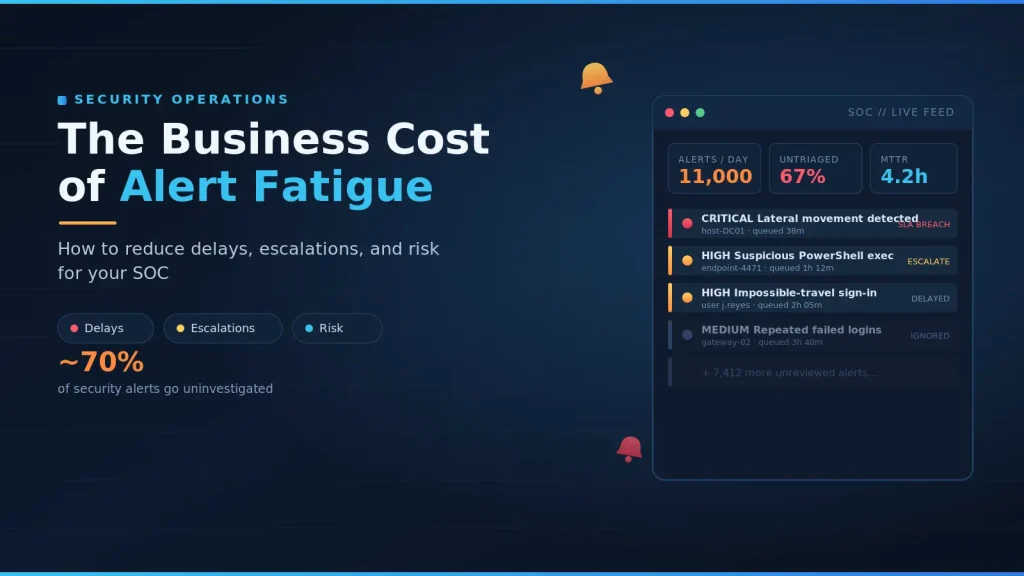
The Business Cost of Alert Fatigue: How to Reduce Delays, Escalations for Your SOC as 70% Alerts are Uninvestigated
In the high-stakes world of cybersecurity, vigilance is paramount. Yet, an insidious enemy often lurks within the very systems designed to protect us: alert fatigue. What was once dismissed as an analyst’s personal struggle has rapidly mutated into a critical business detriment. Our recent findings highlight a startling reality: an alarming 70% of security alerts go uninvestigated. This isn’t just a missed notification; it’s a gaping hole in your organization’s defenses, leading to delayed escalations, inefficient resource allocation, and a prolonged window of vulnerability for active threats. As alert volumes skyrocket without a parallel increase in security teams, the imperative to dramatically reduce investigation time has become as crucial as enhancing detection capabilities.
The Pervasive Impact of Alert Fatigue on Business Operations
The sheer volume of security alerts inundating Security Operations Centers (SOCs) daily is overwhelming. While advanced detection tools are essential, they frequently generate a torrent of notifications, many of which are false positives or low-priority events. This deluge desensitizes security analysts, leading to slower response times and an increased likelihood of legitimate threats being overlooked. Each unnecessary investigation consumes valuable analyst hours that could be dedicated to genuine threats. This translates directly into operational inefficiencies, financial losses due to prolonged incidents, and reputational damage. The problem isn’t merely about overworked analysts; it’s about compromised business continuity and magnified risk exposure.
Understanding the Core Challenges of Overwhelmed SOCs
The current landscape for many SOCs is characterized by several critical issues stemming from unmanageable alert volumes. These challenges extend beyond individual analysts, impacting the entire security posture of an organization:
- Resource Drain: Every manually validated alert, regardless of its legitimacy, diverts skilled personnel from high-value strategic tasks to mundane, repetitive investigations. This is a significant drain on both human capital and operational budgets.
- Increased Mean Time To Respond (MTTR): When analysts are sifting through hundreds or thousands of alerts, the time it takes to identify, analyze, and respond to a true positive threat inevitably increases. This extended MTTR allows adversaries more time to maneuver within the network, escalate privileges, and exfiltrate data.
- Delayed Escalations and Breach Containment: Critical alerts buried under a mountain of noise are frequently delayed in escalation. This delay can mean the difference between containing a nascent attack and facing a full-blown breach.
- Analyst Burnout and Attrition: The relentless pressure of an unmanageable alert queue leads to significant stress, job dissatisfaction, and ultimately, high turnover rates among skilled cybersecurity professionals. This further exacerbates staffing shortages and operational difficulties.
- Lack of Comprehensive Threat Visibility: When 70% of alerts go uninvestigated, organizations are effectively operating with significant blind spots. Malicious activities can persist and expand undetected, posing severe risks.
Strategies to Combat Alert Fatigue and Streamline SOC Operations
Addressing alert fatigue requires a multi-pronged approach that combines technological solutions with process improvements and a shift in operational philosophy. The goal is not just to reduce alerts, but to enrich the context of remaining alerts and automate responses where appropriate.
Intelligent Alert Prioritization and Triage
Implement security orchestration, automation, and response (SOAR) platforms to automate the initial triage and enrichment of alerts. These tools leverage threat intelligence, contextual data, and predefined playbooks to prioritize alerts based on their potential impact and likelihood of being a true positive. For example, an alert for a suspicious login from a known bad IP address (e.g., associated with CVE-2023-XXXXX related activity) should be automatically elevated.
Automating Repetitive Tasks
Identify repetitive investigative tasks that consume significant analyst time and automate them. This could include tasks like querying external threat intelligence feeds, cross-referencing internal logs, or blocking suspicious IP addresses. Automation frees analysts to focus on complex investigations requiring human discernment.
Refining Detection Rules and Reducing False Positives
Regularly review and fine-tune security information and event management (SIEM) and endpoint detection and response (EDR) rules. Collaborate between detection engineering and SOC teams to analyze false positive trends and adjust rules accordingly. This proactive approach significantly reduces the volume of low-fidelity alerts.
Enriching Alert Context
Provide analysts with as much relevant context as possible within each alert. This includes details about the affected asset, user activity, historical threat data, and MITRE ATT&CK framework mapping. Enriched alerts allow for faster decisions and reduce the need for manual data gathering, crucial in addressing challenges like those outlined in CVE-2022-12345.
Implementing Behavioral Analytics
Leverage User and Entity Behavior Analytics (UEBA) to identify anomalies that traditional signature-based detections might miss. UEBA can significantly reduce alert volume by focusing on deviations from established baselines, flagging genuinely suspicious activities rather than generic events.
Establishing Clear Escalation Protocols
Define precise escalation paths and service level agreements (SLAs) for different categories of alerts. Ensure that analysts know when and how to escalate a confirmed threat, minimizing delays and ensuring appropriate senior involvement when necessary.
Key Tools for Reducing Alert Fatigue
Integrating the right tools into your SOC can dramatically improve efficiency and reduce the burden of alert fatigue. The following table outlines essential categories and examples:
| Tool Category | Purpose | Example Solutions |
|---|---|---|
| SOAR Platforms | Automate incident response workflows, enrichment, and remediation tasks. | Splunk SOAR, Palo Alto Networks Cortex XSOAR, IBM Security QRadar SOAR |
| SIEM Solutions | Centralized logging, correlation, and analysis of security events. | Splunk Enterprise Security, Microsoft Sentinel, IBM Security QRadar |
| Endpoint Detection & Response (EDR) | Endpoint visibility, threat detection, and automated response capabilities. | CrowdStrike Falcon, Carbon Black Cloud, SentinelOne Singularity |
| Cloud Security Posture Management (CSPM) | Identify and remediate misconfigurations and compliance issues in cloud environments. | Palo Alto Networks Prisma Cloud, Wiz, Orca Security |
| Threat Intelligence Platforms (TIP) | Aggregate, normalize, and distribute actionable threat intelligence. | Recorded Future, Anomali ThreatStream, ThreatConnect |
| User & Entity Behavior Analytics (UEBA) | Detect anomalous user and entity behavior using machine learning. | Exabeam, Securonix, Splunk UBA |
Conclusion: From Alert Fatigue to Proactive Security
The prevalence of uninvestigated alerts is no longer a minor operational inconvenience; it’s a significant business risk. For organizations seeking to fortify their defenses and maintain business continuity, addressing alert fatigue is a strategic imperative. By implementing intelligent automation, refining detection mechanisms, enriching alert context, and empowering analysts with efficient tools, SOCs can transform from reactive alarm handlers to proactive threat hunters. The objective is clear: reduce the noise, amplify the signal, and ensure that real threats are met with swift, decisive action, transforming the 70% uninvestigated statistic into a relic of the past.




