
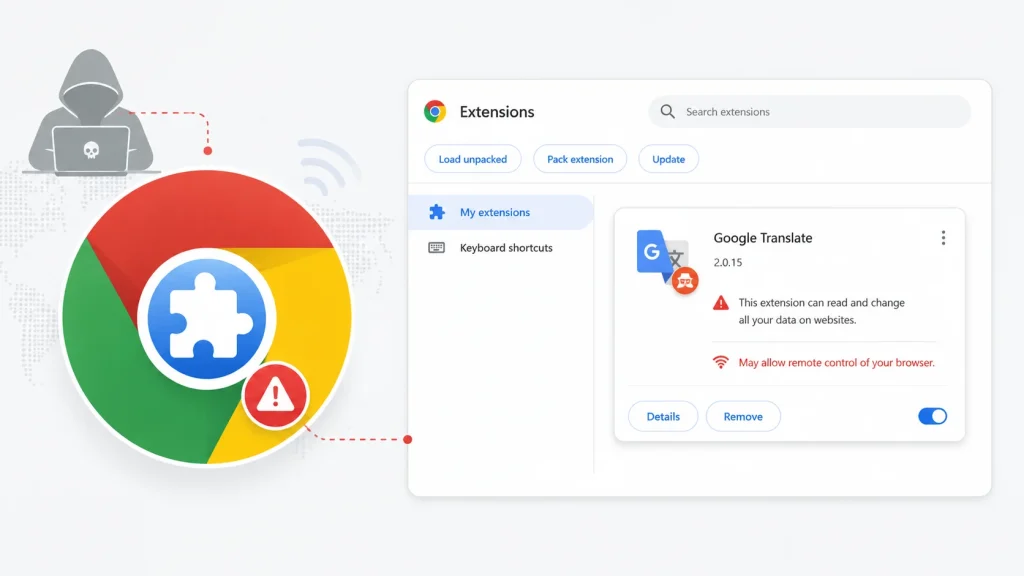
Fake GoogleTranslate Chrome Extension Lets Attackers Remotely Control Your Browsers
The Deceptive Disguise: Fake GoogleTranslate Extension Hijacks Browsers
The digital landscape is rife with threats, and one of the most insidious forms of attack leverages familiar tools against unsuspecting users. A recent discovery by VMRay researchers has brought to light a particularly dangerous campaign involving a malicious Chrome extension posing as the ubiquitous GoogleTranslate. This isn’t just a simple data-stealer; it’s a sophisticated tool granting attackers remote control over victim browsers, silently siphoning sensitive data and even live-streaming web sessions, all while remaining invisible to the user.
Anatomy of the Attack: From Loader to Remote Control
The operation begins with a stealthy entry point: a suspected Rust-based malware loader. This initial binary is the key to unlocking the subsequent stages of the attack. Once executed, the loader’s primary function is to drop and install the malicious Chrome extension. This is a critical step, as legitimate browser extensions operate with elevated privileges, making them a prime target for abuse. By masquerading as a trusted service like GoogleTranslate, the attackers significantly increase their chances of successful installation by users who are unlikely to scrutinize an extension from a seemingly legitimate source.
Once installed, the fake GoogleTranslate extension unleashes a suite of capabilities that are deeply concerning:
- Sensitive Data Exfiltration: The extension is designed to harvest a wide array of sensitive browser data. This can include browsing history, saved credentials, cookies, autofill data, and potentially even financial information entered into web forms.
- Live-Streamed Web Sessions: Perhaps one of the most alarming features is the ability to live-stream the victim’s web sessions. This means attackers can observe, in real-time, every action taken within the browser, effectively having a persistent window into the user’s online activities.
- Remote Browser Interaction: Beyond observation, the threat actors can remotely interact with the victim’s Chrome windows. This could involve navigating to specific websites, injecting malicious scripts, or even performing actions on behalf of the user, all without the victim’s knowledge.
- Covert Operations: A key aspect of this attack is its covert nature. The extension is engineered to keep its malicious activity out of the victim’s view, ensuring prolonged compromise and maximizing data theft opportunities.
The Threat of Browser Extension Compromise
Browser extensions, while incredibly useful, represent a significant attack surface. Their ability to interact directly with web content and often access sensitive browser APIs makes them powerful tools, both for legitimate purposes and for malicious ones. This particular campaign highlights the escalating sophistication of attackers who are now building custom malware loaders specifically to deliver malicious extensions. The use of a known and trusted brand like GoogleTranslate for obfuscation further underscores the need for extreme vigilance.
Remediation Actions and Prevention
Protecting against sophisticated threats like this fake GoogleTranslate extension requires a multi-layered approach. Users and organizations must be proactive in their cybersecurity posture.
- Scrutinize Extension Sources: Always download extensions directly from the official Chrome Web Store. Even then, carefully review the publisher, reviews, and requested permissions before installation. Be wary of extensions offered through third-party websites or unexpected prompts.
- Regularly Review Installed Extensions: Periodically audit your installed browser extensions. Remove any that are no longer needed or seem suspicious. Access this through Chrome settings (
chrome://extensions). - Endpoint Detection and Response (EDR): Implement and maintain robust EDR solutions. These tools can detect suspicious process activity, including the installation of unauthorized software and the dropping of malicious binaries like the Rust-based loader in this attack.
- Antivirus/Anti-Malware Software: Ensure all systems are protected with up-to-date antivirus and anti-malware software that includes real-time protection. Regularly scan your system for threats.
- User Education: Educate users about the dangers of phishing, malvertising, and social engineering tactics that might trick them into installing malicious software or extensions.
- Least Privilege Principle: For corporate environments, enforce the principle of least privilege. Limit user permissions to prevent unauthorized software installation.
- Patch Management: Keep operating systems, browsers, and all software up to date. Vulnerabilities in legitimate software can be exploited to facilitate the initial compromise.
- Network Monitoring: Monitor network traffic for unusual outbound connections or communication patterns that might indicate data exfiltration or command-and-control activity.
Detection and Analysis Tools
For security professionals, several tools can aid in the detection, analysis, and mitigation of such threats.
| Tool Name | Purpose | Link |
|---|---|---|
| VMRay Platform | Automated malware analysis and threat intelligence. | https://www.vmray.com/ |
| VirusTotal | Online service to analyze suspicious files and URLs for malware. | https://www.virustotal.com/ |
| Procmon (Process Monitor) | Advanced monitoring tool for Windows that shows real-time file system, Registry and process/thread activity. | https://learn.microsoft.com/en-us/sysinternals/downloads/procmon |
| Wireshark | Network protocol analyzer to inspect network traffic for suspicious activity. | https://www.wireshark.org/ |
| Cuckoo Sandbox | Automated malware analysis system. | https://cuckoosandbox.org/ |
Key Takeaways
The discovery of this fake GoogleTranslate Chrome extension underscores a critical evolution in attack methodologies. Threat actors are increasingly leveraging trusted brands and powerful browser extension capabilities to achieve deep and persistent access to victim systems. The ability to remotely control browsers, live-stream sessions, and stealthily exfiltrate sensitive data presents a severe risk to both individual users and corporate entities. Vigilance in extension management, coupled with robust endpoint protection and continuous user education, is paramount in defending against these sophisticated and covert cyber threats.




