
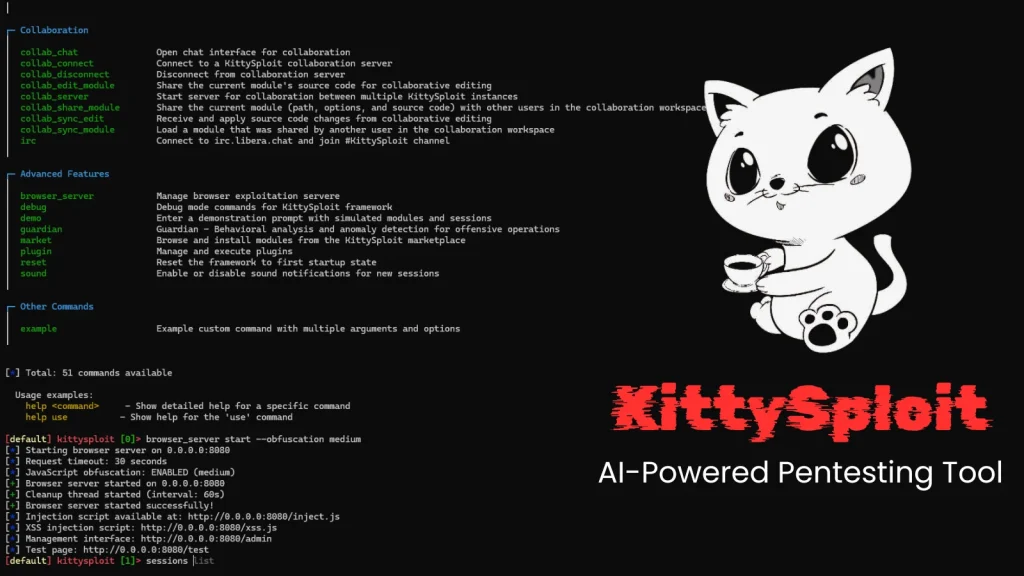
KittySploit – AI-Powered Next-Generation Penetration Testing Framework With 1150+ Modules
The pace of cyber threats demands innovation from offensive and defensive security teams alike. Traditional penetration testing frameworks, while powerful, often rely on manual execution and human-driven analysis. This reliance can limit their scalability and efficiency against increasingly sophisticated adversaries. Enter KittySploit, a formidable open-source penetration testing framework poised to redefine offensive security operations by directly integrating artificial intelligence.
KittySploit: A New Breed of Penetration Testing Framework
KittySploit isn’t just another penetration testing tool; it represents a significant leap forward in offensive security technology. Developed with a hybrid Python and Zig codebase, it leverages the strengths of both languages – Python for rapid development and extensive libraries, and Zig for performance-critical components. Its core innovation lies in its direct integration of autonomous AI agents, powered by local large language models (LLMs) via Ollama. This approach moves beyond simple automation, allowing the framework to exhibit a level of adaptive intelligence during security assessments.
Key Capabilities and Module Arsenal
With an astounding library of over 1,150 modules, KittySploit provides a comprehensive suite of tools for various stages of the penetration testing lifecycle:
- Reconnaissance: Modules dedicated to information gathering and target profiling.
- Exploitation: A vast array of exploits targeting numerous vulnerabilities across different platforms and services.
- Traffic Analysis: Tools for intercepting, analyzing, and manipulating network traffic.
- Payload Generation: Capabilities to craft sophisticated and evasive payloads.
- Collaboration: Features designed to facilitate teamwork among penetration testers.
- Post-Exploitation: Modules for maintaining access, escalating privileges, and furthering objectives within compromised environments.
This extensive module count positions KittySploit as a versatile tool for offensive security teams, enabling them to simulate a wide range of real-world attack scenarios.
The AI-Powered Difference: Local LLM Integration
The true differentiator for KittySploit is its integration of local large language models through Ollama. Unlike cloud-based AI solutions, this local execution ensures enhanced privacy and control over sensitive data during penetration tests. The autonomous AI agents are designed to intelligently navigate attack paths, analyze targets, and potentially even suggest exploitation strategies, significantly reducing the manual overhead typically associated with complex engagements. This “next-generation” aspect shifts the paradigm from purely manual execution to an augmented, intelligent workflow, empowering security professionals to tackle more intricate security challenges.
Addressing Common Cybersecurity Challenges with KittySploit
KittySploit directly addresses several pain points in modern penetration testing:
- Scalability: Automating aspects of reconnaissance and exploitation allows teams to cover more ground and assess larger environments efficiently.
- Complexity: The AI agents can help navigate complex IT infrastructures and identify subtle attack vectors that might be missed by human-only assessment.
- Efficiency: By streamlining workflows and intelligently suggesting next steps, KittySploit can drastically reduce the time spent on repetitive tasks, freeing up analysts for higher-level strategic analysis.
- Evolving Threat Landscape: The framework’s modular nature and AI capabilities make it adaptable to new vulnerabilities and attack techniques. While specifics of recent vulnerabilities like CVE-2023-46805 (Ivanti Connect Secure vulnerability) or CVE-2024-21310 (Microsoft SharePoint Server Privilege Escalation) might not be explicitly detailed in the introductory description, the framework’s expansive module set is designed to incorporate and address such critical exposures through its exploitation capabilities.
Implications for Offensive Security Teams
For offensive security teams, KittySploit represents a powerful augmentation to their toolkit. It enables:
- Enhanced Attack Simulations: Conduct more realistic and comprehensive simulations of sophisticated cyberattacks.
- Faster Vulnerability Discovery: Accelerate the identification of critical weaknesses in systems and applications.
- Improved Resource Utilization: Optimize the allocation of human expertise by offloading mundane or computationally intensive tasks to AI agents.
- Better Collaboration: Built-in collaboration features streamline team efforts during complex engagements.
Conclusion
KittySploit stands out as an innovative open-source penetration testing framework, marrying a robust codebase with the transformative power of AI. Its extensive module library and unique integration of local LLMs through Ollama position it as a critical tool for modern offensive security teams. By automating and intelligently guiding various stages of penetration testing, KittySploit empowers security professionals to conduct more effective, efficient, and comprehensive security assessments, ultimately strengthening an organization’s defense posture against an ever-evolving threat landscape.




