
ClickFix Campaign Delivers Modular TELEPUZ Malware With 36 Remote Commands
Unmasking ClickFix: A Deep Dive into the TELEPUZ Malware Campaign
The digital threat landscape constantly shifts, and a new, insidious campaign dubbed ClickFix is now actively targeting Windows users. This sophisticated operation leverages deceptive web pages to trick victims into self-infecting their systems with a potent new remote-access malware known as TELEPUZ. As cybersecurity professionals, understanding the mechanics and implications of such attacks is paramount. This analysis deciphers the ClickFix campaign, sheds light on the modular capabilities of TELEPUZ, and provides actionable remediation strategies.
The Deceptive Lure: How ClickFix Initiates Infection
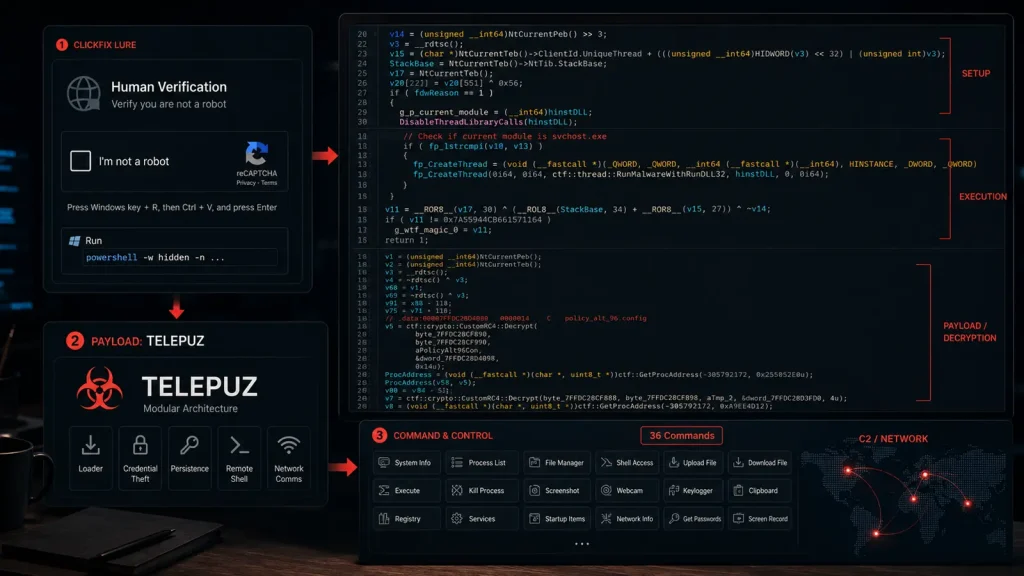
The ClickFix campaign begins with a classic, yet alarmingly effective, social engineering tactic. Users are directed to meticulously crafted, fake verification pages. These pages often mimic legitimate security checks or system diagnostics, creating a false sense of urgency and authority. The core deception lies in the prompt presented to the user: they are instructed to copy and paste a specific command into their command prompt or PowerShell window. This seemingly innocuous action is, in fact, the initial vector for TELEPUZ.
By convincing users to execute commands themselves, the attackers bypass many traditional security layers that aim to prevent automated malware downloads or exploits. This user-initiated execution grants the malware the necessary permissions to establish persistence and begin its malicious operations, making the ClickFix campaign particularly dangerous due to its reliance on human trust and unwitting cooperation.
TELEPUZ: A Modular and Potent Remote-Access Trojan
At the heart of the ClickFix campaign is TELEPUZ, a lightweight but remarkably capable remote-access malware. Don’t let its “lightweight” description mislead you; TELEPUZ is engineered for stealth and efficiency. Its modular design allows operators to deploy specific functionalities as needed, making it adaptable to various attack scenarios. The malware’s primary function is to establish a covert channel for its operators, enabling them to exert extensive control over compromised systems.
Our analysis indicates that TELEPUZ can receive and execute up to 36 distinct remote commands. This extensive command set grants attackers a broad spectrum of capabilities, including but not limited to:
- Data Exfiltration: Stealing sensitive files, documents, and credentials.
- System Information Gathering: Collecting detailed information about the compromised host.
- Remote Code Execution: Deploying additional malware or executing arbitrary commands.
- Keylogging: Capturing keystrokes for credential harvesting.
- Screenshot Capture: Visually monitoring user activity.
- Persistence Mechanisms: Ensuring continued access even after system reboots.
- Process Manipulation: Starting, stopping, or injecting into processes.
The modular nature of TELEPUZ means that its footprint on the compromised system can be minimized, making detection more challenging. New functionalities can be pushed to the malware as new objectives arise, illustrating a dynamic and evolving threat.
Remediation Actions and Proactive Defenses
Defending against campaigns like ClickFix and malware like TELEPUZ requires a multi-layered security approach focusing on prevention, detection, and response. Here are critical actions for IT professionals and security analysts:
- User Education is Paramount: Train employees to recognize social engineering tactics, especially those prompting command execution. Emphasize verification processes and the dangers of copying and pasting unknown commands.
- Implement Least Privilege: Restrict user permissions to the absolute minimum necessary for their job functions. This limits the damage if a user inadvertently executes a malicious command.
- Endpoint Detection and Response (EDR): Deploy EDR solutions that can monitor for unusual process activity, command-line executions, and network connections indicative of TELEPUZ activity. Many EDR platforms can flag suspicious parental processes launching command prompts or PowerShell.
- Network Segmentation: Isolate critical systems and sensitive data. If a workstation is compromised, network segmentation can prevent TELEPUZ from spreading laterally to high-value assets.
- Application Whitelisting: Implement application whitelisting policies to restrict the execution of unauthorized programs. This can prevent TELEPUZ and other unapproved executables from running.
- Regular Patching and Updates: Ensure all operating systems and applications are regularly updated to mitigate known vulnerabilities. While ClickFix relies on user interaction, patching closes other potential attack vectors.
- Web Filtering and Email Security: Employ robust web filtering to block access to known malicious domains and enhance email security to filter out phishing attempts that might lead to ClickFix lures.
Tools for Detection and Analysis
Leveraging the right tools can significantly enhance your ability to detect and analyze threats like TELEPUZ.
| Tool Name | Purpose | Link |
|---|---|---|
| Sysmon | Advanced activity monitoring on Windows systems, essential for detecting unusual command executions and process creations. | https://learn.microsoft.com/en-us/sysinternals/downloads/sysmon |
| Process Explorer | Detailed view of active processes, including DLLs loaded and handles opened, useful for identifying unusual process behavior. | https://learn.microsoft.com/en-us/sysinternals/downloads/process-explorer |
| Wireshark | Network protocol analyzer to inspect network traffic for suspicious C2 communications from TELEPUZ. | https://www.wireshark.org/ |
| YARA Rules | Pattern matching tool used to identify and classify malware samples based on unique strings or binary patterns. | https://virustotal.github.io/yara/ |
Conclusion
The ClickFix campaign, delivering its modular TELEPUZ payload through user-initiated command execution, serves as a stark reminder of the persistent and evolving nature of cyber threats. Its reliance on social engineering highlights the critical importance of user awareness and robust security hygiene. By understanding the attack vectors, recognizing the capabilities of modern malware like TELEPUZ, and implementing comprehensive remediation strategies, organizations can significantly bolster their defenses against such sophisticated threats. Staying informed and proactive is key to navigating the complexities of the current cybersecurity landscape.




