
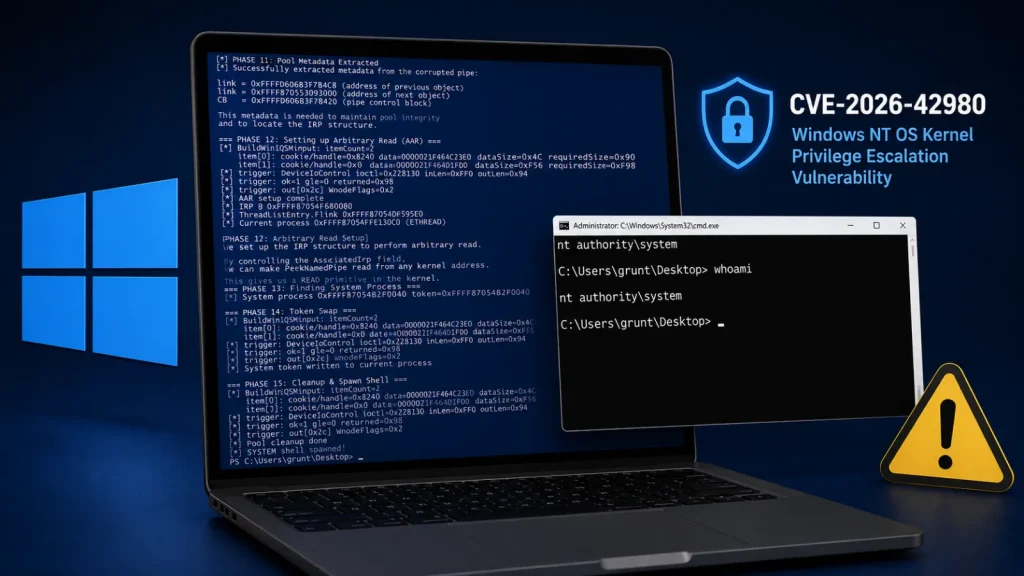
Public PoC Released for Windows NT OS Kernel Privilege Escalation Vulnerability
A significant development in the cybersecurity landscape has emerged with the public release of a Proof-of-Concept (PoC) exploit for a critical local privilege escalation (LPE) vulnerability affecting the Windows NT OS Kernel. Identified as CVE-2026-42980, this flaw presents a substantial risk, allowing attackers to gain elevated privileges on compromised systems. Understanding the mechanics and implications of such vulnerabilities is paramount for maintaining robust system security.
Understanding CVE-2026-42980: An Integer Underflow Explained
The vulnerability, formally tracked as CVE-2026-42980, resides within the Windows NT OS Kernel. At its core, this is an elevation-of-privilege flaw triggered by an integer underflow condition during a specific kernel code path. An integer underflow occurs when an arithmetic operation attempts to create a numeric value that is smaller than the minimum value that the integer type can represent. When this happens, the value “wraps around” to the maximum possible value, often leading to unexpected behavior and, in this case, potential security bypasses.
In the context of a kernel-mode operation, such an underflow can lead to various critical issues, including out-of-bounds memory access, corruption of kernel data structures, or the ability to execute arbitrary code with kernel privileges. For CVE-2026-42980, the integer underflow specifically allows an attacker with low-level access to escalate their privileges to NT AUTHORITY\SYSTEM, effectively gaining complete control over the affected system.
The Impact of a Public PoC
The release of a public PoC for CVE-2026-42980 significantly amplifies the urgency of addressing this vulnerability. A PoC provides a working demonstration of how an exploit can be executed, making it easier for malicious actors to develop and deploy their own attacks. Even less sophisticated attackers can leverage readily available PoC code to target vulnerable systems. This drastically shortens the window between vulnerability disclosure and active exploitation, often referred to as the “patch gap” or “exploit gap.”
For organizations, this means an increased risk of:
- System Compromise: Attackers can move from initial access to full system control.
- Data Breaches: Elevated privileges can lead to unauthorized access to sensitive data.
- Persistent Presence: Adversaries can install backdoors or rootkits, maintaining control even after initial detection.
- Lateral Movement: With kernel-level access, attackers can more easily pivot to other systems within a network.
Affected Systems and Scope
The vulnerability specifically targets the Windows NT OS Kernel. While the “NT” designation might suggest older operating systems, the core NT kernel architecture underpins all modern Windows client and server operating systems. Therefore, enterprises should assume a broad scope of potentially affected systems, including:
- Windows 11
- Windows 10
- Windows Server (various versions)
Details regarding specific affected versions and patches will typically be provided by Microsoft through their security advisories. It is crucial to stay updated on these official communications.
Remediation Actions for CVE-2026-42980
Immediate action is required to mitigate the risks associated with CVE-2026-42980. Organizations should prioritize the following:
- Apply Security Updates Promptly: The most effective defense is to install the official security patches released by Microsoft. Monitor Microsoft’s Security Update Guide for updates related to CVE-2026-42980 and deploy them across all affected systems as soon as they become available.
- Least Privilege Principle: Enforce the principle of least privilege rigorously. Ensure that users and applications operate with the minimum necessary permissions. This can limit the impact of a successful privilege escalation, even if an exploit is successful.
- Endpoint Detection and Response (EDR): Utilize EDR solutions to monitor for suspicious activity and potential exploitation attempts. EDR can help detect the unusual process behavior or memory accesses indicative of privilege escalation.
- Regular Vulnerability Scanning: Conduct regular vulnerability scans to identify unpatched systems and other potential weaknesses in your environment.
- Security Awareness Training: Educate users about phishing and other social engineering tactics that can serve as initial access vectors for attackers before they attempt privilege escalation.
Recommended Tools for Detection and Mitigation
Adopting a layered security approach with appropriate tools can significantly enhance your defense against vulnerabilities like CVE-2026-42980.
| Tool Name | Purpose | Link |
|---|---|---|
| Microsoft Security Update Guide | Official source for security updates and advisories. Track patches for CVEs. | msrc.microsoft.com/update-guide |
| Windows Update / WSUS / SCCM | Deployment of critical security patches across Windows environments. | docs.microsoft.com/en-us/windows-server/get-started/whats-new-in-wsus |
| Endpoint Detection and Response (EDR) Solutions | Real-time threat detection, incident response, and behavioral analysis on endpoints. | (Provider-specific: Carbon Black, CrowdStrike, SentinelOne, Microsoft Defender for Endpoint) |
| Vulnerability Scanners | Identify unpatched systems and configuration weaknesses across the network. | (Nessus, Qualys, OpenVAS) |
| Microsoft System Internals Suite (Process Monitor) | Advanced monitoring of file system, Registry, process, and network activity. Useful for forensic analysis. | docs.microsoft.com/en-us/sysinternals/downloads/procmon |
Conclusion
The disclosure of a public PoC for CVE-2026-42980, an integer underflow vulnerability in the Windows NT OS Kernel, is a critical event for cybersecurity professionals. It underscores the ongoing importance of diligent patch management, robust security practices, and continuous monitoring. Organizations must act swiftly to apply available patches and implement defensive measures to protect their Windows environments from potential privilege escalation attacks. Staying informed through official channels and maintaining a proactive security posture are essential for navigating these evolving threats.




