
A Hidden Line of Website Text Can Turn AWS Kiro Into a Remote Code Execution Tool
The promise of AI-powered development tools is immense, offering to streamline workflows and accelerate innovation. However, as with any powerful technology, security must be paramount. A recent disclosure sheds light on a concerning vulnerability in AWS Kiro, an AI-driven Integrated Development Environment (IDE), demonstrating how a seemingly innocuous line of text hidden on a website could be weaponized for remote code execution (RCE) on a developer’s machine.
This isn’t merely a theoretical exploit; it’s a stark reminder that even sophisticated security models, particularly those relying on “human-in-the-loop” approvals, can be circumvented. For developers and security professionals alike, understanding this attack vector is crucial to safeguarding development environments.
Understanding AWS Kiro’s Security Model and the Vulnerability
AWS Kiro, designed as an AI assistant for developers, operates on a principle of user consent for potentially dangerous actions. This “human-in-the-loop” mechanism is intended to prevent malicious code execution by prompting the user for approval before running shell commands or other high-risk operations. The core of this vulnerability, however, lies in how Kiro processes certain instructions, particularly those related to web content.
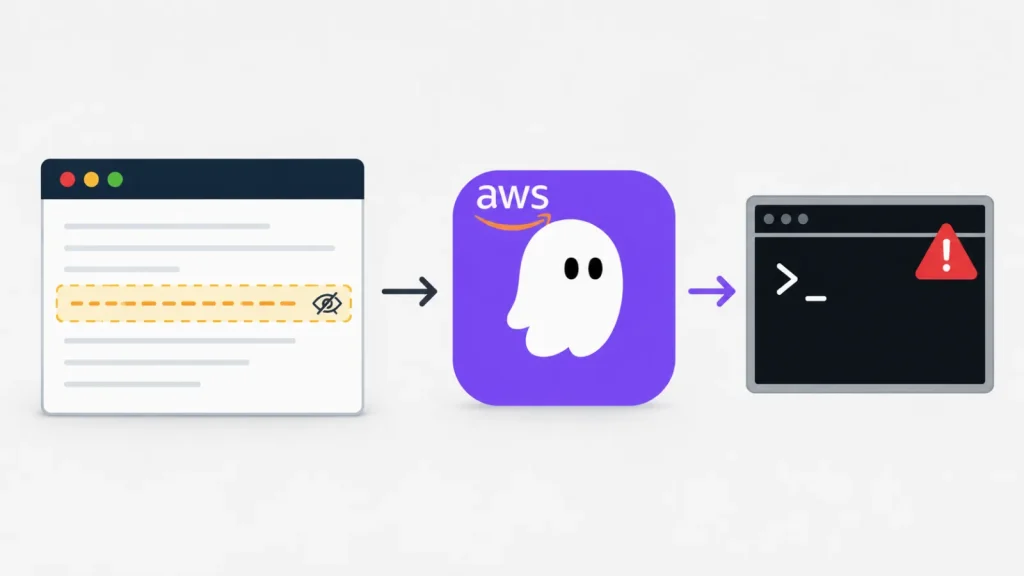
The exploit leverages a hidden line of text within a webpage, which, when encountered by Kiro, is interpreted as a command to execute. The attacker doesn’t need to directly interact with the Kiro environment or trick the user into explicitly approving a dangerous command. Instead, the malicious instruction is embedded discreetly, bypassing the intended security prompts. This essentially creates an uncontrolled execution path, turning a developer’s browser interaction into a gateway for RCE.
While a specific CVE for this exact AWS Kiro vulnerability is not publicly listed at the time of writing, it highlights a broader class of vulnerabilities often referred to as “supply chain attacks” or “web-based code injection.”
The Mechanics of the Remote Code Execution
The attack scenario is deceptively simple. A developer, using AWS Kiro, might navigate to a compromised website or a legitimate site with injected malicious code. Within the HTML or JavaScript of that page, an attacker could embed a specially crafted string that Kiro interprets as an instruction to execute arbitrary code on the developer’s local machine. Because Kiro is designed to assist with development tasks, it has the necessary permissions to perform these actions.
Crucially, the “human-in-the-loop” approval mechanism falls short because the malicious instruction isn’t presented to the user in a way that triggers a security warning. It’s processed silently, leading to the remote execution of code without explicit developer consent. This could range from simple information gathering to installing malware, exfiltrating sensitive data, or even establishing a persistent backdoor.
Implications for Developers and Organizations
The ramifications of this vulnerability are significant:
- Compromised Development Environments: An attacker could gain full control over a developer’s machine, leading to the compromise of source code, credentials, and access keys.
- Supply Chain Attacks: Malicious code injected through this RCE could then be propagated into legitimate software repositories, affecting downstream users and customers.
- Data Exfiltration: Sensitive intellectual property, personal identifiable information (PII), or company secrets could be stolen from compromised workstations.
- Reputational Damage: For organizations using such tools, a breach stemming from this vulnerability could severely damage trust and reputation.
Remediation Actions and Best Practices
Addressing vulnerabilities like the one found in AWS Kiro requires a multi-layered approach, combining immediate technical fixes with robust security practices.
For AWS Kiro Users and Developers:
- Software Updates: Immediately apply any available patches or updates released by AWS for Kiro. Developers should always prioritize keeping their IDEs and associated tools current.
- Input Validation and Sanitization: While Kiro’s internal mechanisms are primarily responsible, developers should be mindful of the content they browse, especially when using an IDE with web-parsing capabilities.
- Least Privilege Principle: Ensure that Kiro, and any development tool, operates with the absolute minimum permissions necessary to perform its functions. Restricting network access or file system write permissions can limit damage.
General Security Best Practices:
- Web Browsing Hygiene: Exercise extreme caution when visiting untrusted websites. Implement browser security extensions that block malicious scripts and advertisements.
- Endpoint Detection and Response (EDR): Deploy EDR solutions on developer workstations to detect and respond to suspicious activity, including unauthorized code execution.
- Security Awareness Training: Educate developers about the risks of sophisticated web-based attacks, phishing, and social engineering.
- Regular Security Audits: Periodically audit development environments, including IDE configurations and installed plugins, for potential vulnerabilities.
- Network Segmentation: Isolate development networks from production environments to contain potential breaches.
Tools for Detection and Mitigation
Here’s a table outlining relevant tools that can assist in detecting or mitigating such vulnerabilities:
| Tool Name | Purpose | Link |
|---|---|---|
| AWS Security Hub | Centralized security alerts and compliance checks for AWS services. | https://aws.amazon.com/security-hub/ |
| OWASP ZAP | Web application security scanner, can identify web-based vulnerabilities. | https://www.zaproxy.org/ |
| Burp Suite | Integrated platform for performing security testing of web applications. | https://portswigger.net/burp |
| Endpoint Detection & Response (EDR) Solutions (e.g., CrowdStrike, SentinelOne) | Detects and responds to advanced threats on endpoints, including RCE attempts. | https://www.crowdstrike.com/ https://www.sentinelone.com/ |
| Web Application Firewalls (WAFs) (e.g., AWS WAF, Cloudflare WAF) | Protects web applications from web-based attacks by filtering and monitoring HTTP traffic. | https://aws.amazon.com/waf/ https://www.cloudflare.com/waf/ |
Key Takeaways
The AWS Kiro RCE vulnerability serves as a critical reminder that security is a continuous process, even with advanced AI-powered tools. The ability for a hidden line of text to bypass a “human-in-the-loop” security model underscores the importance of thorough security assessments and defensive coding practices. Developers and organizations must remain vigilant, prioritize timely updates, and implement comprehensive security measures to protect their development environments from increasingly sophisticated threats.




