
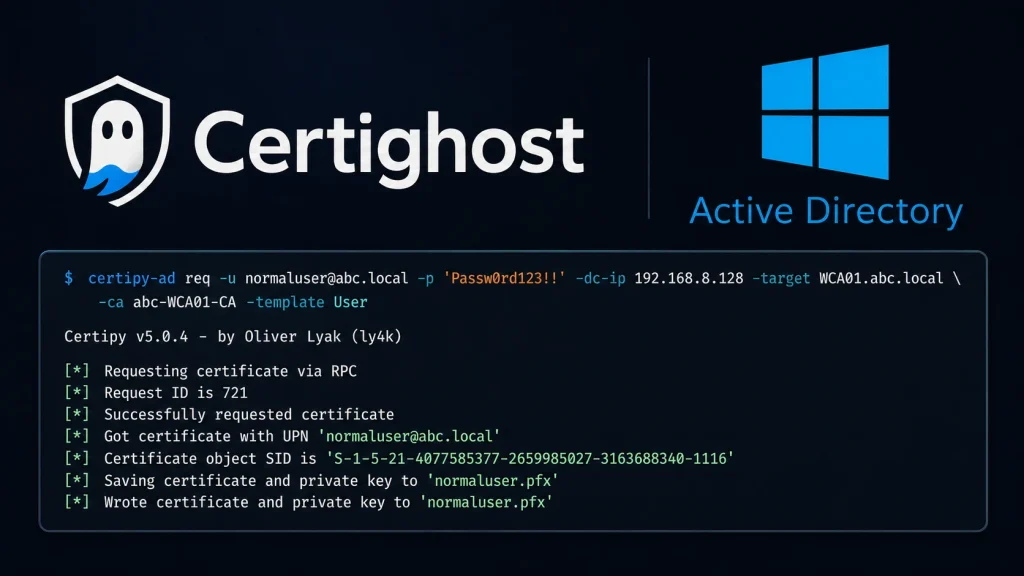
Certighost Active Directory CS Exploit Allows Low-Privileged Users to Compromise Domain
The digital landscape is a constant battleground, and even the most trusted components of enterprise infrastructure can harbor critical weaknesses. A stark reminder of this reality recently emerged with the disclosure of “Certighost,” a severe vulnerability in Active Directory Certificate Services (AD CS). This critical flaw, tracked as CVE-2026-54121, allowed a low-privileged domain user to elevate their privileges dramatically, ultimately impersonating a Domain Controller and compromising an entire Active Directory domain.
Understanding the implications of Certighost is vital for any organization relying on Active Directory for authentication and authorization. This post will delve into the nature of this vulnerability, its potential impact, and the essential steps organizations must take to secure their environments.
What is Certighost (CVE-2026-54121)?
Certighost (CVE-2026-54121) represents a critical privilege escalation vulnerability within Microsoft’s Active Directory Certificate Services (AD CS). AD CS is a cornerstone of many enterprise security architectures, responsible for creating, validating, and managing public key infrastructure (PKI) certificates. These certificates are fundamental for secure communication, authentication, and encryption across the domain.
The core of the Certighost flaw allowed an attacker with standard, low-level domain user privileges to exploit a weakness within the AD CS configuration. By leveraging this vulnerability, the attacker could effectively trick the domain into believing they were a legitimate Domain Controller. This impersonation would grant the attacker unfettered access to the domain, enabling them to:
- Create new administrative users.
- Modify existing user permissions.
- Access sensitive data.
- Install malware and backdoors.
- Cause widespread disruption or data exfiltration.
The Critical Role of Active Directory Certificate Services (AD CS)
Active Directory Certificate Services (AD CS) underpins the security posture of countless organizations. It provides the services necessary to issue and manage digital certificates that ensure authenticity and integrity across the network. These certificates are used for a variety of critical functions, including:
- Secure Sockets Layer/Transport Layer Security (SSL/TLS): Securing web traffic and other network communications.
- Smart Card Logon: Enhanced multi-factor authentication.
- IPsec: Securing network communications at the IP layer.
- Code Signing: Verifying the integrity and origin of software.
Given the pervasive use and inherent trust placed in AD CS, any vulnerability that compromises its integrity, such as Certighost, has far-reaching consequences. An attacker exploiting such a flaw essentially gains control over the foundational trust mechanisms of the entire Active Directory environment.
Understanding the Impact of a Domain Compromise
A full Active Directory domain compromise, as enabled by Certighost, is one of the most severe security incidents an organization can face. The implications extend far beyond mere data breach scenarios:
- Complete Administrative Control: The attacker gains the highest level of administrative privileges, allowing them to manipulate any aspect of the domain.
- Data Exfiltration and Modification: All data stored within the domain, or accessible via the domain, becomes vulnerable to theft or alteration.
- Persistence and Backdoors: Attackers can establish persistent access mechanisms, making detection and eradication extremely challenging.
- Operational Disruption: The ability to disable services, lock out legitimate users, or deploy ransomware can cripple an organization’s operations.
- Reputational Damage: A major security incident of this magnitude can severely harm an organization’s reputation and customer trust.
Remediation Actions and Mitigating Certighost (CVE-2026-54121)
Microsoft responsibly addressed Certighost (CVE-2026-54121) in their July 2026 security updates. Organizations must take immediate and comprehensive steps to remediate this vulnerability:
- Apply Security Updates: The most critical step is to apply the Microsoft July 2026 security updates. Ensure all servers running Active Directory Certificate Services are patched without delay.
- Review AD CS Configurations: Scrutinize all AD CS certificate templates and their associated permissions. Ensure that only authorized users and groups have the necessary enrollment and management rights. Follow Microsoft’s best practices for AD CS template security.
- Implement Least Privilege: Reinforce the principle of least privilege across your Active Directory. Restrict user permissions to the absolute minimum required for their roles. Regularly audit and review these permissions.
- Monitor AD CS Logs: Implement robust logging and monitoring for your AD CS infrastructure. Look for unusual certificate requests, failed certificate issuances, or unauthorized attempts to modify certificate templates. Integrate these logs into your Security Information and Event Management (SIEM) system.
- Perform Regular Audits: Conduct regular security audits of your Active Directory and AD CS configurations. Use automated tools and manual review processes to identify misconfigurations or potential vulnerabilities.
- Network Segmentation: Isolate critical infrastructure, such as Domain Controllers and AD CS servers, within segmented network zones to limit the blast radius of any potential compromise.
Tools for Detection and Mitigation
Leveraging specialized tools can significantly aid in identifying and mitigating Active Directory and AD CS vulnerabilities. Here’s a selection of useful tools:
| Tool Name | Purpose | Link |
|---|---|---|
| ADCSDetective | Identifies misconfigurations in AD CS deployments, potential attack paths. | https://github.com/cfalta/adcsdetective |
| Certipy | Performs reconnaissance and exploitation of AD CS for pentesters and researchers. | https://github.com/ly4k/Certipy |
| BloodHound | Maps Active Directory attack paths, including those leveraging AD CS. | https://bloodhoundenterprise.io/ |
| PingCastle | Audits Active Directory security posture and identifies common misconfigurations. | https://www.pingcastle.com/ |
| Microsoft Baseline Security Analyzer (MBSA) | Scans for common security misconfigurations on Microsoft systems. | https://www.microsoft.com/en-us/download/details.aspx?id=103784 |
Conclusion
The Certighost vulnerability (CVE-2026-54121) underscores the persistent threat landscape facing Active Directory environments. A low-privileged domain user exploiting this flaw could achieve full domain compromise, highlighting the critical need for vigilance in securing foundational services like AD CS. Applying the necessary Microsoft security updates, rigorously auditing AD CS configurations, and implementing a robust least-privilege model are non-negotiable steps. Proactive monitoring and the use of specialized tools will further fortify your defenses against such sophisticated attacks and help maintain the integrity of your Active Directory.




