
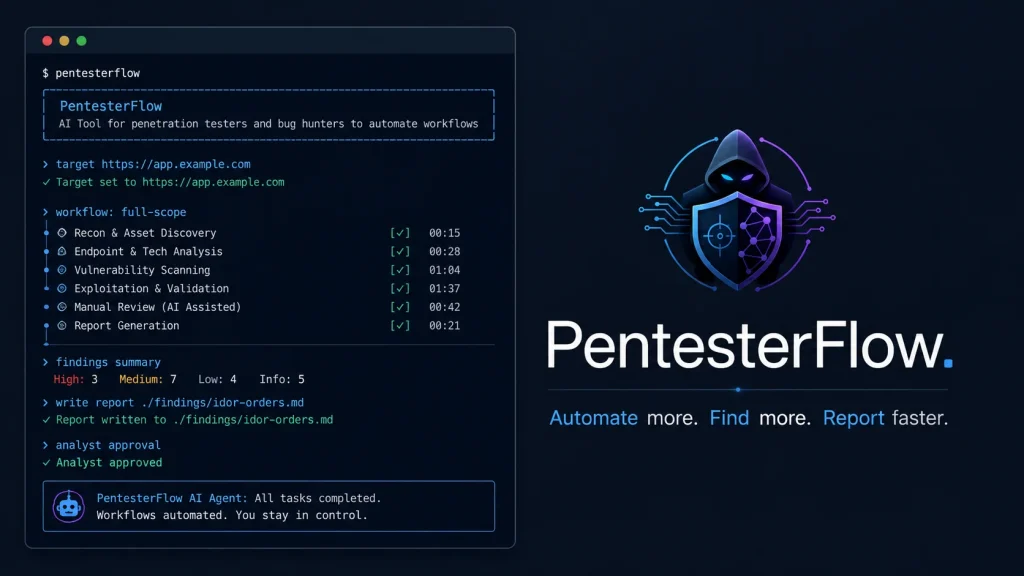
PentesterFlow – AI Tool for Penetration Testers and Bug Hunters to Automate Workflows
The relentless pace of cybersecurity threats demands efficiency from penetration testers and bug bounty hunters. Manual processes, while thorough, often struggle to keep up with the scale and complexity of modern digital landscapes. This challenge has driven innovation in automation, and a new open-source agentic AI tool, PentesterFlow, is emerging as a game-changer, promising to streamline recon-to-reporting workflows without compromising crucial human oversight.
What is PentesterFlow?
PentesterFlow is a command-line interface (CLI) tool specifically designed to empower penetration testers and bug bounty hunters. It leverages the power of agentic AI to automate various stages of the penetration testing lifecycle. Unlike many nascent AI security tools that fall short with “hallucinated” findings or struggle with context, PentesterFlow is built with a focus on practical utility and reliability. It integrates directly into an analyst’s existing toolkit, acting as an intelligent assistant rather than a full replacement.
Addressing Common AI Tool Pitfalls
The cybersecurity community has, rightly, been cautious about fully embracing AI for sensitive tasks due to several persistent issues:
- Hallucinated Findings: Many AI models generate plausible-sounding but entirely fake vulnerabilities, leading to wasted time and effort.
- Weak Context Retention: AI agents often forget previous interactions or findings, failing to build a cohesive understanding of the target system.
- Poor Tool Integration: Friction in integrating AI tools with existing security utilities hinders their adoption and effectiveness.
PentesterFlow aims to tackle these problems head-on. Its design emphasizes human-in-the-loop operation, meaning the AI assists and augments, but the final decision-making and verification remain with the human expert. This approach mitigates the risk of hallucinated findings by requiring evidence-based results and analyst verification.
How PentesterFlow Augments Penetration Testing Workflows
PentesterFlow’s core strength lies in its ability to automate repetitive yet critical tasks across the penetration testing workflow. Here are key areas where it delivers value:
- Reconnaissance Automation: Speeding up the initial information gathering phase, identifying assets, technologies, and potential entry points.
- Vulnerability Identification: Leveraging built-in pentest skills to flag potential weaknesses, guiding the human tester towards more promising avenues.
- Evidence Collection: Systematically gathering and organizing evidence of findings, which is crucial for clear and defensible reporting.
- Reporting Assistance: Structuring and populating reports with initial findings and evidence, freeing up analysts to focus on analysis and remediation recommendations.
By automating these tasks, PentesterFlow allows skilled analysts to dedicate more time to complex problem-solving, manual exploitation, and strategic analysis – areas where human intuition and expertise are irreplaceable.
Key Features and Differentiators
What sets PentesterFlow apart from other emerging AI security solutions?
- Open-Source Nature: Being open-source fosters transparency, community collaboration, and allows security professionals to scrutinize and contribute to its development, building trust and ensuring robust output.
- Human-in-the-Loop Design: This is a critical aspect, ensuring that AI augments human intelligence rather than attempting to replace it entirely. Analysts retain control and provide validation, minimizing false positives and ensuring accuracy.
- Built-in Pentest Skills: The tool is imbued with specific knowledge and methodologies relevant to penetration testing, making its outputs more directly actionable and pertinent.
- Evidence-Based Findings: PentesterFlow generates findings supported by concrete evidence, which is essential for credibility and report generation. This directly combats the hallucination problem.
- Strong Context Retention: The agentic nature allows PentesterFlow to maintain context throughout a testing engagement, leading to more coherent and effective automation.
The Future of AI in Penetration Testing
Tools like PentesterFlow represent a significant step forward in the application of AI for offensive security. They highlight a future where AI acts as a force multiplier for human expertise, rather than a standalone solution. The emphasis on open-source development and human oversight is crucial for building trust and ensuring the ethical and effective deployment of such powerful tools.
While AI will undoubtedly continue to evolve, the core principle of a skilled analyst guiding and validating its outputs will likely remain paramount for critical security functions.
Conclusion
PentesterFlow offers a compelling solution for penetration testers and bug hunters seeking to enhance their efficiency and streamline their workflows. By intelligently automating repetitive tasks, providing evidence-backed findings, and maintaining human oversight, it addresses many of the shortcomings seen in earlier AI security tools. As the cybersecurity landscape continues to expand in complexity, innovative tools like PentesterFlow will be instrumental in empowering defenders to keep pace.




