
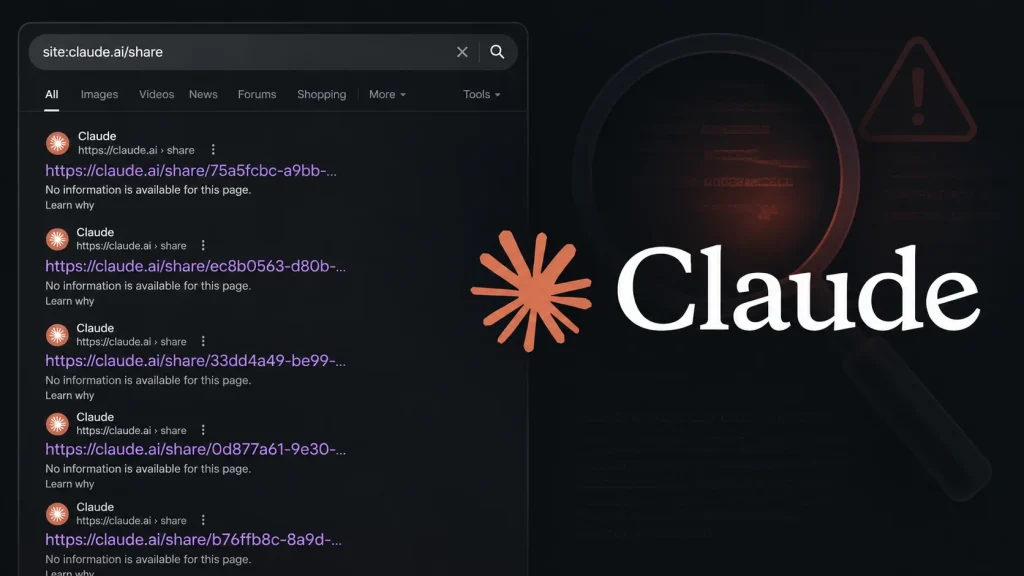
Claude AI Shared Chats Reportedly Exposed in Google Search Results
Claude AI Shared Chats Exposed: A Stark Reminder of AI Privacy Risks
The burgeoning adoption of artificial intelligence tools, particularly large language models (LLMs) like Anthropic’s Claude AI, has ushered in a new era of productivity and innovation. However, a recent incident involving shared Claude AI conversations surfacing in Google search results underscores a critical vulnerability: the potential for sensitive user data to inadvertently become public. This development raises significant privacy concerns for individuals and organizations relying on these platforms for various tasks, highlighting the urgent need for robust security practices and a thorough understanding of data exposure risks.
The Discovery: Shared Chats in Public View
The revelation began with a Reddit post that quickly gained traction within the cybersecurity community. Hundreds of shared Claude AI chats, intended for private sharing or collaboration, were discovered to be publicly discoverable via simple Google search queries. Specifically, users searching for site:claude.ai/share were able to access conversations that contained a wide array of sensitive information. This wasn’t merely trivial chatter; the exposed data included detailed legal advice, intricate engineering work, and deeply personal discussions, all without explicit user consent for public indexing.
Understanding the Mechanism of Exposure
Anthropic’s Claude AI, like many similar platforms, offers a “share” functionality, allowing users to generate a unique link to their conversation. This link facilitates easy sharing with colleagues or collaborators without needing to copy-paste the entire dialogue. The fundamental design flaw, in this case, appears to be that these shared links, while unique, were not sufficiently protected from web crawlers. Google’s search algorithms, designed to index public web content, seem to have treated these share links as public URLs, thereby cataloging and making them searchable.
This exposure isn’t tied to a specific CVE (Common Vulnerabilities and Exposures) number as it’s more of a privacy design oversight rather than a direct software vulnerability in the traditional sense, like an exploit that allows unauthorized code execution. However, the impact on user privacy is severe and mirrors the concerns typically associated with data breaches.
Implications for Users and Data Security
The implications of this incident are far-reaching. For individual users, the exposure of personal conversations, even if seemingly innocuous, can lead to privacy violations, identity theft risks, and potential reputational damage. For businesses, the situation is even graver. The leakage of legal strategies, proprietary engineering designs, or confidential business discussions can result in competitive disadvantages, intellectual property theft, compliance penalties, and severe financial repercussions.
This event serves as a stark reminder that data shared with AI models, regardless of privacy settings, must be handled with extreme caution. Users often input sensitive information believing it’s confined to a private session, a perception that can be dangerously misleading when share functionalities lack robust access controls.
Remediation Actions for Users and Providers
Addressing this issue requires a two-pronged approach, involving both the AI platform provider and its users.
For AI Platform Providers (e.g., Anthropic):
- Implement Robust “noindex” Directives: Ensure that shared conversation URLs include “noindex” meta tags or are disallowed via robots.txt files to prevent search engine indexing.
- Default to Private Sharing: Shared links should ideally default to a non-public state, requiring explicit user action to make them discoverable.
- Time-Limited Sharing: Implement options for shared links to expire after a certain period, reducing the window of potential exposure.
- Enhanced User Notifications: Clearly inform users about the privacy implications and discoverability risks when sharing conversations, even if only with a link.
- Regular Security Audits: Conduct frequent audits of sharing mechanisms to identify and remediate potential data leakage vectors.
For Users of AI Platforms:
- Exercise Extreme Caution with Sensitive Data: Avoid inputting highly confidential, proprietary, or personally identifiable information (PII) into AI models, especially when using share features.
- Review Sharing Settings: Before sharing any conversation, thoroughly understand and review the privacy and discoverability settings associated with the share link.
- Assume Public Exposure: For critical data, operate under the assumption that anything shared via a link could potentially become public.
- Regularly Monitor Your Digital Footprint: Periodically search for your own data on public search engines, especially anything linked to shared AI conversations.
- Utilize Enterprise-Grade Solutions: For business-critical use cases, advocate for and use AI solutions that offer enterprise-level security, data governance, and contractual agreements regarding data privacy.
The Path Forward: Prioritizing Privacy in AI Development
The Claude AI shared chats incident is not an isolated event; it represents a broader challenge in the rapidly evolving landscape of AI. As AI models become more integrated into our daily lives and professional workflows, the responsibility to safeguard user data becomes paramount. Both AI developers and users must proactively address these privacy concerns. Developers have a moral and ethical obligation to design security and privacy into their products from the ground up, while users must remain vigilant and informed about the risks associated with these powerful tools. A culture of privacy-by-design and heightened user awareness will be crucial in ensuring that the benefits of AI do not come at the cost of personal and organizational security.




