
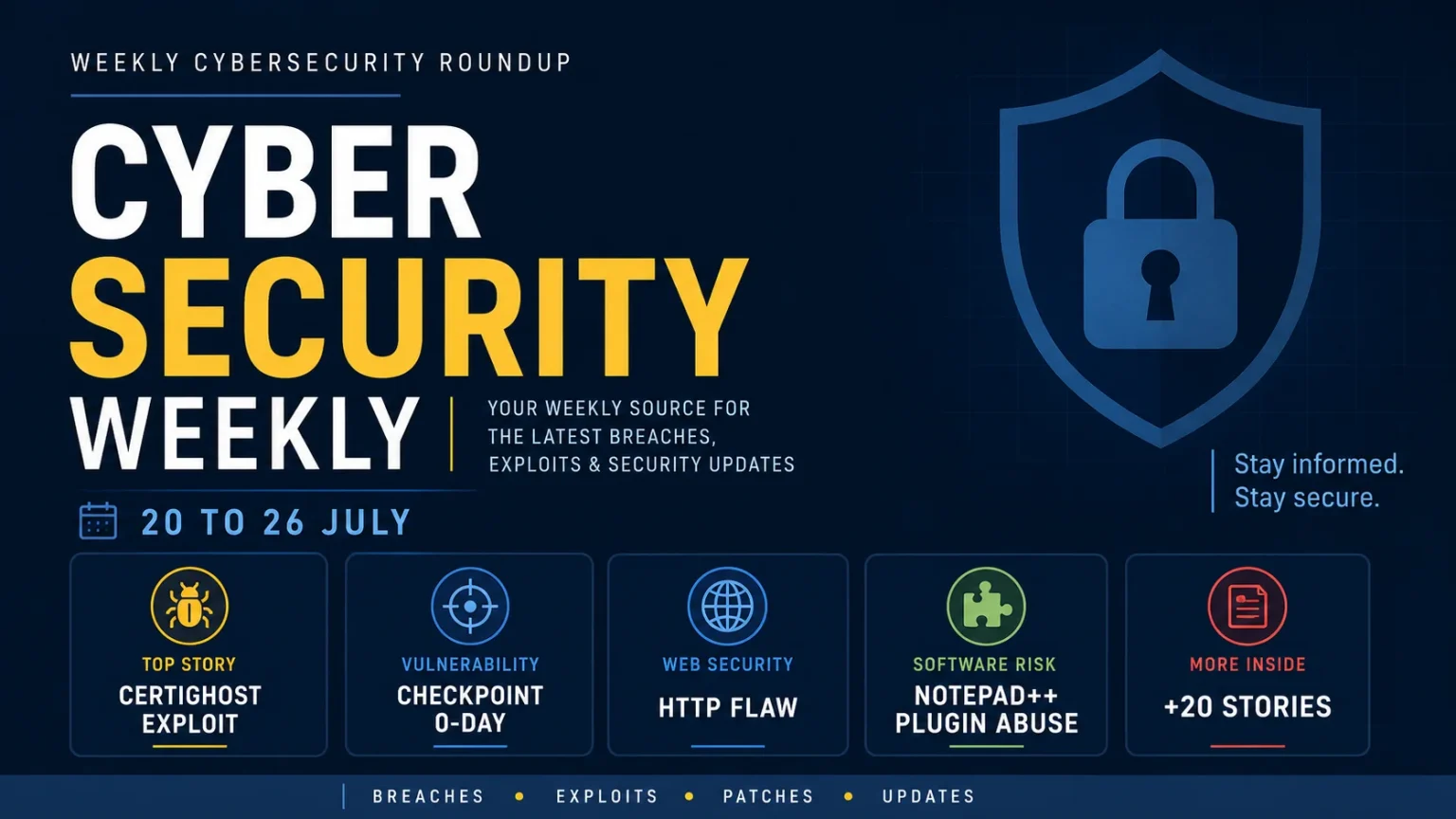
Weekly Cyber Security Newsletter Bulletin – Certighost Exploit, Checkpoint 0-day, HTTP/2 Flaw, Notepad++ Plugin Abuse +20 Stories
Navigating the Evolving Threat Landscape: Your Weekly Cybersecurity Bulletin
The cybersecurity world never sleeps, and this past week proved no exception. We observed a worrying trend where threat actors seamlessly integrated decades-old exploitation techniques with cutting-edge AI-accelerated tools. From a long-standing NGINX vulnerability resurfacing to a critical Check Point zero-day actively exploited in the wild, the attack surface continues to broaden. This bulletin provides a concise overview of the most impactful events, encompassing ransomware, AI security, kernel flaws, cloud and SaaS vulnerabilities, and critical infrastructure concerns.
Certighost Exploit: The NGINX Vulnerability Resurfaces
In a reminder that “old” often doesn’t mean “obsolete,” the Certighost exploit leveraged a 15-year-old NGINX bug. This specific flaw, while known for a significant time, demonstrates that even well-documented vulnerabilities can be successfully repurposed by attackers when systems remain unpatched or misconfigured. Threat actors are keenly aware that organizations often prioritize newer, more publicized threats, leaving older weaknesses exposed. This vulnerability typically involves privilege escalation or information disclosure, providing attackers with a crucial foothold in targeted systems.
Remediation Actions for Certighost Exploit
- Regularly audit NGINX configurations for adherence to security best practices.
- Ensure all NGINX instances are running the latest stable version. Check official NGINX changelogs for security updates.
- Implement strong access controls and principle of least privilege for NGINX server administration.
- Conduct regular penetration testing to identify and remediate older, less obvious vulnerabilities.
Check Point 0-day: A Critical Authentication Bypass
One of the most pressing concerns this week involves an actively exploited zero-day vulnerability in Check Point security gateways. This authentication bypass flaw, tracked as CVE-2024-24919, allows unauthenticated attackers to gain unauthorized access to security gateways. The implications are severe, as attackers could potentially disable security controls, exfiltrate sensitive data, or establish persistent access within a victim’s network. The rapid exploitation of this zero-day highlights the need for immediate action.
Remediation Actions for Check Point 0-day (CVE-2024-24919)
- Immediate Patching: Apply the hotfix released by Check Point without delay. This is paramount for mitigating the risk.
- Monitor for Indicators of Compromise (IoCs): Scrutinize logs for suspicious activity, especially failed or successful authentication attempts from unknown sources.
- Review Access Logs: Investigate all administrator and VPN user logins for any anomalies after applying the patch.
- Isolate and Segment: Ensure Check Point gateways are properly segmented from critical internal networks to limit potential lateral movement if compromised.
- Strengthen Authentication: Enforce multi-factor authentication (MFA) for all administrative interfaces and VPN access where applicable.
HTTP/2 Rapid Reset Attack: A New DDoS Vector
The HTTP/2 protocol, widely adopted for its performance benefits, has unfortunately become the target of a novel distributed denial-of-service (DDoS) vector known as the “Rapid Reset” attack. This attack leverages a legitimate feature of HTTP/2 – the RST_STREAM frame – to overwhelm servers with an unprecedented volume of requests. By repeatedly creating and immediately resetting streams, attackers can exhaust server resources without needing significant bandwidth, making existing DDoS protections less effective. This vulnerability poses a significant threat to web services and critical infrastructure reliant on HTTP/2.
Remediation Actions for HTTP/2 Rapid Reset Attacks
- Update Web Servers and Load Balancers: Ensure that all HTTP/2-enabled components are patched with versions that mitigate this attack. Cloudflare, Google, and Amazon Web Services have all released advisories and mitigations.
- Implement Rate Limiting: Configure stringent rate limiting specifically for HTTP/2 requests, focusing on the number of streams initiated and reset within a given timeframe.
- Monitor Traffic Patterns: Utilize network monitoring tools to detect unusual patterns of HTTP/2 RST_STREAM frames or abnormally high request rates.
- Leverage DDoS Mitigation Services: Engage with specialized DDoS protection services that are equipped to identify and scrub complex, application-layer attacks like Rapid Reset.
Notepad++ Plugin Abuse: A Supply Chain Threat
The popular text editor Notepad++ has been implicated in a supply chain attack vector through the abuse of its plugin ecosystem. Malicious actors are increasingly targeting widely used software components, and plugins offer a convenient entry point. By distributing malicious plugins, attackers can gain code execution on systems where Notepad++ is installed, potentially leading to data exfiltration, malware injection, or persistent access. This highlights the ongoing challenge of securing the software supply chain, even for seemingly innocuous applications.
Remediation Actions for Notepad++ Plugin Abuse
- Source Plugins from Trusted Repositories: Only download and install Notepad++ plugins from the official plugin manager or well-vetted, reputable sources.
- Regularly Audit Installed Plugins: Periodically review the list of installed plugins in Notepad++ and remove any that are unknown, unused, or suspicious.
- Implement Application Whitelisting: Consider using application whitelisting solutions to prevent unauthorized execution of code, including potentially malicious plugins.
- User Education: Educate users about the risks of downloading unofficial software or plugins and the importance of verifying sources.
The Blurry Line: AI Agents and Zero-day Chaining
A particularly concerning development this week involves the reported capability of autonomous AI agents to chain zero-day exploits against platforms like Hugging Face. While the specifics of these autonomous attacks are still emerging, the concept alone represents a significant leap in offensive capabilities. AI agents, with their ability to rapidly analyze vulnerabilities, generate exploits, and adapt to defensive measures, could drastically accelerate the pace of cyberattacks and reduce the time defenders have to react. This signals a new era for AI security, demanding proactive and adaptive defense strategies.
Additional Major Stories and Trends
Beyond these headline events, the cybersecurity landscape was rife with activity. We observed:
- Ransomware Campaigns: Persistent and evolving ransomware attacks continued to target organizations across sectors, often leveraging double extortion tactics.
- Kernel Vulnerabilities: Several critical kernel-level flaws were reported, exposing operating systems to privilege escalation and system compromise.
- Cloud/SaaS Abuse: Misconfigurations, compromised credentials, and untracked shadow IT in cloud and SaaS environments remained a prevalent attack vector.
- Critical Infrastructure Flaws: New vulnerabilities impacting operational technology (OT) and industrial control systems (ICS) underscore the ongoing risk to critical services.
Key Takeaways for the Week
This week’s cyber activity reinforces several critical lessons. First, the resilience of older, unpatched vulnerabilities (like the NGINX bug) means that comprehensive patch management remains foundational. Second, the immediate and widespread exploitation of new zero-days, such as the Check Point flaw, emphasizes the need for rapid response and robust incident management. Finally, the emerging capabilities of AI in offensive security, particularly in chaining exploits, demands a re-evaluation of current defense strategies. Organizations must prioritize continuous vulnerability assessment, strengthen authentication, and adapt to the increasing sophistication of threat actors to stay resilient.




