
Hackers Can Use MedusaHVNC to Control Your PC on a Desktop You Cannot See
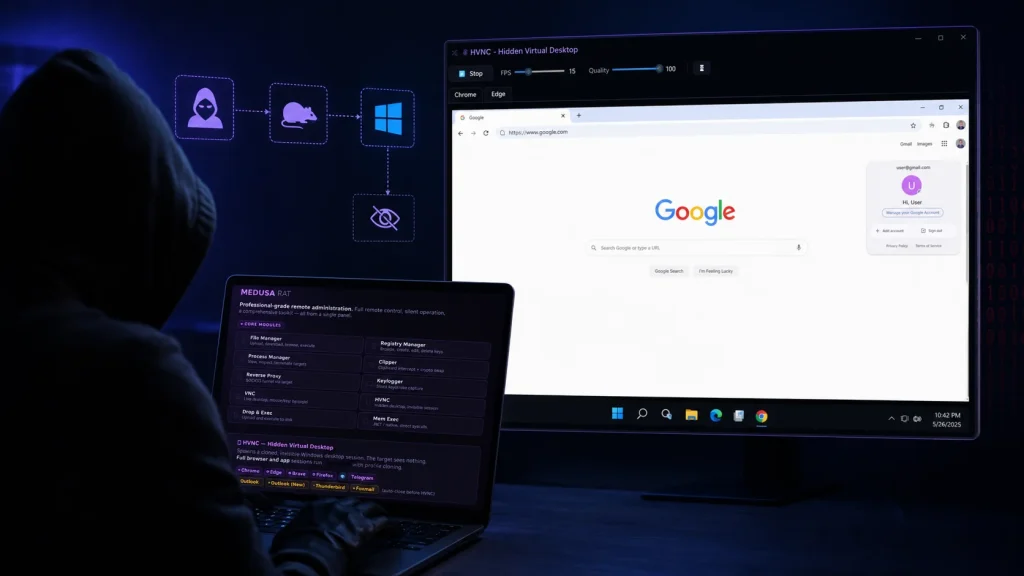
Imagine your computer, running perfectly, displaying your desktop as usual. You’re working, browsing, or gaming. Now, imagine that at the exact same moment, on that very machine, a hacker is also working, browsing, and perhaps even purchasing items – all within an invisible, hidden desktop environment you can’t see, yet it’s using your browser profiles, your cookies, and your logged-in sessions. This isn’t a futuristic nightmare; it’s the stark reality presented by a new remote access Trojan (RAT) called MedusaHVNC.
Understanding MedusaHVNC: A Silent Takeover
MedusaHVNC represents a significant advancement in the realm of malicious software, specifically evolving the established techniques of Hidden Virtual Network Computing (HVNC). Unlike traditional VNC which mirrors your active desktop, HVNC operates a separate, invisible virtual desktop environment on the victim’s machine. What makes MedusaHVNC particularly insidious is its ability to not just operate this hidden session, but to actively hijack and utilize your existing browser profiles, complete with all their stored data.
This means that while you see your familiar desktop, a malicious actor could be:
- Accessing your bank accounts through your default browser’s saved sessions.
- Sending emails from your logged-in webmail.
- Making purchases using your stored credit card details.
- Bypassing multi-factor authentication (MFA) because they are using your already authenticated sessions.
All these actions occur without generating any visible pop-ups, browser windows, or activity on the victim’s primary desktop. The attack essentially lives and breathes within your machine’s resources, yet remains completely opaque to the user.
The Evolution of HVNC Techniques
Historically, HVNC tools have been used to create an isolated, hidden environment. However, MedusaHVNC takes this a step further by integrating directly with the victim’s legitimate browser profiles. This capability significantly lowers the barrier for attackers to exploit sensitive information. Instead of having to exfiltrate cookies or login credentials and then import them into their own environments, MedusaHVNC allows them to operate directly within the victim’s established digital identity, making detection incredibly difficult.
This sophisticated RAT is not a one-off exploit but is being sold as malware-as-a-service (MaaS) through dedicated websites and Telegram channels. This commoditization means that even less technically proficient attackers can utilize this powerful tool, expanding its potential reach and impact.
Attack Vectors and Impact
The primary infection vectors for MedusaHVNC are consistent with many other sophisticated malware campaigns:
- Phishing Campaigns: Malicious emails containing infected attachments or links to compromised websites are common.
- Drive-by Downloads: Visiting a compromised website can silently download and execute the malware.
- Malvertising: Malicious advertisements leading to exploit kits.
- Software Cracks and Pirated Software: Often bundled with free software downloads.
Once MedusaHVNC establishes persistence, the impact is severe, leading to:
- Financial Fraud: Unauthorized transactions from banking and e-commerce sites.
- Identity Theft: Collection of personal identifiable information (PII) from online accounts.
- Corporate Espionage: Access to sensitive corporate data and internal systems if the victim is an employee.
- Further Malware Deployment: The hidden access can be used to deploy additional malware or establish backdoors.
Remediation Actions
Defending against advanced threats like MedusaHVNC requires a multi-layered approach focusing on prevention, detection, and rapid response.
- Implement Advanced Endpoint Detection and Response (EDR): EDR solutions can monitor for unusual process behavior, network connections, and hidden desktop environments, which traditional antivirus might miss.
- Regular Software Updates: Keep operating systems, web browsers, and all installed software updated to patch known vulnerabilities. For instance, exploits targeting browser vulnerabilities or operating system flaws can be prevented by timely updates.
- Strong Email Security: Implement robust email filtering to detect and block phishing attempts. User education on identifying suspicious emails is also crucial.
- Web Filtering and DNS Security: Block access to known malicious domains and employ DNS filtering to prevent connections to command-and-control (C2) servers.
- Least Privilege Principle: Ensure users operate with the minimum necessary permissions to perform their tasks. This limits the potential damage if an account is compromised.
- Segment Networks: Isolate critical systems and sensitive data from general user networks to contain potential breaches.
- Multi-Factor Authentication (MFA): While MedusaHVNC can bypass some MFA by operating within already authenticated sessions, MFA significantly hinders initial unauthorized access attempts and can prevent full account takeover in many scenarios.
- Regular Backups: Maintain offline, encrypted backups of critical data to ensure recovery in case of data compromise or encryption.
- Security Awareness Training: Continuously train employees on cybersecurity best practices, including recognizing phishing, avoiding suspicious downloads, and understanding the risks of shadow IT.
Detection and Mitigation Tools
While specific CVEs for MedusaHVNC are not publicly available as it’s a specific malware strain rather than a vulnerability in a common product, here are general tools that aid in detecting and mitigating such threats:
| Tool Name | Purpose | Link |
|---|---|---|
| Osquery | Endpoint visibility, behavioral monitoring for suspicious processes. | https://osquery.io/ |
| Sysmon | Detailed logging of process creation, network connections, and file system activity. | https://learn.microsoft.com/en-us/sysinternals/downloads/sysmon |
| Snort/Suricata | Network intrusion detection system for identifying C2 communication. | https://www.snort.org/ https://suricata-ids.org/ |
| VirusTotal | Analyzing suspicious files and URLs for known malware signatures. | https://www.virustotal.com/ |
| FireEye HX (Mandiant Advantage) | Advanced endpoint threat detection and incident response. | https://www.mandiant.com/advantage/extended-detection-and-response-xdr |
Conclusion
MedusaHVNC is a potent reminder of the ever-evolving threat landscape. Its ability to silently commandeer your digital identity on your own machine, leveraging your browser profiles and authenticated sessions, presents a significant challenge to conventional security measures. Organizations and individuals must prioritize robust endpoint security, proactive threat intelligence, continuous user education, and agile incident response capabilities. The key to mitigating such sophisticated threats lies in a comprehensive defense strategy that anticipates stealthy attacks and works to detect unusual behavior at every layer of the IT infrastructure.




