
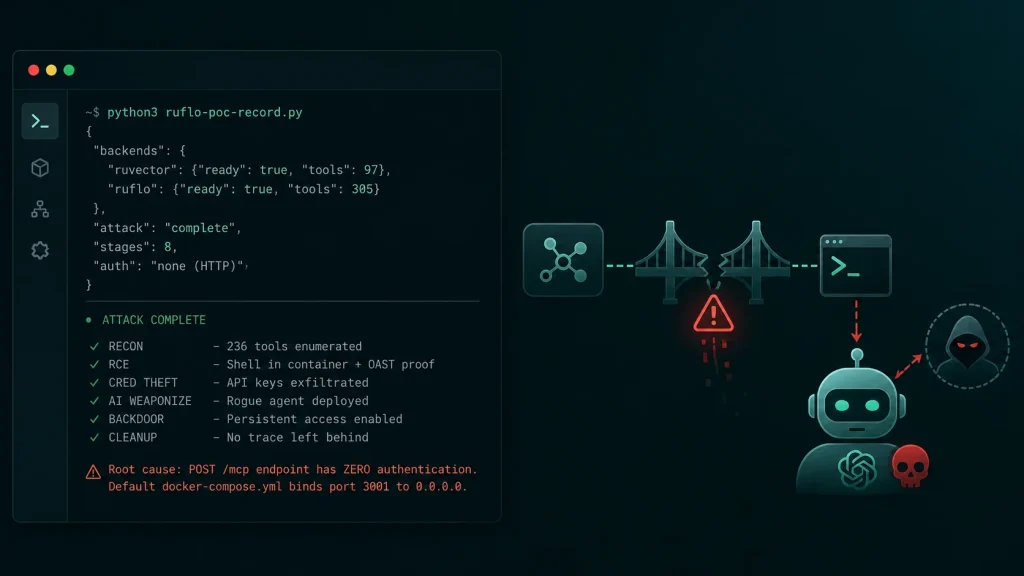
Critical Ruflo MCP Bridge Flaw Lets Attackers Execute Commands and Hijack AI Agents
Critical Ruflo MCP Bridge Flaw Exposes AI Agents to Full Compromise
A severe security vulnerability has been identified in Ruflo, an open-source AI orchestration platform, posing a significant risk to organizations leveraging its Model Context Protocol (MCP) Bridge. This critical flaw allows unauthenticated attackers to execute arbitrary commands, leading to the complete compromise of AI agent environments. With the rapid expansion of AI applications across industries, such vulnerabilities underscore the urgent need for robust security practices within AI infrastructures.
Understanding CVE-2026-59726: The Core Vulnerability
The vulnerability, officially tracked as CVE-2026-59726, has been assigned the maximum CVSS base score of 10.0, denoting its utmost severity. Discovered by Noma Labs, this flaw resides within Ruflo’s Model Context Protocol (MCP) Bridge – a fundamental component of the platform responsible for AI agent management and communication. The ability for an attacker to exploit this without prior authentication grants them unfettered access, highlighting a critical exposure point for any organization utilizing Ruflo.
Impact of a Compromised AI Agent Environment
The implications of this vulnerability are far-reaching. Successful exploitation of CVE-2026-59726 allows attackers to:
- Execute Arbitrary Commands: Gain control over the underlying system hosting the AI agents, enabling them to install malware, steal sensitive data, or disrupt operations.
- Hijack AI Agents: Take control of AI agents, potentially manipulating their behavior, altering decision-making processes, or using them for malicious purposes.
- Data Exfiltration: Access and exfiltrate proprietary data, intellectual property, or confidential information processed and stored by the AI agents.
- System Disruption: Render critical AI services inoperable, leading to significant operational downtime and financial losses.
- Reputational Damage: Suffer severe damage to an organization’s reputation and trust if their AI systems are compromised.
This level of access threatens not just the integrity of AI operations but also the broader IT infrastructure connected to these intelligent systems.
Remediation Actions for Ruflo Users
Given the critical nature of CVE-2026-59726, immediate remediation is essential. Users of Ruflo’s MCP Bridge must take the following steps:
- Apply Patches Immediately: Monitor official Ruflo channels for security advisories and patches related to CVE-2026-59726. Apply all recommended updates as soon as they become available.
- Isolate and Segment AI Environments: Implement network segmentation to isolate AI agent environments from other critical systems. This can limit the lateral movement of an attacker in case of a breach.
- Implement Strong Access Controls: Ensure that all access to the Ruflo MCP Bridge and associated components is strictly controlled and follows the principle of least privilege.
- Monitor for Suspicious Activity: Enhance logging and monitoring for AI orchestration platforms to detect unusual commands, unauthorized access attempts, or abnormal behavior from AI agents.
- Conduct Security Audits: Regularly audit AI platforms and their configurations for misconfigurations or unpatched vulnerabilities.
- Review Ruflo’s Official Documentation: Consult Ruflo’s official security documentation and advisories for specific recommendations tailored to their platform.
Tools for Detection and Mitigation
Organizations should leverage appropriate tools to help detect potential exploitation and fortify their defenses against this and similar vulnerabilities:
| Tool Name | Purpose | Link |
|---|---|---|
| Vulnerability Scanners (e.g., Nessus, OpenVAS) | Identify known vulnerabilities, including CVEs, in network devices and applications. | Nessus / OpenVAS |
| Intrusion Detection/Prevention Systems (IDPS) | Detect and prevent unauthorized access or malicious activity on networks and systems. | Snort / Suricata |
| Security Information and Event Management (SIEM) | Aggregate and analyze security logs from various sources to detect threats and manage incidents. | Splunk / Elastic SIEM |
| Endpoint Detection and Response (EDR) Solutions | Monitor endpoints for malicious activities, identify threats, and facilitate response actions. | CrowdStrike Falcon Insight / Microsoft Defender for Endpoint |
Protecting Critical AI Deployments
The disclosure of CVE-2026-59726 serves as a stark reminder that even cutting-edge AI technologies are not immune to critical security flaws. As organizations increasingly depend on AI-driven processes, securing these platforms becomes paramount. Proactive vulnerability management, coupled with a vigilant stance on patching and architectural security, is non-negotiable for safeguarding AI deployments against sophisticated threats and ensuring the integrity of autonomous systems.




