
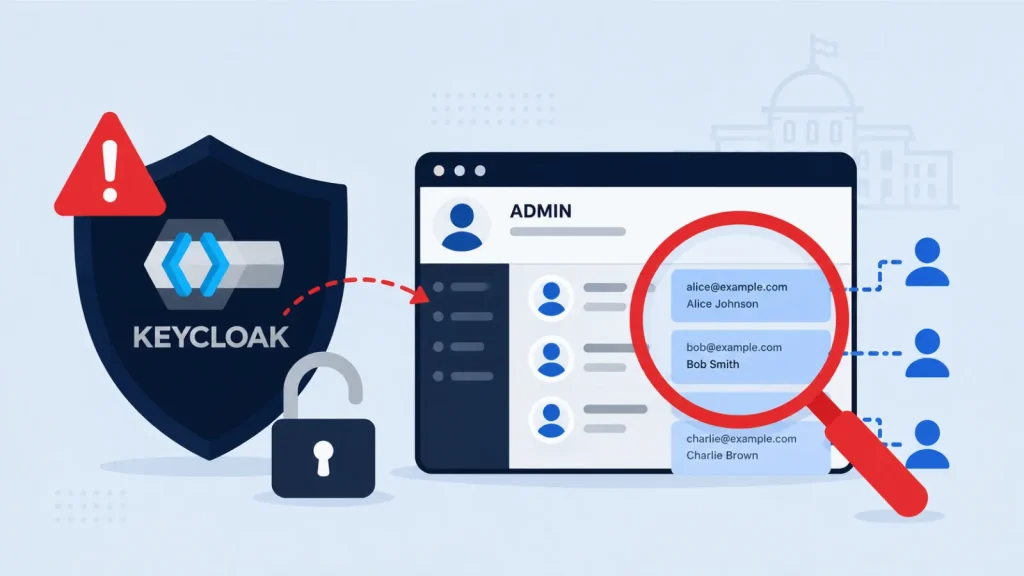
Keycloak Vulnerability Exposes User Names and Email Addresses Across Admin Boundaries
Keycloak Vulnerability: Unauthorized Access to User Data Across Admin Boundaries
A significant security flaw in Keycloak, a popular open-source identity and access management solution, recently came to light. This vulnerability allowed restricted administrators to bypass intended access controls, exposing sensitive user information such as usernames and email addresses that should have been outside their administrative scope. This incident underscores the critical importance of robust access control mechanisms within identity management systems.
Understanding the Keycloak Broken Access Control Vulnerability
The vulnerability, identified as CVE-2026-17059, is a classic example of a Broken Access Control issue. It specifically impacted the Keycloak Admin REST API. In a typical Keycloak deployment, administrators are assigned specific realms or groups, limiting their administrative actions and data access to only those defined boundaries. However, this flaw permitted an attacker with restricted administrative privileges to craft specific API requests that would reveal user profiles, including usernames and email addresses, belonging to users outside their authorized administrative domain.
Discovered by Escape researcher Enzo Mongin, known as Orionexe, this vulnerability highlights the potential for privilege escalation and unauthorized data exposure even within a seemingly segmented administrative environment. The ability for a restricted admin to access data beyond their designated scope presents a serious compliance and privacy risk, especially in organizations managing a large number of users or sensitive data.
Impact of CVE-2026-17059
The primary impact of this Keycloak vulnerability is the unauthorized exposure of user data. While the specific extent of exposed information could vary, the potential access to usernames and email addresses is a significant concern. This information can be leveraged in various ways by malicious actors, including:
- Phishing Attacks: Exposed email addresses can be used to craft highly targeted phishing campaigns, increasing their likelihood of success.
- Credential Stuffing: Usernames, especially if combined with common password patterns or previously leaked credentials, can facilitate credential stuffing attacks against other services.
- Information Gathering: The collection of user identities can aid in further reconnaissance for more sophisticated attacks.
- Privacy Breaches: Any unauthorized access to personal identifiable information (PII) constitutes a privacy breach, potentially leading to regulatory fines and reputational damage.
Remediation Actions
Red Hat, the maintainer of Keycloak, has addressed CVE-2026-17059. Organizations running Keycloak instances must take immediate action to secure their environments:
- Upgrade Keycloak: The most critical step is to upgrade your Keycloak instance to a patched version as soon as possible. Consult the official Red Hat security advisories for the specific versions that contain the fix.
- Review Administrator Permissions: Regularly audit and review administrator permissions within Keycloak. Ensure that no administrator has more privileges than absolutely necessary for their role (principle of least privilege).
- Monitor Admin API Activity: Implement robust logging and monitoring for the Keycloak Admin REST API. Look for unusual access patterns, repeated failed requests, or requests originating from unexpected sources.
- Implement Multi-Factor Authentication (MFA): Enforce MFA for all administrative accounts in Keycloak to add an additional layer of security against unauthorized access, even if credentials are compromised.
- Regular Security Audits: Conduct periodic security audits and penetration tests of your Keycloak deployment to identify and address potential vulnerabilities proactively.
Tools for Detection and Mitigation
While direct detection of this specific vulnerability requires Keycloak internal monitoring, several general cybersecurity tools can aid in overall security posture and help in identifying suspicious activity that might indicate exploitation attempts or other vulnerabilities.
| Tool Name | Purpose | Link |
|---|---|---|
| Keycloak Official Documentation | For official security advisories, upgrade guides, and best practices. | https://www.keycloak.org/documentation |
| Security Information and Event Management (SIEM) | Centralized logging and real-time analysis of security alerts from Keycloak and other systems. | (Refer to your specific SIEM vendor, e.g., Splunk, Elastic SIEM, QRadar) |
| Vulnerability Scanners (e.g., Nessus, OpenVAS) | Automated scanning for known vulnerabilities in your Keycloak deployment and underlying infrastructure. | https://www.tenable.com/products/nessus https://www.greenbone.net/en/community-edition/ |
| Web Application Firewalls (WAF) | Protects the Keycloak Admin REST API from common web-based attacks and can help detect anomalous traffic patterns. | (Refer to your specific WAF vendor, e.g., Cloudflare, Akamai, AWS WAF) |
Conclusion
The Keycloak vulnerability, CVE-2026-17059, serves as a potent reminder that even mature identity management systems can harbor critical security flaws. The ability for a restricted administrator to access sensitive user data across intended boundaries highlights the necessity of continuous security vigilance. Prompt patching, rigorous access control audits, and comprehensive monitoring are essential practices for any organization relying on Keycloak to secure their digital identities.




